Aikibatto 2 DetailsShiho USHIRO
DetailsAspects and considerations already treated in a previous exercise of Aikibatto, are omitted here.Shiho, four directions, is commented in the text on MAE. Ushiro, back, is the second of the four Shiho, with uke coming straight at tori from behind. As well as with MAE, most iaido schools have some application for this situation, and again the main deviation in Aikibatto from those, is the taisabaki movement and its consequences. From the moment of the draw in movement five, this exercise continues the same way as MAE.
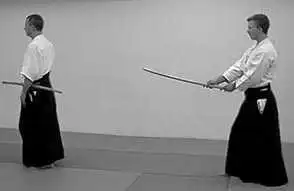 Starting position. Tori at left, uke at right. At the start of the exercise, when uke stands behind tori, there should be enough of a distance between them for tori to stand a chance of finding the best timing for the steps of movement three. In basic training of this exercise, tori should make sure to have uke in view at the start, although only in the corner of the eye. An advanced form of training this, would be for tori to look straight ahead, not seeing uke at all, and still try to move away at the right moment. It takes some awareness to accomplish, no doubt. Probably also a thick skull. When stepping out of range, in movement three, it is important to let the left foot follow a bit, so that none of that leg is in the way of uke's sword. Of course, the same goes for movement six.
Uke's second cut, in movement seven, should be directed at the place where tori was at movement five — neither at the spot which was tori's original position nor the position tori heads for in movement six. The former of these two mistaken directions is very common, and not only among beginners.
Iai considerations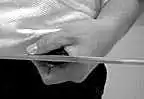 In iai style single training of the tori movements in this exercise, the modifications of the above would be: full extension of the do cut in movement six, and all the way to chudan level with the cut in movement eight. The chiburi and noto are done exactly the same way as in MAE.
Uke's movements in this exercise are not very meaningful to practice in a iai solo style.
Stefan Stenudd Table of movementsNext exercise© Stefan Stenudd, 2000. You are free to any non-commercial use of this material, without having to ask for my permission. But please refer to this website, when doing so.
AikibattoIntroductionBackgroundAikibatto BasicsSword exercisesJo staff exercisesSolo video clipsDuo video clipsKen suburiCorrectionsGlossaryVisitor responseShinken, the swordAikibatto — the book
About CookiesMy Other WebsitesCREATION MYTHSMyths in general and myths of creation in particular.
TAOISMThe wisdom of Taoism and the Tao Te Ching, its ancient source.
LIFE ENERGYAn encyclopedia of life energy concepts around the world.
QI ENERGY EXERCISESQi (also spelled chi or ki) explained, with exercises to increase it.
I CHINGThe ancient Chinese system of divination and free online reading.
TAROTTarot card meanings in divination and a free online spread.
ASTROLOGYThe complete horoscope chart and how to read it.
MY AMAZON PAGE
MY YOUTUBE AIKIDO
MY YOUTUBE ART
MY FACEBOOK
MY INSTAGRAM
MY TWITTER
STENUDD PÅ SVENSKA
|
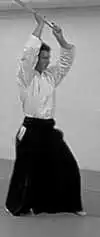 Immediately after missing with the cut in movement four, uke takes about half a step back and lifts the sword to jodan kamae, for a new cut. This should be done as if almost automatic.
 Aikibatto — Sword Exercises for Aikido Students