Aikibatto 7 DetailsKote CHUDAN
DetailsAspects and considerations already treated in a previous exercise of Aikibatto, are omitted here.
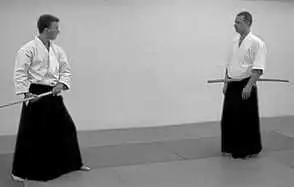 Starting position. Tori at right, uke at left. Chudan, middle level, is the first of the two Kote exercises, so named for hitting uke's wrist at middle level, when uke's position of the sword is pretty much identical to chudan kamae, middle level guard — because of the previous chudan giri, cut to middle level. This kote cut, executed immediately after the draw of the sword, is not far at all from the nuki tsuke, the draw, of MAE and the other Shiho exercises. The sword is drawn in much the same way, although coming down at the end instead of going forward horizontally in a do cut, and the body is moving out of the way — although to the left instead of the right. The most important difference is that of timing: in the Shiho exercises, and many others as well, tori needs to get ahead of uke's cut, but in this one tori's sword needs not even be completely drawn until immediately after uke's cut. The best rhythm of the technique, though, is when tori's sword hits uke's wrist at the same time as uke's cut reaches its end. Uke's starting position is different from every exercise preceding this one — migi no waki, right side guard, where the sword is held by the side of the body, its edge pointing to the right. The blade should either be completely horizontal, which feels a little stiff, or tipping slightly down backward, so that the point of it is lower than the hilt — not much, though, in a basic form of this guard. Because of this position of the sword, the body is turned sideways, to make it possible for the left hand grip on the sword to be exactly in front of tanden, the center. Some prefer to keep the body straight, also in this guard, but I find that distinctly inferior. It is with the left hand directly in front of the center, or at least the vertical center line, that one can move the sword the fastest and the strongest, since the left hand dominates when cutting with both hands gripping the sword. When uke performs the cut of movements two and three, this is done by a big, flowing move without stop — from the side guard, over the head, and down to chudan level. This is a mighty cut, and can still be done very quickly, when one learns to use one's body in the right way. The big cut is accompanied by a big step forward, when right foot comes from behind to far in front.
The kote position of the sword, when not cutting through, is blocking uke's right hand — to raise it when tori's blade rests on it, would be unwise. Therefore, tori can decide the moment when uke can draw the sword to jodan kamae for the next cut. This is not done by moving the blade away, which would lack continuous control, but by changing the angle of it into a steep one, giving room for uke — just barely — to raise the arms. This guiding move makes it pretty much compulsory for uke to do the jodan kamae followed by a straight cut, which is in this case to the head, men, but could just as well be chudan or gedan, to middle or low level.
Simultaneously also, tori raises the sword in a semi-circle from its chudan position at the kote, to a jodan kamae. From there one could say that the second half of the circle is made in the yokomen cut, to uke's left temple. The sword does not stop at jodan, but passes that position in its orbit from uke's right wrist to the left temple. This way, it's like the whole movement is one long yokomen cut. The chiburi jodan, shaking off the blood at a high level, is well known in iaido — and not easy to do so that it feels comfortable. I find it ideal from a yokomen position, and that is precisely why it is used in this exercise.
At this position, bend the right arm at the elbow, so that the sword approaches the side of your head, but at the same time step back with left foot.
This swinging the sword, which is the actual chiburi, should not be done by the whole arm, just the forearm, so that the elbow is the hub, the center of the circle. The best timing in this move, is when the sword reaches its right side position an instant after the left foot has finished its step.
Iai considerationsIn iai style single training of the tori movements in this exercise, the modifications of the above would really be just one: a proper extension of the yokomen cut. Also, certainly, the initial kote can be done in full speed, although not going any deeper than in partner training.Uke's movements in this exercise are not very meaningful to practice in a iai solo style.
Stefan Stenudd Table of movementsNext exercise© Stefan Stenudd, 2000. You are free to any non-commercial use of this material, without having to ask for my permission. But please refer to this website, when doing so.
AikibattoIntroductionBackgroundAikibatto BasicsSword exercisesJo staff exercisesSolo video clipsDuo video clipsKen suburiCorrectionsGlossaryVisitor responseShinken, the swordAikibatto — the book
About CookiesMy Other WebsitesCREATION MYTHSMyths in general and myths of creation in particular.
TAOISMThe wisdom of Taoism and the Tao Te Ching, its ancient source.
LIFE ENERGYAn encyclopedia of life energy concepts around the world.
QI ENERGY EXERCISESQi (also spelled chi or ki) explained, with exercises to increase it.
I CHINGThe ancient Chinese system of divination and free online reading.
TAROTTarot card meanings in divination and a free online spread.
ASTROLOGYThe complete horoscope chart and how to read it.
MY AMAZON PAGE
MY YOUTUBE AIKIDO
MY YOUTUBE ART
MY FACEBOOK
MY INSTAGRAM
MY TWITTER
STENUDD PÅ SVENSKA
|
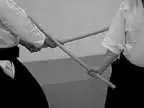 Kote, wrist, is a sword technique aiming for that body part. In fencing, the wrist is often much easier to reach than the adversary's body, and certainly, by striking at the wrist, one still gets an essential advantage, making it infinitely more difficult for the attacker to move the sword sufficiently. If one wrist has been damaged, then the sword can be gripped by just one hand. For these two reasons, the kote technique is an important one in the Japanese sword arts.
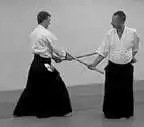 In the meantime tori steps out to the left side, immediately starting to draw the sword in a slightly upward way, continuing in a circular move which finishes downward, onto uke's right wrist. Here, some contact is allowed and to an advantage in learning the proper way of doing the technique. Usually, since uke's cut has the same direction as that of tori's kote cut, a slight contact should not hurt at all. Still, tori should be careful, not cutting at a higher speed than can be controlled.
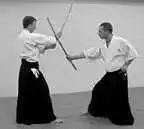 At the same time as tori opens for uke to go to jodan kamae, tori takes a preparatory step with the right foot to the right. Do not wait with this step — when uke has reached the high guard position, the cut can follow very quickly indeed, and there will be no time for this step. But when it has been taken beforehand, tori has to do little more than follow with the body, and slide along a bit with left foot, to be out of the way of uke's cut.
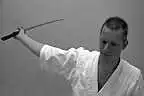 Start by pulling the sword back from its yokomen extension, to a position where the sword point is backward and the arm is stretched out to the side, at shoulder height. At the same time the right foot takes one full step back. The left hand goes to the left side, where the scabbard would be.
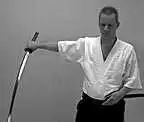 Now, the sword hand should lead the sword to the position where your head was before backing one more step, and then continue around in a big, circular move to the side, where the blade is tilted a bit forward, not so much, and the edge of the sword is to the right. Again, the right arm is extended to the right, at shoulder height.
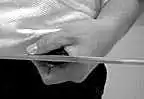 The noto from this position is not very different from that in chiburi chudan, found in MAE and USHIRO. The right hand is lowered to middle level, at the same time as the sword is swung over to meet the scabbard, held by the left hand in front of tanden, the center. As the back of the blade slides on the left hand grip, the scabbard is moved along the side of the body — very near it — so that you reach to get the sword point into its opening. This movement should be done in a flowing way, not quick but with a steady pace.
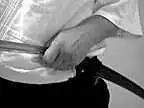 When the blade enters the scabbard, or the belt if done with a bokken, the hilt should be straight ahead, neither to the right nor the left. Ideally, the tsuba, the sword guard, reaches the opening of the scabbard right in front of tanden, the center.
 Aikibatto — Sword Exercises for Aikido Students