Aikibatto 10 DetailsHarai TSUKI
DetailsAspects and considerations already treated in a previous exercise of Aikibatto, are omitted here.Harai, parry or warding off, is commented in the text on ATE, so is tsuki, in general terms, and chiburi kaiten. Tsuki, thrust, is the second of the two Harai, named after the tsuki done by tori in movement seven. A significant difference to the previous Harai exercise is also, that here tori does a taisabaki move to the left instead of the right.
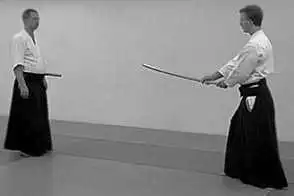 Starting position. Tori at left, uke at right.
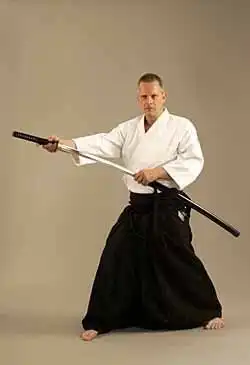
The harai ends with a draw of the sword, tori's right hand pulling the sword horizontally to the right, left hand holding the scabbard back. It is very important not to start the draw already in the harai move, where the sword should instead be held very firmly inside the scabbard. When the draw commences, it is firstly done by the left hand thumb pushing the tsuba, sword guard, so that the blade starts to slide out — and the rest of the draw is done by the right hand.
Pushing uke, in the continued tsuki movement, is done to help get the sword back — which would take some effort, were the thrust an actual one with a real blade through uke's body. Directly after the push, tori pulls the sword back, to a horizontal position near the body, much like that of movement five — but this time, there is no contact between the blade and the body, nor is the right hand as far back as in movement five.
Regarding noto, there is a 2017 change for safety: the noto is sideways instead of at the shoulder. See the video above for details.
Iai considerationsIn iai style single training of the tori movements in this exercise, the modifications of the above would be only one: a correct direction for the chudan tsuki of movement seven — right at where the uke would be.Uke's movements in this exercise are not very meaningful to practice in a iai solo style.
Stefan Stenudd Table of movementsTable of all exercises© Stefan Stenudd, 2000. You are free to any non-commercial use of this material, without having to ask for my permission. But please refer to this website, when doing so.
AikibattoIntroductionBackgroundAikibatto BasicsSword exercisesJo staff exercisesSolo video clipsDuo video clipsKen suburiCorrectionsGlossaryVisitor responseShinken, the swordAikibatto — the book
About CookiesMy Other WebsitesCREATION MYTHSMyths in general and myths of creation in particular.
TAOISMThe wisdom of Taoism and the Tao Te Ching, its ancient source.
LIFE ENERGYAn encyclopedia of life energy concepts around the world.
QI ENERGY EXERCISESQi (also spelled chi or ki) explained, with exercises to increase it.
I CHINGThe ancient Chinese system of divination and free online reading.
TAROTTarot card meanings in divination and a free online spread.
ASTROLOGYThe complete horoscope chart and how to read it.
MY AMAZON PAGE
MY YOUTUBE AIKIDO
MY YOUTUBE ART
MY FACEBOOK
MY INSTAGRAM
MY TWITTER
STENUDD PÅ SVENSKA
|
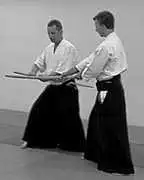 The harai in movement four, is done similarly to the ATE harai, but tori being on the other side of uke, the semi-circular move is from left to right, pushing uke's sword slightly to uke's left. Remember not to grip the tsuka, the hilt, with the right hand until after harai is completed, but to hold the hand open, palm pushing the tsuka from the side not hitting uke's sword. The left hand holds the scabbard, the thumb firmly hooks the tsuba, sword guard. At the end of the harai, the sword is held horizontal, the edge of the blade — inside the scabbard — pointing horizontally away from tori
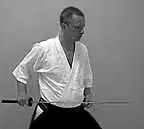 When the sword is drawn, the blade is stabilized by its back being pressed against tori's body — naturally still with the edge of the blade pointing horizontally outward. This is done not only to fix the position of the sword, when drawn, but also to make sure that neither it nor the right arm is in the way of uke's following cut.
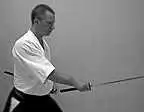 The chudan tsuki, thrust to middle level, in movement seven, is done with the blade still in the same position, its edge pointing horizontally to the right. Here, the tsuki is an unusually extended move, for two reasons: uke has retreated after the harai, and since tori's next step is only a sliding forward to the left with the left foot, right foot following, uke can be hard to reach otherwise, and also, the tsuki will continue with the push of movement eight.
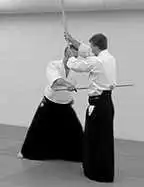 In partner training the tsuki thrust is done at the right side of uke's waist, with a slight, sliding contact to uke's body — make sure that the point of your bokken does not hit uke at all! This is, of course, a modified version of an actual chudan tsuki to the center of the body.
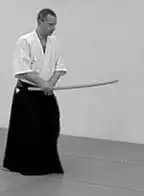 Now, tori steps back slowly with left foot, at the same time turning the blade clockwise, until the edge is pointing to the floor and the sword held in a normal chudan kamae position. At the end of the step, the left hand approaches and grips the hilt, so that the step ends in a correct chudan kamae, middle level guard position.
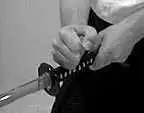 The chiburi is kaiten, the counterclockwise rotation of the sword described in
  Aikibatto — Sword Exercises for Aikido Students