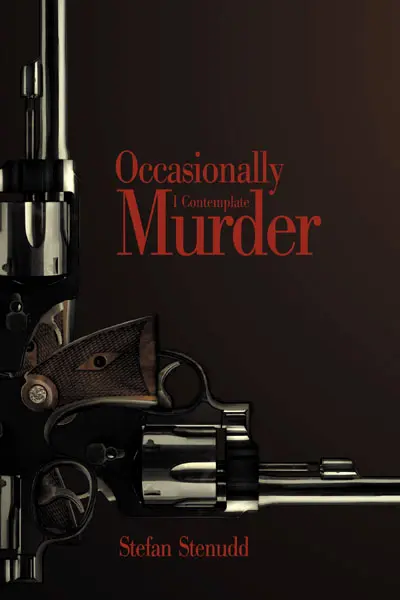
 Occasionally I Contemplate Murder 14The complete book online omebody I know had an accident when he was about twenty years old.
Together with two young friends, he was strolling, late at night, through the suburban area where they lived. It was in the winter, between Christmas and New Year. Snow covered the ground. Most of the apartment building windows were dark and the air carried few sounds. They were approached by a drug addict, some five years their senior, who was obviously high on something or other. Soon enough, they were involved in an intense quarrel, in the midst of which the addict pulled a knife.
The moment he held it safely in his hand, he rushed forward and stabbed the drug addict in the chest. Seven times. The addict died on the spot.
The facts were obvious enough — who killed who and why and such. But the court's considerations were more complex.
But all seven? Hardly. Then they found something out: The defendant suffered from diabetes, and doctors explained that somebody with this malady might be overcome by an uncontrollable rage, when put in a situation of great stress. Therefore, he must not be regarded as responsible for his deed. He was acquitted and sent to psychiatric care, for observation and treatment. After a few months he was sent home.
In fact, his companions at the night of the stabbing seem to have been more affected by it. I get the impression that they've had more severe struggles with their consciences, than he ever did.
If the court is only to find the proper punishment for someone ending the life of another — must not the moral conclusion always be the same? Either it's wrong to kill, or it's not. If it's wrong, then there should be just one punishment for it, the same for every circumstance — simply because the crime is the same. For the victim, anything else is an insult.
Killing is not regarded as immoral. It's not that easy, as is obvious in the case of the executioner and the soldier. Like in so many cases of human law, the decisive issue is not the 'what', but the 'who' — concealed behind a 'why'.
We seek no way to avenge the dead, may he rest in peace, but to protect the living. That is what the court has really to consider, although the game of pretense sometimes makes the affair confusing.
Maybe they thought that he'd probably only be a risk to drug addicts and such. Only when provoked.
We pluck the weeds in our garden, not for the sake of the weeds, but for the sake of the roses. What more can we do, than to cultivate our garden? Not even that do we handle very well. Judges we were not set out to be. Who can possibly cast the first stone? Still, lots of people get stoned. I wonder how.
Continuing...STARTHow to get the bookIf you want to buy the book, you can do so at most Internet bookstores. Click the image below to see the book at Amazon (paid link). It is also a Kindle ebook and an Audiobook. The link takes you to your local Amazon store (or to Amazon.com).
Facebook Page of Occasionally I Contemplate MurderClick the header to visit the book's Facebook page.
My BooksAll my booksOm the Omnipotent — science fictionEver Young — vampire novelSunday Brunch with the World Maker — fictionAll's End — science fictionOccasionally I Contemplate Murder — essayMy Swedish writingOnlineWaves — short storiesPoemsVideo recitalsFabulous fiction by other writersAbout CookiesMy Other WebsitesCREATION MYTHSMyths in general and myths of creation in particular.
TAOISMThe wisdom of Taoism and the Tao Te Ching, its ancient source.
LIFE ENERGYAn encyclopedia of life energy concepts around the world.
QI ENERGY EXERCISESQi (also spelled chi or ki) explained, with exercises to increase it.
I CHINGThe ancient Chinese system of divination and free online reading.
TAROTTarot card meanings in divination and a free online spread.
ASTROLOGYThe complete horoscope chart and how to read it.
MY AMAZON PAGE
MY YOUTUBE AIKIDO
MY YOUTUBE ART
MY FACEBOOK
MY INSTAGRAM
STENUDD PÅ SVENSKA
|