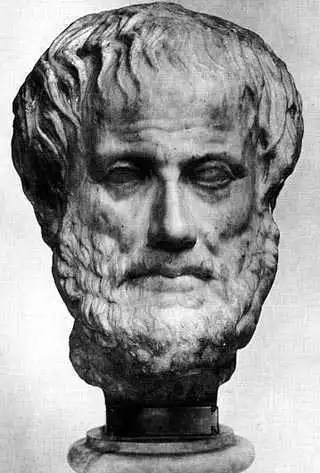
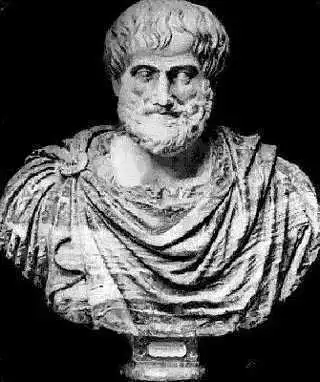
Cosmos of the Ancients The Greek Philosophers on Myth and CosmologyAristotle ith Aristotle (384-322 BC) there is, just as with his teacher Plato, a mass of writing remaining, exceeding what can be dealt with extensively here. Still, regarding myths and things of divine nature, Aristotle makes the task easier than does Plato, since there is one of his many books, particularly concentrated on the subject: Metaphysics. Here he gives a personally commented, often sharp, review of past theories of cosmology, and presents his own. For a sufficient coverage of his perspectives on these things, Metaphysics will do.
Aristotle's judgement on myth can be harsh, as expressed in relation to "the school of Hesiod" and similar "theologians", who have said that those who do not eat the nectar and ambrosia are mortal, but Aristotle questions how immortals can be of need of food. Then he plainly states: "about those who have invented clever mythologies it is not worthwhile to take a serious book."
From old — and indeed extremely ancient — times there has been handed down to our later age intimations of a mythical character to the effect that the stars are gods and that the divine embraces the whole of nature. The further details were subsequently added in the manner of myth. Their purpose was the persuasion of the masses and general legislative and political expediency. For instance, the myths tell us that these gods are anthropomorphic or resemble some of the other animals and give us other, comparable extrapolations of the basic picture.
His own supreme deity is the primal mover of the universe, someone so elevated as to be only thinking — the highest form of life — and thinking about thinking, at that. In this tautological fashion, this supreme being is untarnished, untouchable, closed within its own perfection. Were it to think about anything other than its own thinking, it would be vulnerable, in risk of losing its grandeur or its perfection. This being he calls god, and defines: God is a supreme and eternal living being, so that to God belong life and continuous and eternal duration. For that is what God is.
LiteratureAristotle, Metaphysics, translated by Hugh Lawson-Tancred, London 1998.
© Stefan Stenudd 2000
The Greek Philosophers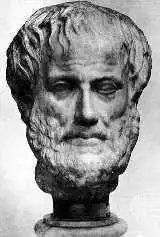
AristotleIntroductionAristotle's LifeTimelineAristotle's PoeticsAristotle's CosmologyAbout CookiesMy Other WebsitesCREATION MYTHSMyths in general and myths of creation in particular.
TAOISMThe wisdom of Taoism and the Tao Te Ching, its ancient source.
LIFE ENERGYAn encyclopedia of life energy concepts around the world.
QI ENERGY EXERCISESQi (also spelled chi or ki) explained, with exercises to increase it.
I CHINGThe ancient Chinese system of divination and free online reading.
TAROTTarot card meanings in divination and a free online spread.
ASTROLOGYThe complete horoscope chart and how to read it.
MY AMAZON PAGE
MY YOUTUBE AIKIDO
MY YOUTUBE ART
MY FACEBOOK
MY INSTAGRAM
STENUDD PÅ SVENSKA
|
 Cosmos of the Ancients