Aristotle Biography 9: Corpus
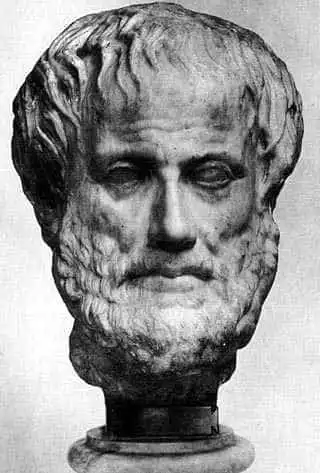
The life and time of the Greek Philosopher
The corpus, Aristotle's texts
Although Aristotle wrote numerous texts, as Diogenes Laertius and others list them, a limited part of them remains — and from only one source, the edition made by Andronicus of Rhodes, 11th president of the Peripatetic school, about 70 BC, published sometime 43-20 BC. It consists only of the writing Aristotle called esoteric, interior texts for use at the school — either made by him, as notes for lectures to have, or made by pupils after listening to them. None of his exoteric writing, for the public outside of the school, remains — other than minimal fragments. In the Hellenistic period, though, the overwhelming majority of references to Aristotle were to his dialogues, the exoteric works.
by Stefan Stenudd
In this book I present the Greek philosophers and what they thought about cosmology, the myths, and the gods. Click the image to see the book at Amazon (paid link).
|
Regarding the adventure of those books that ended up in the hands of Andonicus, some 250 years after the death of Aristotle, had gone through an adventure, the earliest source is that of Strabo (c.63 BC-c.24 AD) in his
Geography, written early in the 1st century AD. Here is the Strabo text about the matter, in its entirety:
From Scepsis came the Socratic philosophers Erastus and Coriscus and Neleus the son of Coriscus, this last a man who not only was a pupil of Aristotle and Theophrastus, but also inherited the library of Theophrastus, which included that of Aristotle. At any rate, Aristotle bequeathed his own library to Theophrastus, to whom he also left his school; and he is the first man, so far as I know, to have collected books and to have taught the kings in Egypt how to arrange a library. Theophrastus bequeathed it to Neleus; and Neleus took it to Scepsis and bequeathed it to his heirs, ordinary people, who kept the books locked up and not even carefully stored. But when they heard bow zealously the Attalic kings to whom the city was subject were searching for books to build up the library in Pergamum, they hid their books underground in a kind of trench. But much later, when the books had been damaged by moisture and moths, their descendants sold them to Apellicon of Teos for a large sum of money, both the books of Aristotle and those of Theophrastus. But Apellicon was a bibliophile rather than a philosopher; and therefore, seeking a restoration of the parts that had been eaten through, he made new copies of the text, filling up the gaps incorrectly, and published the books full of errors. The result was that the earlier school of Peripatetics who came after Theophrastus had no books at all, with the exception of only a few, mostly exoteric works, and were therefore able to philosophize about nothing in a practical way, but only to talk bombast about commonplace propositions, whereas the later school, from the time the books in question appeared, though better able to philosophise and Aristotelise, were forced to call most of their statements probabilities, because of the large number of errors [in the available texts of Aristotle]. Rome also contributed much to this; for, immediately after the death of Apellicon, Sulla, who had captured Athens, carried off Apellicon's library to Rome, where Tyrannion the grammarian, who was fond of Aristotle, got it in his hands by paying court to the librarian, as did also certain booksellers who used bad copyists and would not collate the texts — a thing that also takes place in the case of the other books that are copied for selling, both here [Rome] and at Alexandria. However, this is enough about these men.
An approximate dating of the events, would make the books leave the Lyceum together with Neleus in the mid-3rd century BC, hid in the trench in the earlier part of the 2nd century, to stay there for upto almost a hundred years. Plutarch does in Parallell Lives, written in 99-107 AD, give additional information about what happened to the books from the time of Sylla:
Having set out from Ephesus with the whole navy, he [Sylla] came the third day to anchor in the Piraeus. Here he was initiated in the mysteries, and seized for his use the library of Apellicon the Teian, in which were most of the works of Theophrastus and Aristotle, then not in general circulation. When the whole was afterwards conveyed to Rome, there, it is said, the greater part of the collection passed through the hands of Tyrannion the grammarian, and that Andronicus the Rhodian, having through his means the command of numerous copies, made the treatises public, and drew up the catalogues that are now current. The elder Peripatetics appear themselves, indeed, to have been accomplished and learned men, but of the writings of Aristotle and Theophrastus they had no large or exact knowledge, because Theophrastus bequeathing his books to the heir of Neleus of Scepsis, they came into careless and illiterate hands.
The Andronican edition has got the following order by subjects, much repeated through time, as if the order in which the books were written, but probably they were not:
Organon
Physics and natural science
Psychology and biology (also Metaphysics)
Ethics
Politics
Aesthetics (Rhetoric and Poetics)
The oldest list of Aristotle's works is thought to have originated by Ariston of Ceos, who headed the school, around 200 BC. Diogenes Laertius of the 3rd century AD gives a substantial list covering several pages, as does the Vita Menagiana by Hesychius Milesius (6th century AD), and Life of Ptolemy. None of them match precisely.
The Traditional order of Aristotle's remaining works, according to the edition of Immanuel Bekker, Berlin 1831. This is not at all necessarily the order in which the texts were written.
Organon (6 logical treatises)
On Coming-to-be and Passing-away
On the Cosmos
Physics I-VIII
On the Heavens I-IV
Meteorologica I-IV
On the Soul I-III
Parva naturalia
Historia Animalium I-X
Parts of Animals I-IV
On Movement of Animals
Progression of Animals
Generation of Animals I-V
Minor Works: On Colours, On Things Heard, Physiognomics, On Plants I-II, On Marvellous Things Heard, Mechanical Problems, On Invisible Lines, The Situations and Names of Winds, On Melissus, Xenophanes and Gorgias
Problems I-XXXVIII
Rhetoric to Alexander
Metaphysics I-XIV
Oeconomia I-III
Magna Moralia I-II
Nicomachean Ethics I-X
Athenian Constitution
Eudemian Ethics I-VIII
On Virtyues and Vices
Politics I-VIII
"Art" of Rhetoric
Poetics
His texts are also often sorted according to categories, as in the following way:
Popular writings
poems (three fragments survive)
letters (fragments, some not genuine)
exoteric writings (Eudemus, Protrepticus, On Philosophy, On the Good, On the Ideas, only remaining in some extracts or summaries)
Memoranda and collections of material
(Over 200 titles, whereof 158 constitutions of Greek states, of which Constitution of the Athenians was rediscovered in 1890, also a lost record of dramtic festivals called Didascaliae, and surviving Problems, Historia Animalium)
Scientific and philosophical treatises (the surviving corpus, sorted into:)
Logical works (The Organon)
Physical works
Psychological works
Works on natural history
Philosophical works (containing Poetics)
© Stefan Stenudd 2003, 2006.
Aristotle
The Greek Philosophers
My Other Websites
Myths in general and myths of creation in particular.
The wisdom of Taoism and the
Tao Te Ching, its ancient source.
An encyclopedia of life energy concepts around the world.
Qi (also spelled
chi or
ki) explained, with exercises to increase it.
The ancient Chinese system of divination and free online reading.
Tarot card meanings in divination and a free online spread.
The complete horoscope chart and how to read it.

Stefan Stenudd
About me
I'm a Swedish author of fiction and non-fiction books in both English and Swedish. I'm also an artist, a historian of ideas, and a 7 dan Aikikai Shihan aikido instructor. Click the header to read my full bio.
 Cosmos of the Ancients