Sigmund Freud and the Freudians on myth and religion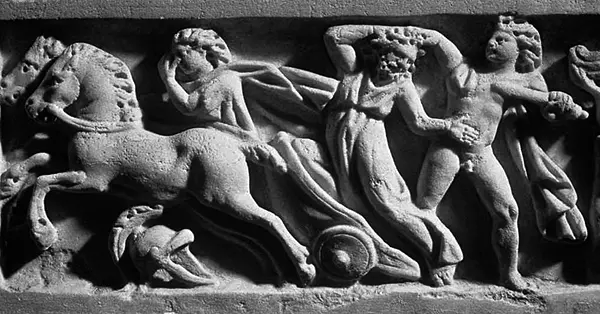 Oedipus killing his father Laius. Marble relief from the 3rd century BC. The Oedipus complex is a central theme in Freudian thought. Their theories about mythology and religion examined by Stefan Stenudd
The texts are chapters from my book Psychoanalysis of Mythology. In addition to Freud himself are nine of his followers, who have made the most significant contributions to Freudian thought on myth. Below are the links to their chapters, in the approximate order of their flourishing.
This webpage also contains the introductory chapter of the book, which discusses the background, basics and characteristics of Freudian theories on mythology. I hope it can be an interesting read, but the chapters on each Freudian also stand on their own.
Freudians on Myth and Religion
IntroductionThe psychoanalytical perspective on mythology was unavoidable. When the study of myths and religions from all over the world intensified during the 19th century, patterns in them were extracted and compared, and theories on what they revealed about common human conditions were proposed. Myths were increasingly seen as expressions of needs of the human psyche.The beliefs expressed in myths, as well as in rites, gradually ceased to be dismissed as merely heathen misconceptions as opposed to the sacred truth of the Christian doctrine. Instead, they became respected fields of study of the human nature, inspired by the quickly growing mass of documented myths and increasing knowledge about religious traditions among distant and obscure cultures. By the end of the 19th century, the literature on the subject was immense, and mostly pointing to psychological explanations to the structure and content of myths, as well as for the birth of religions and their spiritual meaning. To name a few: English anthropologist Edward Burnett Tylor's Primitive Culture: Researches into the Development of Mythology, Philosophy, Religion, Language, Art, and Custom was published in 1871 and made a lasting impression. A few years earlier, in 1865, he had written Researches into the Early History of Mankind on the same theme. The German philologist and orientalist Max Müller, who is regarded as the initiator of comparative religion, became Oxford's first professor of comparative theology in 1868. He edited Sacred Books of the East, published in 50 volumes from the years 1879 to 1910. Scottish anthropologist James George Frazer's The Golden Bough, presenting a vast material on myth, lore, and ritual around the world, was originally published in 1890, as a two-volumes work. In the following decades it expanded considerably, reaching twelve volumes in its third edition, published between 1906 and 1915. The Scottish author Andrew Lang's Myth, Ritual, and Religion in two volumes preceded Frazer by just a few years, getting published in 1887. There were also journals of anthropology published since the mid-1800's, frequently containing documentations of myths and rituals in nonliterate societies. This rapid growth of interest in the traditions of other cultures was taking place simultaneously with the establishment of the science of psychology, and they influenced one another continuously. Anthropologists used psychological concepts to analyze and explain beliefs and religious practices of societies they studied, and psychologists searched anthropological material for support of their theories about the mentality of man. This is still the case. The two persons most influential in the emergence of psychological treatments of myth were Sigmund Freud and Carl Gustav Jung, the latter to a much wider extent than the former. Since both were connected to the psychoanalytical movement — Freud as its founder and Jung as his most prominent disciple until they parted ways — and their perspectives on man and myth involved unconscious parts of the psyche supposed to play much more of a role than mere emotions and instinctive stimuli, it is possible to label their theories on myth psychoanalytical. It can certainly be said about Freud's followers, who stuck with the term and what it contained. Jung was to change his name for the discipline to analytical psychology, which is not that different. The term depth psychology is often used in this framework, but that would imply the existence of a shallow counterpart, which can be questioned, and it also suggests a vertical grading of the components of the psyche that is not necessarily shared by other psychologists. By psychoanalytical perspectives on myths, I here refer to the theories of Freud, Jung, and their followers. For the 20th century, these two groups of theorists are so clearly defined that they can be treated as such without doing their individual thoughts any significant injustice. Freudians have treated myth and religion from the paradigm given by Freud, and Jungians have done the same from that of Jung. For the future, though, both groups are sure to lose some of their homogeneity, since both Freudian and Jungian ideas about myth and religion are increasingly questioned and altered in differing directions, where they are not altogether abandoned. The latter seems to be more the case for Freud's ideas than for those of Jung. Freud has not stood the test of time to the extent that his former disciple has — especially in regard to theories about mythology, its psychological roots, and how it should be interpreted. While Freud's psychology as a whole had a considerably wider reputation and respect than Jung's — and to some extent still does, although questioned on many central points — his take on myths in particular did not fare so well. There, Jung's influence grew to overshadow Freud all but completely, not that it has managed to find any consensus among either psychologists or mythologists. This book deals exclusively with Sigmund Freud and his followers. A book about Jung and the Jungians is in the works. Initially, the project was intended to be one book, but it was getting rather voluminous. Also, the Freudian and Jungian theories differ so distinctly, there is little meaning in combining them in one text. The Freudian perspective can be described as one of mythology stemming from personal urges that may be shared by all, but are strictly internal and based on each individual's instinctual emotions. Jungian theories, on the other hand, involve social causes and a symbolism formed and upheld by the human species, more or less independently of individual minds. Where Freudians see a pattern of instincts, Jungians point to imagination nurtured by cultural heritage. One focuses on strictly internal factors, and the other emphasizes external influence. Although these two perspectives sometimes lead to similar conclusions regarding the causes and effects of myth and religion, they display fundamentally different views on the human psyche. So, they may just as well be treated separately, in order to explore each approach adequately. In examining the Freudian theories about myth and religion, I have turned to their own writing on the subject, just about exclusively. Neither contemporary nor later commentators on their views are treated more than occasionally in passing, since their own words speak well for themselves and are enough material for an examination of them. This book is about their theories on mythology, and not aiming at presenting other aspects of their psychology. It is also the reason for some significant Freudians being excluded for not treating the subject at hand in any substantial way, if at all. Only those who in their writing showed an interest in myth and religion are included. I may not have caught all of them, nor all of their writing on the subject, but I am confident that most of them are treated, as well as their most notable texts.
A Critical ExaminationAs is certainly evident in this book, my examination of the Freudians who theorized about the psychological causes behind mythology and religion is quite critical. I trust that it is also evident why. Anything else would be a betrayal of the book's objective. A serious investigation of this subject unavoidably leads to criticism, since there is such a discrepancy between Freudian claims and their arguments for them. So much is stated and so little is proven.It is blatantly obvious already with what Sigmund Freud had to say about the emergence of religion and its constant fuel — the Oedipus complex, which he regarded as the root to just about all expressions of the male psyche, and he would not even admit to the existence of something similar in the female mind. The theory is, especially but not only when applied to religion, as preposterous as Freud's insistence on it is obstinate. He stuck with it until his death, refusing even to consider a nuanced view or alternative hypotheses. What he claimed to be a verified scientific theory was really a doctrine not to be questioned. A decree. His followers were anxious to comply and did so with a reverence akin to that given high priests in religious congregations. This fidelity was clearly demonstrated by the formation and activities of the so-called Secret Committee, described in the last chapter of the text about Freud. That kind of loyalty is not unheard of in many kinds of subcultures, but it is gravely detrimental to scientific research. The Freudians were more obsessed with defending Freud's dogma than trying to expand the understanding of the human psyche. This explains the high degree of conformity in their theories about mythology and religion. Those who followed other lines of thought were condemned and expelled. The texts by the loyal ones can often be described as almost playful applications of Freud's paradigm on this or that myth or religious phenomenon, but they lack any questioning of the paradigm and they whisk away any anomaly they may come across. They are so happy with their tool, if not to say toy, by which they believe to make revelations about the mysteries of the human mind and its most intriguing manifestations. It is often strikingly naïve. One must wonder how it was possible for so many pondering minds to get so lost. To a significant extent it can be explained by the cultish characteristics of the Freudian society, energetically promoted by its founder and master. Psychology, their field of expertise, was no vaccine against it. Instead, it may have dimmed their perception, thinking it could not happen to them because of their training. The ones who are the likeliest to be fooled are those who think they can't be. But if that were the only reason, it would sooner or later be revealed and the participants would reconsider, with cheeks blushing from shame. What made this situation possible and consolidated it was the vague nature of the science in which they worked. Psychology was still very much limited to speculation and little was proven by hard empirical facts, during the first few decades of psychoanalysis. Freud was convinced that the approach he pioneered was rooted in objective science, and he insisted in the beginning that only persons with a medical education could be entrusted with conducting psychoanalytical treatment. But there were — and to a large extent still are — substantial differences between science of the body and of the mind. The former can be systematically tested and the results are observable, usually measurable and often unquestionable, whereas the latter has difficulties with all of that. Systematic testing of a psychological hypothesis is an intricate matter already because it is very difficult to repeat the test with a similar setting, which is necessary in an empirical process. Even if the hypothesis is defined with precision and clear delimitation, which is particularly problematic in psychology, repeated testing is not sure to isolate the item to be studied from other known or unknown variables. If the hypothesis is vague, the task is practically impossible. The human mind is just too much of a maze to be trapped in repeated clinical experiments, without lots of circumstances bound to deviate from one test to the next. And people are far too different, in ways impossible to predict, for their results to be confidently compared even if the tests are deemed identical — in itself something very hard to assess. In addition, the psyche is not enough understood and its processes not sufficiently mapped, for test results to be adequately observable and measurable in an empirically trustworthy manner. There are too many unknowns in the equation. The simple cause and effect of, say, what the lack of one vitamin does to the body or how a broken bone is healed, is objectively observable. But that is rare to find in psychology. In the mind, everything is subjective. That gives room for speculations, but few affirmed conclusions. What modern psychology often relies on to make conclusions are statistical correlations: more people than pure chance would have it react in a certain way to something. It is a precarious path of inquiry, and its application is limited to very simplified assumptions. Still, it is used a lot by psychologists, mainly because they have few other tools by which to experiment and get tangible results. The psychoanalysts discussed in this book used a method to reach their conclusions, which was similar to the statistical one, but with alarming shortcomings. They referred to their experiences with patients treated by psychoanalysis, and used that as evidence of their theories. But those numbers were far too few to make any statistical evaluation, and they did not bother to present any figures. Instead, they regarded their thesis as true because they had patients whose behavior confirmed it. They often settled for just one case to prove their point, no matter how far-fetched or intricate it was. As a method in empirical science, it has little value. It lacks any more weight than saying, "I once knew someone who was like that."
PlaceboThere is another shortcoming in the psychoanalytical practice of using patients to prove a point, and it strikes at the core of psychoanalysis as a whole: How to ensure that a successful treatment is not the result of a psychological equivalent to placebo?When a new medical drug is tested, a primary one to pass is if its effect surpasses that of placebo, the sugar pill substitution of the real medicine. Many do not. Placebo is a strong force, which is yet an example of the mysterious complexity of the human being, needed to be explained before anything certain can be said about the human psyche. In psychoanalysis, there is an elaborate therapeutic setting, where the patient is guided towards what is to be expected and how to reach it. When that moment comes, patient and therapist rejoice and mutually regard the problem as solved. That is an ideal placebo situation — the process presented as a cure, led by the expert, and demanding the patient's trusting engagement. They cooperate in making it work, whether it would or not. Reading a number of examples of psychoanalytical cures, I suspect that most or all of them could be explained by the placebo effect. I have not come across any psychoanalytical effort to check against this, and for a good reason — if it works on something as complicated as the human mind, why not leave it be? What still needs to be considered is if the cure accomplished by psychoanalysis is a lasting one. I have not seen an eagerness within that profession to examine this aspect. A sudden revelation can be a great momentary relief, but if it was in error the problem is likely to return, given time. So many of the psychoanalytical solutions give the impression of magic potions. Once the revelation is reached, everything is dandy. I find that hard to believe, and certainly not without some kind of evidence other than the psychoanalyst's assurance of it. Of course, that particular topic goes beyond the scope of this book, which is not aimed at examining the theories and practices of psychoanalysis in their entirety. I am not even concerned with its possible benefits or damages in healthcare. But since psychoanalytical theories about myth and religion claim support through therapeutic experience, I would be negligent not to bring it up. This is one more indicator that those statements remain to be proven.
Freudians on Myth and Religion
MYTH
IntroductionCreation Myths: Emergence and MeaningsPsychoanalysis of Myth: Freud and JungJungian Theories on Myth and ReligionFreudian Theories on Myth and ReligionArchetypes of Mythology - the bookPsychoanalysis of Mythology - the bookIdeas and LearningCosmos of the AncientsLife Energy EncyclopediaOn my Creation Myths website:
Creation Myths Around the WorldThe Logics of MythTheories through History about Myth and FableGenesis 1: The First Creation of the BibleEnuma Elish, Babylonian CreationThe Paradox of Creation: Rig Veda 10:129Xingu CreationArchetypes in MythAbout CookiesMy Other WebsitesCREATION MYTHSMyths in general and myths of creation in particular.
TAOISMThe wisdom of Taoism and the Tao Te Ching, its ancient source.
LIFE ENERGYAn encyclopedia of life energy concepts around the world.
QI ENERGY EXERCISESQi (also spelled chi or ki) explained, with exercises to increase it.
I CHINGThe ancient Chinese system of divination and free online reading.
TAROTTarot card meanings in divination and a free online spread.
ASTROLOGYThe complete horoscope chart and how to read it.
MY AMAZON PAGE
MY YOUTUBE AIKIDO
MY YOUTUBE ART
MY FACEBOOK
MY INSTAGRAM
STENUDD PÅ SVENSKA
|
 Archetypes of Mythology
 Psychoanalysis of Mythology