Psychoanalysis of Myth 6
Jung's Archetypes
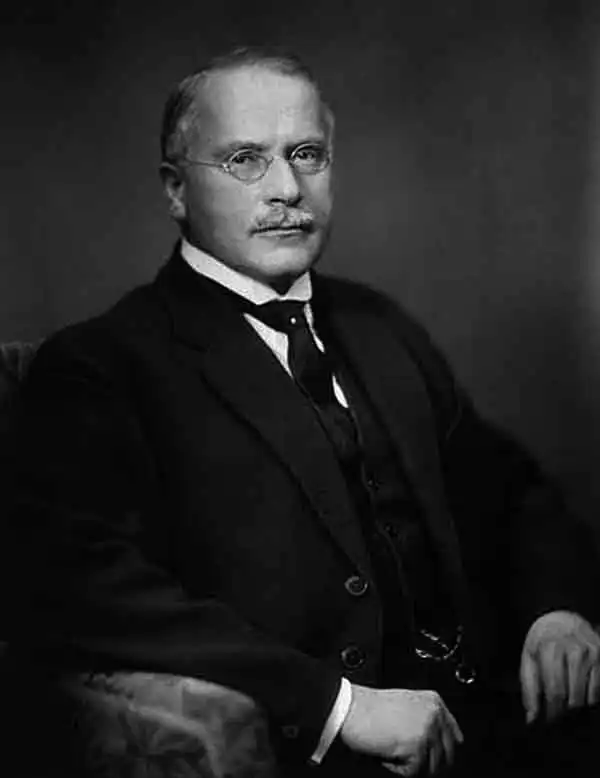
The clues to self-realization in myths, and in many other cultural phenomena, are according to Carl G. Jung the archetypes, symbolic elements containing aspects of the workings of human life and mind. The term archetype is not one of his invention, but he used it in an elaborate way in his theories of psychology and culture, giving it his own specific meaning.
by Stefan Stenudd
Jungian theories on myth and religion examined, from Carl G. Jung to Jordan B. Peterson. Click the image to see the book at Amazon (paid link).
by Stefan Stenudd
Freudian theories on myth and religion examined, from Sigmund Freud to Erich Fromm. Click the image to see the book at Amazon (paid link).
|
The word archetype is from the Greek arkhetupon, first mould or model, in the meaning of being the initial version of something later multiplied. It is made up of arkhos, meaning chief or ruler (used also in e.g. archbishop and monarch), and tupos, meaning mould, model or type. The archetype has been used to describe original or ideal model phenomena and characters, such as easily recognizable type-roles in drama — like the evil stepmother, the miser, the brave hero. In the case of drama and literature, such archetypes are usually traceable back to myth and fable.
Jung's use of the term archetype is similar at first glance. He repeatedly refers to such fictional type-roles as archetypes, the hero being the one most frequently used. But to Jung they are far more than recognizable characters — in fact, they are not at all characters, essentially, but symbolic keys to truths about the human condition and to the path of personal enlightenment. The Jungian archetypes can reveal the workings of the world, as to how it affects the human psyche, and what man should do to accomplish something or for that matter ward something off. They are learning tools, lessons from primordial time, answers included. And they do more than that:
Archetypes create myths, religions, and philosophical ideas that influence and set their stamp on whole nations and epochs.
Jung's archetypes are not limited to human characters — there are also animal archetypes, like the serpent and the lion, and objects functioning as archetypes, like gold or the castle or the forest. There is a multitude of archetypes — some known, many others yet to be discovered. Jung allows for an unlimited number of them: "There are as many archetypes as there are typical situations in life."
It might be best compared to mathematical components, such as pi or the x of an equation. A Jungian archetype is like pi in the sense that it has a fixed value, but its applications are just about endless. It is like the x of an equation in the way that it is the solution to a given problem — if that problem is significant enough. The Jungian archetypes carry meanings for the human mind to decipher and utilize. Jung also associates to formula:
The archetype is a symbolic formula which always begins to function when there are no conscious ideas present, or when conscious ideas are inhibited for internal or external reasons.
In another text, Jung compares the archetypes to: "the axial system of a crystal, which, as it were, preforms the crystalline structure in the mother liquid, although it has no material existence of its own." This shows a resemblance to Plato's world of ideas and theory of form, where physical manifestations are nothing but inferior copies of the ideal forms, which are the only things completely real, giving meaning to everything in this world.
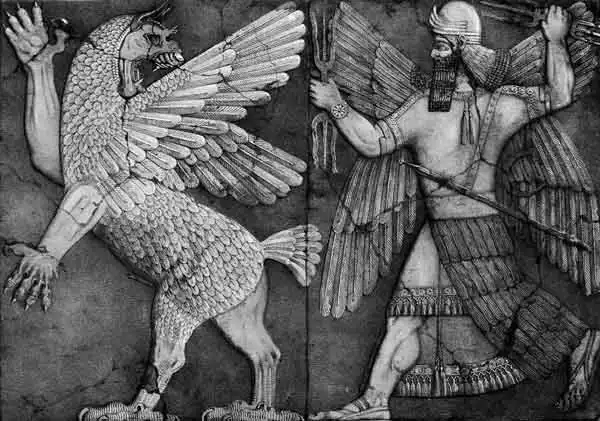
Marduk and Tiamat, Babylonian deities.
Since the archetypes are symbolic components rather than objects or persons, they are discovered by their function instead of their attire. A symbolic element that reappears in many a myth from separate cultures or time-periods, and seems to contain some kind of significance in those stories, is in the Jungian perspective most certainly an archetype:
An image can be considered archetypal when it can be shown to exist in the records of human history, in identical form and with the same meaning.
Not only that, but in Jung's world, an archetype contains such potency that it is its archetype, wherever it appears. Its symbolic archetypal function emerges, even when that was not intended by its user in that specific case. It is also this primordial potency of the archetypes that makes them attractive and exciting, wherever they appear. People are drawn to archetypes, often obsessed by them, whether they know of their Jungian function or not. They feel a resonance from their unconscious, recognizing and being stimulated by the archetype.
So, where do archetypes come from? How do they appear and remain? Jung is not very talkative about it, but his explanation is quite identical to that of Freud about how memories get incorporated into the archaic heritage — by repetitious experience. Jung imagines the same for archetypes:
It seems to me that their origin can only be explained by assuming them to be deposits of the constantly repeated experiences of humanity.
It is not possible to make a complete list of Jungian archetypes, since many of them are yet to be discovered. Nor is there room for a substantial list of archetypes recognized so far in Jungian theory. Jung himself never even suggested a listing. In addition, some archetypes can be seen as examples of more fundamental ones, or sorts of mixes of other archetypes. It is not a very orderly universe. So, here are just some of the archetypes mentioned by Jung and his colleagues, and my own attempt at shortly explaining them:
- The hero, who pursues a great quest to realize his destiny.
- The self, the personality striving towards its own complete realization.
- The shadow, the amoral remnant of our instinctual animal past.
- The persona, the mask and pretense we show others.
- The anima and animus, our female and male roles and urges.
- The mother, primarily in the sense of our need of her.
- The father, primarily an authority figure often inducing fear.
- The child, our innocent beginning with all our potential in front of us.
- The sage, or wise old man, one who has the profound knowledge.
- The god, the perfect image of the Self.
- The goddess, the great mother, or Mother Earth.
- The trickster, a rascal agent pushing us towards change.
- The hermaphrodite, the joiner of opposites.
- The beast, a representation of the primitive past of man.
- The scapegoat, suffering the shortcomings of others.
- The fool, wandering off in confusion and faulty directions.
- The artist, the visionary and inspired way of approaching truth.
- Mana and other concepts of spiritual energy.
- The journey, a representation of the quest towards self-realization.
- Life, death and rebirth, the cyclic nature of existence.
- Light and dark, images of the conscious and the unconscious.
- The tree, the growth towards self-fulfillment.
- Water, the unconscious and the emotions.
- The wizard, knowledgeable of the hidden and of transformation needed.
The foremost of the Jungian archetypes is the hero, a person who bravely overcomes great difficulty in order to realize his destiny. He could be described as a role-model, urging each of us to go ahead and pursue our own quest. Freud, too, put significant emphasis on the hero of myth and lore.
Jung's hero meets with certain characters, events and obstacles on his quest. Those are often recognizable from one myth to another, and archetypes as well. The hero myth is the ultimate formula of self-realization, wherefore it is central in Jung's treatments on myth. Other myths — even such of seemingly greater magnitude, like those of creation, the flood, or apocalypse — could more or less be seen as components of the hero myth, symbolizing certain premises or necessary processes of the hero quest.
Jung's collective unconscious
Psychoanalysis of Myth
-
-
-
-
-
-
-
-
-
© Stefan Stenudd 2006
MYTH
On my Creation Myths website:
My Other Websites
Mythology in general and creation myths in particular.
The wisdom of Taoism and the
Tao Te Ching, its ancient source.
An encyclopedia of life energy concepts around the world.
Qi (also spelled
chi or
ki) explained, with exercises to increase it.
The ancient Chinese system of divination and free online reading.
Tarot card meanings in divination and a free online spread.
The complete horoscope chart and how to read it.
Stefan Stenudd
About me
I'm a Swedish author of fiction and non-fiction books in both English and Swedish. I'm also an artist, a historian of ideas, and a 7 dan Aikikai Shihan aikido instructor. Click the header to read my full bio.
 Archetypes of Mythology
 Psychoanalysis of Mythology