Carl G. Jung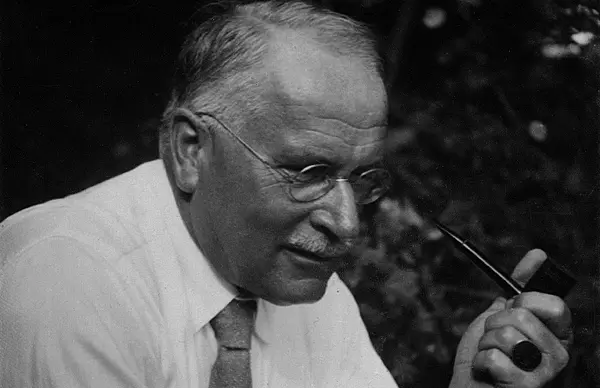
His theories about mythology and religion examined by Stefan Stenudd
Between 1905 and 1913 he was a lecturer of psychiatry at the University of Zürich. In 1909 he opened a private practice, which he would run until his death. He sent his 1906 book The Psychology of Dementia Praecox (the ailment later by Eugen Bleuler renamed schizophrenia) to Sigmund Freud, which was the start of a collegial friendship between them. This was turned into dispute and separation, especially with Jung's 1912 book Wandlungen und Symbole der Libido, (published in English 1916 as Psychology of the Unconscious), which questioned Freud's focus on sexual trauma and the Oedipus complex, arguing for his own alternative theories about the psyche. Jung's writing on mythology is not to be found concentrated to a few books on this subject, as is the case with Freud, but sprayed all over his works. There is rarely a text of his that does not touch on the subject, and just as rarely one devoted exclusively to it. So, Jung's theories on myth come to us in bits and pieces, spread over all his writing. The job of systematizing has mainly been left in the hands of his pupils and followers. Among them, though, it is equally difficult to find one with the intention to bring together and present Jung's theories on myth in any authoritative and organized fashion. His gospel remains an elusive one, presenting few straightforward answers. That is quite befitting his psychological doctrine, which is in itself rather mythological.
Considerable InfluenceJung's ideas on myth and religion have made far more of an impact than those of Freud, among scholars as well as to an even larger extent on the general public. Where Freud remains little more than a joke in the field of history of religion and the study of mythology, Jung has made a lasting impression through most of the 20th century, to partly fade only in the last decade or so of it. And he is far from forgotten yet.Apart from his own widely read writing, which deals considerably with myths, mythology, and many elements of religion, he has greatly influenced a number of significant scholars and other writers on these themes. The most important of them are Mircea Eliade (1907-86) and Joseph Campbell (1904-87). Eliade wrote many books on myths and how they should be interpreted. He also formed the minds of numerous students as the head of the University of Chicago History of Religion department for almost 30 years. Campbell's books have become bestsellers and made deep impressions on the general public as to how myth should be understood. He was the central participant in a 1987 TV series about mythology, which received a huge audience in many countries. In addition, there is the continued work of Jungian theorists and psychologists more often than not involving their perspective on myth in their writing on the mind of man and the inner workings of society. Notable Jungian theorists dealing extensively with myth are Erich Neumann (1905-1960), Marie-Louise von Franz (1915-1998), and James Hillman (1926-2011).[1] By the sheer mass of it, Jungian literature on myth has set a standard and its theories have become a paradigm of sorts as to how myths should be understood. The Jungian perspective has widely influenced how mythological material is presented and interpreted. For most of the 20th century, a substantial part of the literature on myth and lore used a Jungian viewpoint, whether or not that was adequate to the material. Myths were often even translated into the Jungian vocabulary, to the extent that their original content got distorted. It can be compared to how the missionaries, who collected myths around the world in the 19th century, interpreted these myths through a Christian filter. Especially when they recorded exclusively oral traditions in this manner, they left us with flawed material of primary sources difficult to reconstruct. Our world has since become increasingly integrated, whereby orally transmitted mythology free from outside influence is nowadays almost impossible to find. Washing off the Jungian influence from much of the literature on mythology of the 20th century is a challenge comparable to doing the same with the Christian influence on the literature of the preceding century.
Opposing FreudWhere Freud was mainly interested in the origin of religion and explaining the functions of rituals, Jung focused on myth and legend, the stories told within religions. To him, these stories were the essence of any religion, and therefore he was keener to explore the origin of myths than of religion as a whole.Also contrary to Freud, Jung found myth and its meaning within the individual psyche. In spite of myths and their components being shared by all members of a society — and essentially by all mankind — he saw their workings as strictly personal. According to Jung, man is on a quest towards self-realization, and myths serve as clues to this process. Although every person is on this quest, fulfilling it to various degrees, it is a solo venture, each man for himself. This difference between Freud and Jung can be loosely compared to the generalizations of Mahayana and Hinayana in Buddhism. The former is characterized as a joint effort together with people of the same conviction to find spiritual perfection, while the latter is doing it in solitude. Freud saw the individual as deeply dependent on society and anxious to conform to it, while Jung saw society as little more than a number of individuals of similar nature. Therefore, to Jung the myths contain messages to the individuals, not the group, no matter how many people are involved in retelling and listening to them. Myths speak to each of us in the same way, but have to be dealt with individually as opposed to collectively. Jung himself pointed out other differences to Freud, mainly regarding how to interpret dreams and fantasies:
Jung also objected to the sexual themes Freud mostly found in dream interpretation:
He expressed it as if certain that he had revealed the very key to how the human mind works. His students were just as convinced of the same. Time has gnawed on this conviction, but still far from discarded it completely. Jung's vision is far too attractive and exciting to be ignored. In that way, it shares the quality of the myths it explores. Whether accurate of false, it is a wonderful story.
Three Basic Jungian ConceptsIn the following, I have as much as possible used the original English translations of Jung's texts, since they have been more or less altered in later editions — either by Jung or by new translators. Sticking to the earliest versions was necessary when searching for the timeline of the emergence of his ideas and his terminology for them.There are three basic concepts in Jung's psychology and analysis of myth: the collective unconscious, the archetypes, and individuation. They are closely connected, describing the human mind as on a quest for self-realization. The collective unconscious is where the archetypes are stored. They emerge to the conscious mind, urging it to realize the existence and function of the collective unconscious. That is the process of individuation. Already in his first written work, the dissertation from 1902, Jung's interest in the unconscious and the imagery emanating from it was evident. He describes the case of a 15 years old girl who acted out a wild imagination, thinking of herself as a medium, who in her frequent trances expressed the personalities of deceased persons. This girl, Hélène Preiswerk, was Jung's cousin, which he neglected to mention in his dissertation.[5] Unconvinced of her medial abilities, Jung was still amazed by her fantasy in creating them and making them believable. He regarded it as a form of cryptomnesia,[6] the error of believing that images and ideas are new, when they are actually deeply hidden memories of the past. The visions of the patient were examples of cryptomnesic images from the unconscious. He says about their nature:
The Collective UnconsciousNeither Jung nor Freud were the first to use the term unconscious (Unbewusste) as a noun, representing a certain entity within the psyche. It was the German philosopher Friedrich Schelling in his book System des transcendentalen Idealismus from 1800.He discussed the dynamics between the conscious and the unconscious, calling the former the absolutely subjective and the latter the absolutely objective.[10] To Schiller, the unconscious should have priority over the conscious, and he explained:
The massive text had a significant impact at the time, making the concept of the unconscious widely established long before the works of Freud and Jung. Jung mentions in his memoirs that he read Eduard von Hartmann "assiduously" already in his university years.[12] But the text is most definitely the philosophy of the unconscious, and not the psychology of it. The unconscious of von Hartmann's interpretation is metaphysical, if not to say cosmological, discussed alongside the thoughts of Schelling as well as Kant, Leibnitz, and other philosophers. He still spoke of an unconscious in the psyche of man, but it led him to speculate way beyond the mind:
The collective unconscious is a concept of Jung's own invention. His first description of it was in a 1916 lecture, which was the same year translated into French. It was published in English the following year.[14] In this text, he describes the conflict inside every individual mind between personal aspirations and the collective demands. When one dominates the other, the person suffers. This tension exists in the conscious as well as the unconscious. Jung considers the risk of the collective material taking over, because of its quantity. Individuation is the process by which a personality can develop in spite of the overwhelming collective material in both the conscious and the unconscious.[15] He does not yet use the expression collective unconscious, but implies it. The English translation has other terms, such as collective psyche and impersonal unconscious, whereof the latter may be what Jung later called collective unconscious. In a summary at the end of the text Jung expresses the need for dividing both the conscious and the unconscious contents into individualistic and collectivistic, defining the latter: "A content is collectivistic whose developing tendency aims at universal validity."[16] The individualistic content, on the other hand, tends towards differentiation from the collective. He also states:
The ArchetypesJung's first treatment of the term archetype was in the 1919 symposium text Instinct and the Unconscious.[17] Before that he had used the expression 'primordial image' (Urbild in German), derived from the Swiss art historian Jacob Burckhardt.[18] In this text, he also talks about the collective unconscious, smoothly bringing them together in one simple formula.After defining what belongs to the personal unconscious, he talks about another stratum of the unconscious, containing "supra-individual" qualities which were not acquired but inherited, like instincts and impulses. He continues:
IndividuationThe term individuation I have not found Jung use before 1912, when he did so briefly in Wandlungen und Symbole der Libido, translated to English in 1916 as Psychology of the Unconscious. Discussing sacrifice, he calls the individual mask the veil of individuation, and later in a footnote he describes the separation from the mother as an individuation. In both cases he puts the word within quotes.[24]As mentioned earlier, Jung also used the term in his 1916 lecture "The Conception of the Unconscious," where he describes individuation as a necessary process to avoid drowning in one's unconscious:
The English translation from 1923 had the subtitle The Psychology of Individuation. In the definitions of terms at the end of the book, he writes about individuation:
In the definition of intuition, he also describes the archetypes, and here with that term:
Apart from in the definitions, Jung uses the word archetype in only two of the chapters. Individuation is used three times, but collective unconscious twenty times, most of them in a chapter discussing the type-problem in poetry. The poets, at least the major ones and in their principal and most inspired work, "create from the very depths of the collective unconscious, voicing aloud what others only dream." But they lack conscious understanding of the true meaning of what emerges.[30] So, by this time, in 1921, Jung was comfortable with the three concepts archetypes, collective unconscious, and individuation, and how to utilize them in his psychology. But he had not yet started making a habit of it. He settled with arguing for their utility when used to understand the psyche. It would take additional years before he did so himself consistently, without hesitation.
Notes
Carl G. Jung on Myth and Religion
Jungians on Myth and Religion
This text is an excerpt from my book Archetypes of Mythology: Jungian Theories on Myth and Religion Examined, from 2022. The excerpt was published on this website in February, 2026.
MYTH
IntroductionCreation Myths: Emergence and MeaningsPsychoanalysis of Myth: Freud and JungJungian Theories on Myth and ReligionFreudian Theories on Myth and ReligionArchetypes of Mythology - the bookPsychoanalysis of Mythology - the bookIdeas and LearningCosmos of the AncientsLife Energy EncyclopediaOn my Creation Myths website:
Creation Myths Around the WorldThe Logics of MythTheories through History about Myth and FableGenesis 1: The First Creation of the BibleEnuma Elish, Babylonian CreationThe Paradox of Creation: Rig Veda 10:129Xingu CreationArchetypes in MythAbout CookiesMy Other WebsitesCREATION MYTHSMythology in general and creation myths in particular.
TAOISMThe wisdom of Taoism and the Tao Te Ching, its ancient source.
LIFE ENERGYAn encyclopedia of life energy concepts around the world.
QI ENERGY EXERCISESQi (also spelled chi or ki) explained, with exercises to increase it.
I CHINGThe ancient Chinese system of divination and free online reading.
TAROTTarot card meanings in divination and a free online spread.
ASTROLOGYThe complete horoscope chart and how to read it.
MY AMAZON PAGE
MY YOUTUBE AIKIDO
MY YOUTUBE ART
MY FACEBOOK
MY INSTAGRAM
STENUDD PÅ SVENSKA
|
 Archetypes of Mythology
 Psychoanalysis of Mythology