Carl G. Jung: The Blessing and Curse of Religion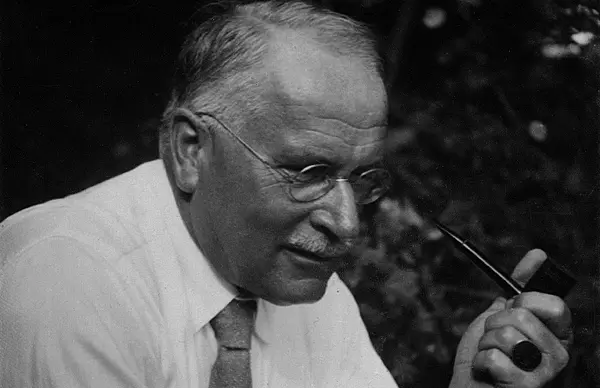
Chapter 3 on his theories about mythology and religion examined by Stefan Stenudd
This turn from the individual patient to society as a whole, with the psychological tools he had at hand, sprung out of the deep disappointment that was World War I. It is quite clear in his essay "The Spiritual Problem of Modern Man" from 1933, which is an edited and expanded version of the 1928 German original "Das Seelenproblem des modernen Menschen." He laments:
There is a need of the soul that repeatedly manifests itself in monstrosities of the Western world, to itself as well as to the other cultures it comes across. Jung quotes a Native American friend of his: "We don't understand the whites, they are always wanting something — always restless — always looking for something. What is it?"[2] A good question, indeed. To Jung, the answer is coming to peace with the unconscious. A 1932 lecture, "Die Beziehungen der Psychotherapie zur Seelsorge," was the following year published in English with the title "Psychotherapists or the Clergy" in the same book as the previously mentioned text about the spiritual problems of modern man. Their subjects are similar. Jung states that modern medicine disregards the psychological perspective and is therefore unable to treat illnesses of the mind. He claims without hesitation that "organic medicine fails completely in the treatment of neuroses, while psychic methods cure them."[3] The same problem he sees with Sigmund Freud's and Alfred Adler's therapies, because they refuse to leave the perspective of natural science and therefore "they give too little value to fictional and imaginative processes,"[4] which are to the human psyche as real as anything physical is to its body. What needs to be considered is something as profound as the patient's lack of meaning of life. Faced with the patient's unrest not being physical but existential, the doctor without recognition of the psyche is helpless:
That is particularly true for Protestantism. As an example of this, Jung mentions that his own texts "were seriously studied in Rome long before any Protestant pastor thought them worthy of a glance."[6] He finds Catholicism much more relevant to human spiritual needs:
Jung calls on the clergy, Protestants in particular, to stand up to this challenge by assimilating the discoveries about the psyche and its needs: "It is indeed high time for the clergyman and the psychotherapist to join forces to meet this great spiritual task."[9] But that means the clergy must recognize and accept modern man's search for a meaning of life relevant to him, instead of sermons about guilt and sin.[10] Although Jung studied ancient Eastern traditions with enthusiasm, his main perspective remained Christian, with the Bible as a major source. His writing reveals that it was also a personal process, not without frustration. When discussing the dilemmas of patients of his, as well as tendencies in society around him, his own processing of religious issues — even wrestling with them — is visible. Two of his works stand out: Psychology and Religion from 1938 and Answer to Job from 1952. The former lands in a praise of religion as a blessing for well-being of the human psyche, whereas the latter is a bitter confrontation with the ruthlessness of God. Surely, another world war taking place between the two books had its influence on Jung's mood.
Mythological DreamsIn 1937, Jung gave three lectures on psychology and religion at Yale University. It was part of the annual Terry Lectureship on the theme of religion in the light of modern science. His lectures were published in a book the following year.[11]For his speculations on the sources and workings of religion, Jung analyzed the dreams of one of his patients, who was an intellectual with little conscious interest in religious questions. Nor had he ever studied psychology. Out of a series of more than 400 dreams, Jung selected and published 74 of "a peculiar religious interest." That does not mean their content was evidently religious — only two of the 400 dreams "obviously deal with religion."[12] The patient was given the task of recording his dreams, without any guidance by Jung during this process:
Already the detailed recollections of the dreams raise questions about how they were assembled. Dreams are fleeting by nature and particularly difficult to reconstruct backwards from the moment of waking up. This patient's dreams are notably detailed, even containing long dialogues word by word. One of the two dreams with evident religious content written down by the patient, covers two and a half pages of the book.[14] In these dreams of a significantly mythical nature, Jung finds several archetypes and archetypal ingredients on which he bases his interpretation. Among them is the unknown woman, who represents anima, the female entity in man's unconscious, "since time immemorial man in his myths always manifested the idea of a coexistence of male and female in the same body."[15] There is also a voice of unknown origin, which speaks in an archaic way about the essence of religion:
Jung also finds in the dreams several examples of what he calls the quaternarium or quaternity, the symbol of four. He also finds it in Christian iconology, Gnostic philosophy, and medieval alchemy.[17] To Jung, it symbolizes a fourth entity to complement the Trinity, which is the evil principle of the devil.[18] He can't be speaking only of Christianity, since he claims the "suffering God-Man" to be at least five thousand years old and "the Trinity is probably even older."[19] He mentions no support for that probability, nor a definition of the Trinity by which to spot it in ancient cultures. So, it is difficult indeed to falsify. A suffering God-Man, on the other hand, is easier to find in mythologies of the distant past — well, depending on how he is defined. But surely, in the old myths there have been many gods and men of grandeur suffering, possibly as far back as five thousand years. To Jung, the quaternity is "a more or less direct representation of the God manifested in his creation." Therefore, in dreams it signifies the God within, by which he means the very important archetypal image of the Deity.[20] The quaternity symbols occur 71 times in the 400 dreams of Jung's patient, as well as frequently in dreams of other patients. They are always of an unconscious origin, since the four, contrary to the Trinity, "conveys no more than any other number."[21] That statement must be questioned, though, since four is the number of seasons, of basic directions on a map, of the Greek elements, of the Gospels, of corners in the square and any rectangle, of dimensions in the physical world, and so on. It would be hard to find a society where four is not as significant to all of its members as one, two, and three. He also speaks of an evolution of the deities through time, from polytheism to monotheism. It is a view he shared with several scholars at the time, starting with Edward Burnett Tylor's Primitive Culture from 1871. The theory was that when societies became more advanced, the primitive polytheism was replaced by monotheism. To Jung, the last step of this progression is god's descent into the psyche of man:
Jung uses dreams to explore what is going on in the patient's unconscious, which is the main source to them: "The dream occurs when consciousness and will are to a great extent extinguished." In Jung's view of the psyche, it means that only the unconscious remains. Dreams are neither created nor controlled by the conscious mind. He even quotes the Talmud: "The dream is its own interpretation."[26] Emerging from the unconscious, dreams are far from unique to the individual:
He finds support for the concept of preconscious, primordial ideas within psychology in Adolf Bastian, Friedrich Nietzsche, Henri Hubert and Marcel Mauss, and also in Lucien Lévy-Bruhl. Hubert and Mauss spoke of categories and gave mana, the Polynesian concept of personal power, as an example. As for Nietzsche, who used the expression atavistic relic, Jung quotes from Human, All-Too-Human:
This major function of religion is best served by religious rites and symbols accepting a mysterious reality beyond the palpable and visible one. Reason is not enough, by far. There has to be magnificence, magic, and a strong sense of metaphysical meaning. Jung sees Catholicism as a good example of this, whereas Protestantism has become far too bland and de-mythologized to do the trick, "because dogma and ritual have become so pale and faint that they have lost their efficacy to a high degree."[31] He warns against the continued decay of Protestantism:
But Jung cannot have been blind to the many drawbacks of religious belief and practice — also in relation to mental health. His own experience as a therapist for decades must have shown to him that religion can cause at least as much anguish as it can cure. And upon inspection, worshipers don't prove to be more at peace, healthier or more satisfied than those who discard religion from their minds. His text certainly shows no evidence of it. Whatever perils from the unconscious religion can hinder or soften, it remains to be proven that the absence of this mental filter leads to increased suffering. Religious practice and rites may even increase the burdens. The life of the pious is not an easy one. This is constantly pointed out in Christianity, the religion with which Jung was the most familiar ever since his childhood. Man should prepare to suffer for his faith, as did Christ, and humbly accept it. As Joe Hill wrote in his song from 1911, the reward is not to come in this life, but, "You'll get pie in the sky when you die."
The Psyche of a GodIn 1939, Sigmund Freud's book on Moses was published. That was also the year when World War II began. A few years after the end of it, in 1952, Jung published a book about another biblical figure: Antwort auf Hiob. Its English translation by R. F. C. Hull, Answer to Job, came two years later.The severe testing of Job's faith made Jung wonder about the nature of the biblical god Yahweh and what drove him to put Job through such torment: "Yahweh's behaviour is so revolting that one has to ask oneself whether there is not a deeper motive hidden behind it."[35] Jung saw evidence of an imperfection in Yahweh: "Job stands morally higher than Yahweh. In this respect the creature has surpassed the creator."[36] But the book soon moves from the Old Testament and Job to Christ of the New Testament, where Jung finds the explanations to Yahweh's behavior — it is the god's wish to become a man, all but completely. Thereby, he would be able to perfect himself. This is done through Christ:
It is strange that Jung chooses to explain the meaning of one biblical story with others at that time yet to be written. Thereby he ignores considering explanations based on the Book of Job and its contextual setting. His choice is theological. He analyzes the fate of Job and what it says about Yahweh with arguments from within the mythology of the Bible, also some of its Apocrypha, as if the texts speak the truth, the whole truth and nothing but the truth. That does not necessarily mean he confesses to the Christian faith. He complains about how many times he has been asked if he believes in the existence of God, finding the question irrelevant. What he states firmly is that God is real in the psyche, but can never be proven to exist anywhere else:
So, Jung's choice of making his analysis theological has a psychological reason. The theology of mythology is real, whether objectively true or not, because it speaks accurately of the way the mind works, especially the unconscious and its relation to the conscious. This psychological theology is a maze. Jung's steps of reasoning are hard to follow and often lack convincing arguments, whether psychological or theological. We are mainly left with accepting his statements because he knows them to be true. His bold idea of applying analytical psychology to a god is intriguing, but the picture he paints is obscured by numerous symbols and mythological detours. God remains hard to figure out and his psyche continues to evade our understanding. If Jung's book were a novel, we would have to say that the character of Yahweh remains vague and contradictive to the last page. His actions remain irrational and frequently out of character, to the extent that the character can at all be envisioned. For example, Jung claims that though Yahweh is omniscient he often forgets this. Jung has no better explanation to this forgetfulness than that "Yahweh was so fascinated by his successive acts of creation, so taken up with them, that he forgot about his omniscience altogether."[42] If he had not, he would have no question remaining to be answered and no insecurity to upset his temper. If he had used his omniscience all through, his creation would have been perfect in every way. It is hard to see that this oblivious omniscience fits Yahweh as well as it fits Jung's need of it in his reasoning. If Jung had not decided to argue completely within the theology of Christianity, he would have concluded that omniscience is much easier to say than to imagine. Just like omnipotence. They are absurdities that ruin any story when pursued. In other words, an omniscient god may forget, but he must know that he does and what it is he forgets. So, he can't really forget. It is as paradoxical as the old trap of omnipotence: creating a stone too heavy to lift, i.e., a problem too big to be solved. Both omniscience and omnipotence are impossible. Most mythologies don't have these contradictions, because their deities are neither all-knowing nor all-powerful. But they do have characters that stand out for all to see. Jung's method may have proven much more fruitful if applied to any other deity than one of monotheism. Contrary to the gods Jung calls pagan, Yahweh had "no origin and no past, except his creation of the world." On the other hand, the colorful biographies of the pagan gods were the reasons for their undoing:
Still, the Greek gods would all be much more exciting objects of psychoanalysis than the sole invisible observer of his own creation who is Yahweh. Actually, the problem of monotheism is another angle on Christianity that might prove both intriguing and complicated. The Trinity is a questionable way of trying to secure monotheism, as is Jung's alternative of a quaternity, where the fourth apparition of God would be the woman — either Sophia, the wisdom Yahweh frequently seems lacking, or Maria the virgin mother of Christ, whose ascension decreed by the pope in 1950 Jung applauds.[45] Or is the fourth alias in his view Satan, whom he calls the dark son of Yahweh?[46] Jung's claims are neither clear nor consistent on this point. The lacking monotheism of the monotheisms makes for a number of anomalies in their theology that needs a wider scope to reflect upon — a scope comparing with other mythologies and how they interfered and competed with the monotheisms. Faithfully following the theological doctrine doesn't solve the riddle.
Power CorruptsReturning to Job, his story is not hard to figure out on its own. It addresses the question of how bad things can happen to a good man. This is the problem named theodicy by Gottfried Leibnitz in 1710, but it had been discussed long before: How can there be evil in a world created by a good god?Not that the god testing Job seems the least bit good. He is far too swiftly persuaded by Satan to strike Job with terrible misfortune, although saying about him that "there is none like him in the earth, a perfect and an upright man, one that feareth God, and escheweth evil."[47] And when Job's torments are over, Yahweh has given no reason for it, nor any kind of excuse, but just insisted that his deeds cannot be questioned because none other than he has the power to perform them. Might makes right. Still, Yahweh does give credit to Job's complaints, albeit indirectly, when dismissing the arguments of his friends who criticized him, "ye have not spoken of me the thing that is right, as my servant Job hath."[48] But the literary value of the Book of Job lies between the appearances of Yahweh in the beginning and the end. That is where Job argues with his three old friends, who repeatedly condemn him for daring to question their god's wisdom. They insist that Job must have sinned or he would not have been struck so severely by Yahweh's wrath. Job persists with his surprisingly outspoken critique of Yahweh's judgment, until his friends give up against his stubbornness and fall silent. At that point, another person opens his mouth to continue the dispute. It is the young man Elihu, who repeats the complaints of Job's friends, but also introduces new arguments as to the meaning of Yahweh's action and the nature of Job's sin. As for the former, Yahweh strikes people with suffering to warn them and give them incentive to repent. There, their fate is decided, and not before:
Neither Elihu nor anyone else mentions it, but one circumstance is cause for questioning Job's character: When he lost all his children and his riches, he remained faithful and praised his god — but when his own body was struck with disease, his patience ran out. He loved himself more than both Yahweh and his own children. The end of the story proves to be rightly divined by Elihu, when Job repents and is given back even more than was taken away from him. But the speech of Elihu is by many Bible scholars regarded as a later addition to the text. Others claim that it has always belonged there. Without Elihu's additional arguments, the dispute between Job and his friends would have been little more than a quarrel between Job claiming not to have sinned and his old friends claiming that he had. Yahweh, when he speaks at the end, adds surprisingly little to the big question of what is fair and what is not. He simply demands to be obeyed because he is so tremendously mighty. Just as god is not necessarily good and just, life is simply not always fair. Nor are the repeated cruel tests of Job's faith that he has to endure necessarily fair (even less so to his children). The story would have the same meaning with or without a god. In his misfortune, Job must wonder — why bother to be good? And there is just one answer to be found: Even when struck by bad things, it is good to be good. The ideal withholds, whether tested by a god or by fate. Of course, since the story contains a god, an almighty one at that, there is someone to blame. Then the question is how this god can allow such injustice. But in his might he doesn't allow to be questioned and sees no obligation to explain. Jung writes, "Yahweh is no friend of critical thoughts which in any way diminish the tribute of recognition he demands."[50] He is what he is, and man just has to accept — even worship him — without question. Such a god is an interesting object of analytical psychology, without the introduction of the Trinity or a quaternity and other symbols of another incarnation of the deity. The god Job meets has a psyche mainly formed by his omnipotence. In the words of Lord Acton: "Power tends to corrupt, and absolute power corrupts absolutely." In his 1887 letter to Archbishop Mandell Creighton, Lord Acton continues with words also relevant here: "Great men are almost always bad men, even when they exercise influence and not authority: still more when you superadd the tendency or the certainty of corruption by authority. There is no worse heresy than that the office sanctifies the holder of it."[51] As Jung also points out, Yahweh acts without any consideration or remorse: "God does not want to be just; he merely flaunts might over right."[52] He does so because he can. In his absolute state he can do nothing else, because his almightiness is the dominant thing about him, overshadowing anything else. Since he has all power, he is nothing but power. That's a psyche worth analyzing, probably not so different from some men who have made blood-drenched footprints in history.
The Inwards Eastern PathThere is one more aspect of Jung's writing relevant to this exploration — his interest in Eastern thought. For that I go to a text of his originally from 1939, "The Difference between Eastern and Western Thinking," which was published in 1954 as a psychological commentary in The Tibetan Book of the Great Liberation. It is not the only text of his on the subject, but an adequate representation of his views.Jung wrote his text in English. It was edited for the 1954 publication, which is evident from — for example — its mention of man's ability to produce the atom bomb.[53] Below, I use the 1958 additionally edited version of the text in the 11th volume of The Collected Works of C. G. Jung, since this late edit a few years before his death in 1961 is likely to show his definitive thoughts on the subject. Comparing East and West, Jung sees the mentality of the former as essentially introverted, and the latter extroverted:
The Eastern idea of this higher state contains the characteristic manifestations of the unconscious, "archaic thought-forms imbued with 'ancestral' or 'historic' feeling, and, beyond them, the sense of indefiniteness, timelessness, oneness."[59] Although Jung is eager to stress the vast importance of the unconscious, he does not praise the way of the East as the one true solution, especially not for Westerners, who seem increasingly to turn to the East for new spiritual revelations:
Self-liberation may or may not be produced by the unconscious. It can't be produced at will. The unconscious has its own dynamics, mainly incomprehensible to the conscious mind. So, the Eastern path is little more than a roll of the dice. This insufficiency, the Eastern mind has missed:
Christianity versus BuddhismOf course, some measure of generalization is needed when speculating about differences or similarities. But there must be reasonable cause for the generalization. So, is there reason for talking about the West and the East as two clearly definable cultures, and to presume that each has homogeneity within it?Mere geography is surely not enough. All the continents of our planet have a multitude of different populations within them, with more or less separate cultures, languages, histories, and so on. Finding trustworthy generalizations from just splitting the world into West and East is as difficult as to decide exactly where to put the dividing line. But Jung's division seems to be based on religions. If we define the West as the countries which have for hundreds of years or more been formed by Christianity, then that might constitute a somewhat homogenous culture — at least in aspects connected to that religion and its ideas. But there are substantial differences within Christianity and its many churches. For example, Jung has frequently in his writings pointed out the vast differences between Catholicism and Protestantism, also regarding what is of such importance to him — the unconscious and its workings. The East is no less complicated. Jung seems to base his claims about the East exclusively on Buddhism, the influence of which is certainly spread over great parts of Asia. But it has far from a monopoly on that continent, and it is far from homogenous. Although stemming from the same Indian prince, Buddhism has developed into interpretations, teachings and practices that are quite far apart. So, generalizations about Christianity and Buddhism also run the risk of missing most of their respective characteristics and inner discrepancies. When Jung moves on to state that the West has turned from religion to science whereas the East has not, he compares the present Western world to the ancient Eastern one. The East has also adapted modern science and its technology, which was definitely obvious in the 1950s, if not long before that. What remains, then, is a comparison between Christianity and Buddhism, and the ideas they contain regarding the psyche and its tendencies. Jung claims that one is extroverted and the other introverted. That, too, needs to be examined. Christianity may well be called extroverted in that you are judged by your actions towards others, but also introverted in the sense that the purity of your soul is what really counts at the end. The ideal is to fill your psyche with faith and erase any immoral urges — in other words a cultivation of the soul. The carnal and the spiritual are regarded as incompatible opposites, where the latter is deemed good and the former bad. In other texts, Jung has discussed this Christian tendency to dismiss and suppress what is natural to the human species, in order to promote the idea of a perfectly moral psyche. To the pious Christian, the body is all but condemned and the soul is all. Buddhism can be seen as introspective in as much as it propagates dismissal of all material values in order to reach detachment from all things worldly. The unattached mind is one free from the influence of longings, fears, and ambitions. Optimally, it leads to a final farewell to worldly existence, or at least complete detachment from it. On the other hand, Buddhism also contains several extroverted conditions about behavior towards the outside world. This is expressed in the eightfold path, where several of the conditions deal with how to act in the world with the right intention, speech, action, and livelihood.[62] Karma is created by both action and thought. The Buddhist path to detachment from the world focuses on worldly matters, but not to be replaced by some inner enrichment. Actually, the inner world of one's mind should also be dissolved. Emotions and any mental aspirations are illusionary and need to be dismissed. The Buddhist process is one of letting go of the outer and the inner world, as if they are essentially one and the same. Introversion is just as much of a trap as extroversion. Both need to be overcome. When dividing Christianity and Buddhism according to extroversion and introversion, there is just as much reason for both to be one or the other. It is a question of subjective interpretation. There is one significant difference between Christianity and Buddhism, though, which surely has an impact on the minds of their practitioners. One has an elevated deity in firm control of all, whereas the other makes so little use of deities in any shape or form that it is really questionable to call it a religion in any mythological sense of the word. Buddhism's lack of significant deities also sets it apart from Hinduism of the same national origin. But it shares this with Taoism from China, which is frequently but mistakenly categorized as a religion. The fact that Buddhism all but lacks deities, whereas Christianity is totally dominated by one, makes it questionable indeed to compare them as if they were somehow relatable phenomena. Now, the central idea of an invisible and impalpable deity suggests a mentality of prioritizing the imaginary over physical reality. That would indeed make for introversion. A tradition lacking this element, then, would come closer to focusing on what is observable. Thereby, the Buddhist would more readily accept science over belief, and the Christian would not. Jung described Christian mentality as he saw it in his own time, roughly the first half of the 20th century. But doing so, he ignored the many centuries when Christian churches fought hard against scientific thinking and discoveries. Buddhist countries have definitely not taken that long to accept and adapt Western science, which reached them much later. The difference is still visible today, as fundamentalist Christians insist on denying major scientific discoveries already established a hundred years ago or more. The Buddhist world, to my limited knowledge, shows little of the same reaction.
Satori Without an Empty MindJung's significant writing on Eastern traditions was in the form of forewords or commentaries in books by others, as in the above case. For example, he also wrote a psychological commentary to The Tibetan Book of the Dead in 1935, a foreword to the Chinese classic I Ching in 1950, and a foreword to D. T. Suzuki's An Introduction to Zen Buddhism in 1939.Since Jung's treatment of Eastern thought has little to do with mythology and mythical components, but deals with their ideas of the psyche and its transformation, there is no need to explore all his texts on the subject here. His thoughts on Zen, though, deserve some attention since it is obvious how well his theories on analytical psychology allow themselves to be applied to it. The concepts and aims of Zen translate remarkably to Jung's ideas of the dynamics between the conscious and the unconscious. Jung's foreword to D. T. Suzuki's book on Zen was originally published in its 1939 German translation. The first edition of Suzuki's book, which was in English, appeared in 1934. In its 1949 edition, an English translation by Constance Rolfe of Jung's foreword had been added. Jung begins his foreword by stating the importance of satori, usually translated as enlightenment, and pursues with this concept in focus all through. In support for this, he quotes Suzuki's words later in the same book: "Satori is the raison d'être of Zen, and without it there is no Zen."[63] On the same page from which Jung quotes, Suzuki also writes: "Without the attainment of satori no one can enter into the truth of Zen. Satori is the sudden flashing into consciousness of a new truth hitherto undreamed of." But already on the next page he points out that "there is also such a thing as too much attachment to the experience of satori, which is to be detested."[64] There are, of course, many different schools of Zen with differing focus. They all acknowledge satori, but this sudden moment of enlightenment or insight is rarely described as the goal of Zen. It is merely an event, though spectacular, after which things go on pretty much as usual. This usual may be seen in a very different light from that point on, as Jung is also aware, "It is not that something different is seen, but that one sees differently."[65] Nonetheless, the exercises of Zen go on and they essentially have no goal. They need to be without goal, or what can be reached is only what was imagined beforehand. That said, Jung's interest in satori is understandable, since it has evident similarities with his theories of the interaction between the conscious and the unconscious. That is also how he describes it in his foreword. Any path towards a spiritual whole must reach the unconscious, since "the conscious is only a part of the spiritual, and is never therefore capable of spiritual completeness: for that the indefinite expansion of the unconscious is needed."[66] He compares it to his concept of the individuation process, which he describes as "becoming whole" (Ganzwerdung). This implies that he talks about the collective unconscious, partly or exclusively. Jung quotes the view on satori as an insight into the nature of self, but points out that this self is not the same as his concept of the ego. Expressed in his own terminology, satori can be described as "a break-through of a consciousness limited to the ego-form in the form of the non-ego-like self."[67] He finds that this spiritual experience is not unknown in the West, presenting the medieval theologian Master Eckehart (also spelled Eckhart) as an example, quoting from his Sermon 87:
As another example of a Western experience similar to satori, Jung turns to one of his foremost literary favorites, appearing frequently in his writing: Nietzsche's Zarathustra. There Jung sees a transformation process "which has completely swallowed up intellect." The result is:
Jung describes it as a destruction of the rational intellect, creating an almost perfect lack of supposition of the consciousness. What is not erased, though, and never can be, is unconscious supposition:
However, Jung doubts that the Zen method is accessible to Western people. The necessary trust in a superior master's incomprehensible ways exists only in the East, he claims. Already the belief in such a paradoxical transformation, demanding years of pursuit, is beyond us. In the West it would even be hard to find someone willing to lead others through such a heterodox transformation. Not that there are no satori experiences happening to Westerners. Jung is sure of it. But they will keep silence, not only out of shyness but because they know that any attempt to convey their experiences to others would be hopeless.[74] Jung ends his foreword by dismissing the false hope of Europeans that the spirit of Zen can be obtained by sitting and by breathing. He insists that Zen demands intelligence and will-power, "as do all the greater things which desire to become real."[75] His final remark is amusing, considering how Zen teaches the fundamental importance of breathing and ever more so of sitting. A typical Zen school teaching is to sit (zazen) not for reaching any goal, but just to sit. Both will-power and intelligence are distractions, not methods to reach the state of empty mind. The Zen disciple is encouraged to expect nothing and think of nothing. If there is one mental capacity it takes, it is patience. Still, Jung's theories of the psyche apply well to Zen practice. The conscious mind can be said to succumb to the unconscious — or whatever it is that is left when the conscious is switched off. The experience that there is something replacing the conscious and renewing it, as if out of nowhere, must indeed be a sensation of enlightenment. In the psyche of Jung's description, what would appear from the collective part of the unconscious should be archetypes, since they are ever-present and shared by all humanity. But he makes no mention of it in this text. He says little about the exact nature of the satori experience, beyond what causes it. He does mention a sense of oneness or completeness, which may have an archetypal quality to it. But can that really be the only thing emerging from the unconscious, when the conscious has been drained? If so, Zen practice must have the ability of erasing a lot of the unconscious, too. Jung's theory does not allow it, stating that the content of the unconscious always remains. So, either Zen is an anomaly in Jung's psychology, or he has missed some aspect of it in his presentation. In the case of the latter, what he seems to neglect is the important Zen concept of empty mind — maybe because it would be difficult to accept without thereby confessing to the anomaly.
Notes
Carl G. Jung on Myth and Religion
Jungians on Myth and Religion
This text is an excerpt from my book Archetypes of Mythology: Jungian Theories on Myth and Religion Examined, from 2022. The excerpt was published on this website in February, 2026.
MYTH
IntroductionCreation Myths: Emergence and MeaningsPsychoanalysis of Myth: Freud and JungJungian Theories on Myth and ReligionFreudian Theories on Myth and ReligionArchetypes of Mythology - the bookPsychoanalysis of Mythology - the bookIdeas and LearningCosmos of the AncientsLife Energy EncyclopediaOn my Creation Myths website:
Creation Myths Around the WorldThe Logics of MythTheories through History about Myth and FableGenesis 1: The First Creation of the BibleEnuma Elish, Babylonian CreationThe Paradox of Creation: Rig Veda 10:129Xingu CreationArchetypes in MythAbout CookiesMy Other WebsitesCREATION MYTHSMythology in general and creation myths in particular.
TAOISMThe wisdom of Taoism and the Tao Te Ching, its ancient source.
LIFE ENERGYAn encyclopedia of life energy concepts around the world.
QI ENERGY EXERCISESQi (also spelled chi or ki) explained, with exercises to increase it.
I CHINGThe ancient Chinese system of divination and free online reading.
TAROTTarot card meanings in divination and a free online spread.
ASTROLOGYThe complete horoscope chart and how to read it.
MY AMAZON PAGE
MY YOUTUBE AIKIDO
MY YOUTUBE ART
MY FACEBOOK
MY INSTAGRAM
STENUDD PÅ SVENSKA
|
 Archetypes of Mythology
 Psychoanalysis of Mythology