Carl G. Jung:
|
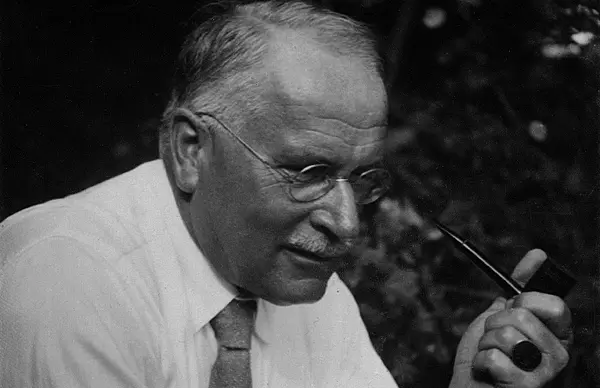
by Stefan Stenudd |
 Archetypes of Mythology
 Psychoanalysis of Mythology
Although Jung emphasized the myths as stories, a series of related events from a beginning to an end, he showed no interest in the satisfaction of relief that Aristotle called catharsis, a mental or emotional cleansing appearing in the audience after a good drama.
I have not found any text in which Jung discusses the term in relation to the Aristotelean meaning. His only use of the word is in reference to psychotherapy, as an early method of "putting the patient, with or without hypnotic aid, in touch with the hinterland of his mind."[2]
The goal of the treatment is the release of suppressed emotions.
Jung did point out the emotional attraction of those mythical stories, but explained it as a resonance from within the human mind, an inner recognition of the hidden truth those stories contained.
In that way, the myths served as inspiration. The hidden truth was a number of keys to self-realization, and the inspiration was one of getting people started on that path.
Myth is the primordial language natural to these psychic processes, and no intellectual formulation comes anywhere near the richness and expressiveness of mythical imagery. Such processes are concerned with the primordial images, and these are best and most succinctly reproduced by figurative language.[3]
The most obvious example is that of the hero myth, where the hero's struggle to overcome his fear and other obstacles to reach his goal, serves as an instigation for every person to do the same — get free of inhibition, and find the courage to pursue the path that leads to the realization of one's own potential. That makes the myth a kind of self-therapeutic manual, and the final outcome for the successful use of it is an enlightened mind, someone who truly knows himself.
This self-realization is what Jung calls the individuation process. It mainly consists of joining the unconscious with the conscious, by having the knowledge of the former rise to the latter. When man is completely aware of his unconscious and what is stored therein, especially in the collective unconscious, he has reached self-realization.
Jung's theories have certainly been applied to the study of myth — abundantly so. But not in their entirety. The collective unconscious and the process towards self-realization are psychoanalytical components with little meaning to historians of religion or anthropologists, and dreadfully difficult to work with when examining mythological material. The archetypes, on the other hand, have flourished in interpretations of myths.
Joseph Campbell, Mircea Eliade, and others have not exactly adapted the Jungian archetypes as such, although several of those scholars of mythology admit to their existence and importance, but they have used the idea of extracting symbolic elements from the myths, and comparing these across cultural borders.
Myths do have lots of similarities, no matter what culture or time they stem from, and these similarities can easily be described in a manner approaching that of the Jungian archetypes. There are certain character types appearing and reappearing in countless myths — such as the hero, the sage, the god, and the child — often with recognizably similar character traits. Also, significant ingredients that are neither human nor anthropomorphic seem to pop up and look just about the same in myths without any cultural connection — such as the flood, the journey, and certainly life as well as death.
Of course, this can easily be explained by the existence of these phenomena in any human life, wherever it is lived, but that is also one of the points Jung makes — the universality of those symbols. If they were not universal human experiences, they would not be archetypes.
Then the question is, are they symbols carrying additional meaning, or are they just heroes, sages, floods, journeys, and so forth? I have not found that Jung gives any method of proving the one or the other, nor have I seen it done by any other writer on myth.
It is understandable, since this is not easily accomplished. If myths are stories of no other meaning than to entertain and excite, they would still need to contain elements of what people have vivid ideas about. Otherwise, they could not make any sense at all.
So, how to prove that a myth is more than just a story?
Historians of religion, anthropologists, and other scholars point to how myths are used. Some of the myths, those dealing with creation in particular, are acted out in ritualistic ways, and integrated into a religious apparatus. These myths are definitely regarded as more than just stories, by the people keeping them alive.
It should be noted that myths of the highest significance to Jung, those of the hero, are normally not treated that reverently in the cultures where they belong. This might imply an anomaly in Jung's paradigm.
If he is correct about the archetypes and the function of individuation, would not the myth that is the most accurate portrayal of this be worshipped and cherished the most?
Even in the mythological tradition closest to Jung himself — that of the Old and New Testament — the hero marching triumphantly towards his self-fulfillment is much harder to find than figures of a less triumphant fate.
In Genesis I, God creates the world in six days, and upon completion he does nothing more spectacular than take a rest — as if that quest was just a regular week's work. Adam does the very opposite of rising to self-realization, when spending a long life in misery after being expelled from Eden. It was actually knowledge — that of good and bad — getting him expelled. Jesus has a few years of increased success, only to be painfully executed at the end, complaining that his god has forsaken him, and his glorious return is yet to happen after two thousand years.
Most of the other characters in the stories of the Bible also struggle with misfortune and a god hard to please. It is not often that they end their days in any kind of bliss.
The same is true for many myths around the world. Hardships and tragic endings are to be found everywhere — even for heroes. The ancient epic of Gilgamesh has its hero go through all kinds of ordeals, even in the underworld, only to find that life is a tragedy with no hope of a happy ending. The formidable hero Achilles meets his end in a humiliating way when an arrow pierces his heel. Again, the lesson is far from cheerful.
There sure are hero tales that end happily, but it is questionable if they are the ones making the deepest imprints in our souls. It seems we cherish the tales of those who suffer more than the ones that end in triumph. Actually, most myths are closer to tragedy than to any kind of success story. If that is indeed what our collective unconscious has to teach us, then there is reason to despair.
Furthermore, death is regarded with awe in most cultures and myths. Also, the dead are feared in many cultures, which regard them as malcontent and malevolent. The pie in the sky when you die is offered to few others than the Christians. And the religion most connected to the idea of incarnation, Buddhism, preaches that this is a rotation one should do the utmost to end, by utterly and finally disappearing.
Upon examination, the myths really don't say much more than that life is tough and then you die — something of which our conscious minds are already quite aware.
Jung's interpretation of myth and its meaning is rather utopian, almost like a salvation doctrine for the modern man. It may be possible to extract something that positive from at least some of the old myths, but it is quite another thing to regard it as the standard.
Other writers on myth have found the need to limit the application of Jung to using the idea of the archetypes as a means of sorting and classifying them, to some extent also in pointing out archetypal elements in the meaning extant before Jung — that of type-characters and type-events. Even when they repeatedly refer to Jung in pointing out archetypes, what they actually do is much nearer to just finding the recognizable components of a story. That is just about the opposite of cryptic symbols from a hidden unconscious.
These components represent basic concepts or characters with the specific quality of being immediately recognized as such by any audience. The types used in myth and drama are not echoes of patterns in the depths of our minds that we react to without understanding why. They are standard ingredients that our conscious minds understand and relate to immediately. They are not mysterious, but evident.
The universality that Jung demands of myths and their components is precisely what makes applying his theory halt. That which is universal is immediately recognizable by all, otherwise it would not be universal, and therefore it cannot contain anything that is hidden from the conscious mind. We react to those universal elements of myths and other stories, because we recognize them and can relate to them. If not, they would leave us indifferent.
Yet, there is truth in the strange and complex attraction some of the Jung archetypes emit. They do ring a bell, deep in our minds. We need to ponder what in the myths makes them so fascinating to us, and what — if anything — they may tell us with those stories that we just can't let go.
Most definitely, there are universal truths about the human being to be found in such an exploration. I do not think that this truth only can be found in the stories we call myths, but they are a good place to start.
And, again, they are all accessible to the conscious mind or they would be of no significance to us.
Personal Myth
Although both Freud and Jung made their major contributions in the field of individual psychology, they have jumped to conclusion in assuming a collective psyche — the former in his idea of the archaic heritage, the latter in the concept of the collective unconscious and its archetypes.They both admit to having little proof for those assumptions, mainly referring to impressions from patients they have treated. In therapy sessions, several patients have revealed concepts and images that neither Freud nor Jung could imagine to have come out of personal experience. Thereby, in spite of their specialty, they actually underestimated the complexity of the human psyche.
The human mind is quite able to absorb a multitude of impressions from its surroundings — even unawares — and make its very personal stew of it all, one that it can itself fail to interpret or at all understand. We do not need to have first hand experience of everything we load into our minds, but fill it also with hearsay, things implied, misunderstandings, rumors, vague impressions, and whatnot. The brain's input is so vast that there is simply no way of saying what it cannot have amassed.
And it starts long before we are able to talk, some of it even before we are born. There is fetal perception, especially that of hearing, so that the fetus learns to identify different voices.[4]
Freud and Jung took support for their theories in the fact that they received complex, seemingly mythological images also from children. Well, those children were obviously able to talk about these things, or they would not have been understandably transmitted — and by the time you have learned to talk, you have learned a lot of other things as well.
It is also odd that the two pioneers of psychological dream interpretation neglected the possibility of personal dreams mixing with social awareness, and finding a collective frame of reference in which to translate them. This is what every artist does — inner fantasies are translated to a form conceivable to other people.
A writer needs to do this when putting a story into words, since words are instruments for communication between people. The mere writing down of a story, then, equals translating it to a socially understandable form. Painters do something similar when reproducing an inner image with the tools of brush and colors, musicians with their instruments, and dancers with their body movements. If inner images are at all to be presented to the outside world, they have to be transformed and adapted to it. The very process of bringing them out from the individual mind for others to perceive is a process of translation.
Dreams are pure dreams only as long as they are not retold in any way. When they are, they become interpretations of dreams, representations of them, but not dreams at all. So, what is true for the artist is true for the dreamer — if those images, impressions, and sentiments are at all to be presented, they have to adapt to socially understandable forms. If not, the conscious mind would simply be unable to transmit them.
In the translation of inner images to the outside world, concepts familiar to the latter are bound to be used. What cannot be translated into such a concept is simply not presented. It either leaves a gap, or it is ignored, or it is substituted by something socially recognizable.
We all know it. When did anyone of us manage to present a dream exactly as we experienced it? So, instead of the dream there is a combination of elements familiar to all, or at least to most of us. Anything else, the social forms of communication do not have tools for. There is no word for something that people are unable to recognize.
We are approaching Wittgenstein's theory of language-game (Sprachspiel), which states that the meanings of words depend on the context in which they are uttered — even if the basic understanding of those words is shared by all, and that is rarely the case.[5] When one person tells a story to another, it is done by words representing familiar concepts, but it is very difficult indeed to ascertain that the concepts are identical for the narrator and the listener. This is certainly true for all the concepts that Jung calls archetypes — such as mother, god, fool, child, journey, and so forth.
The same confusion is likely to take place within a person's imagination. The social concept of the mother corresponds to a multitude of images in one's mind — the countless impressions of each person's own mother, as well as those of other mothers, the mother one would like to have, the mother one dreads to have, and so on almost infinitely.
So, we have a mind that has the same difficulty both ways — translating the complex inner images into socially understandable concepts, and also interpreting such concepts when taking them in. In this cobweb, all kinds of generalized structures and symbolic forms are bound to appear. We have no need for an inherited storage of them. They are learned by each individual, step by step, much like the ability to walk. Every person creates their own set of archetypes and other tools of generalization. These tools are as sure to have much in common with the corresponding tools of other people, as they are to also differ significantly from them.
Take the image of the clown. Not so few people find it scary, although for most of us it is a character we associate with amusement and laughter. The difference may stem from childhood experiences or what impression Stephen King's horrific clown in It made, either through the novel or the screen versions. The same archetype is experienced in vastly different ways.
It is a pity that the two pioneers of penetrating the individual mind did not explore its ability to create its own universe of symbols, before yielding to a solution giving much less credit to it.
Each man has his own mythology, some of it similar to that of other people and some of it not, some of it rather constant through a lifetime because of its relevance to early personal experience and aspirations, and some of it evolving with the additional impressions received through the years. That personal mythology relates tightly to personal beliefs, as well as to personal anxieties and frustrations. It is the framework from which we as persons present ourselves and things of our imagination. Also, it is the framework to which we adapt impressions from outside. We utilize it in reading and writing, listening and talking, watching and showing.
Any myth or other story entering this personal framework of one's own mythology will transform to fit it. If such a fitting is impossible the person will reject the myth, or maybe alter their framework slightly to adapt to it, if rejection is not possible. If it is an easy fit, the person will cherish it as confirmation of the personal mythology. The bottom line is that any myth, no matter how universal, becomes utterly personal to each one who hears it.
In that way, myths as well as any other stories can be instruments towards self-realization. Probably, the myths that fascinate its audience the most are not the ones which easily fit into their personal mythologies, but the ones that seem to make a lot of sense in that framework and still have some anomalies, demanding the personal mythology to adapt.
Fascinating stories challenge the personal mythology slightly, so that the process of making them fit disturbs the mind somewhat, and then reforms it. Nice stories caress the mind, but good stories tickle and tease it.
Myths Are Stories
Myths are stories, often very good ones, and as such they have a certain power to affect and stimulate their audience. In that sense, they are not different from other stories. Any story can promote self-realization or be used to support ritual and tradition.Every story affects the minds of its audience, more or less. The human psyche is influenced by all it takes in, as well as all it does itself produce. When stories engage, the impression they make is deeper and lasts longer. For the audience, that is done from the outside inwards, which means the experience has to pass through their conscious minds. For the creator of the story, the process can be described as reversed — from the inside of the author's mind, through the translation of the conscious and then onto the audience. For both, it is a conscious process, in no need of the hidden activity of an unconscious.
Myths and their effects need primarily to be regarded and examined as consciously produced and consciously consumed stories, whatever themes and components they have. There is no mystery in that process.
The stories engaging the author as well as the audience are those that relate to their lives, their experiences, and needs. As discussed above, the basic emotional triggers are fears and longings, losses and gains. Any story must play on these opposites to get the attention of an audience.
The audience does not have to feel threatened or tempted. Their empathy will be evoked by watching characters in a story subjected to these things. We care when characters risk losing something or have a chance of gaining something. That is the first and foremost premise. If we humans lacked the ability of empathy there would be no stories.
So, every story needs to contain the threat of losing something and the hope of gaining something. Strictly speaking, it could be enough if there is just a threat of losing something, or just the hope of gaining something. But such a story would lack the excitement brought on by the polarity. No other gain than avoiding loss is just status quo, and so is no other loss than the opportunity to gain. It really just means that nothing significant has happened at the end of the story. The situation is just as it was in the beginning.
A good story needs to up the ante, as explained already by Aristotle in the 4th century BC, and demonstrated by the great Greek playwrights of the century before that. An engaging story approaches the extremes — the risk of losing everything versus the hope of gaining everything. That will keep an audience on its toes.
There is no need for an unconscious urge towards self-realization, not even for catharsis, the sense of relief after the story has ended. It is just how we are triggered, like the dog chasing a stick or the toddler staring at all the plates with food at the dinner table. When we hear of someone — fictive or real, stranger or family — being involved in, say, a car accident, we want to know how that person fared. If a pole-vault athlete rushes with his pole towards the bar way up high, we don't turn our eyes away before we see how the jump went.
That athlete could be anybody. If it is a world champion, a failed jump would be more of an excitement for the audience than if he succeeds as expected. If it is a total beginner, the opposite is true. For those two — as well as, to a lesser extent, for anyone in between — we would watch the jump to the end. That is the basic force of a story.
The story can be extended both backwards and forward. We can follow the jumper through years of training and ordeals before that jump, and we can see what happens to him afterwards, whether his jump was successful or not. But in order to get the audience's attention already in the beginning of the story, that particular jump must be indicated, as must the consequences of it be for the audience to remain after the jump.
The story can be extended quite a lot at both ends, by the use of all kinds of complications. But the general pattern is the same. As long as we want to see that jump, we remain attentive.
Of course, once we have seen it, the story cannot extend very long without the promise of something like a new jump, even more spectacular. If there is none ahead, the story might as well end shortly — and it will only keep us to the end if we feel it is imminent.
The Hamlet Story
Now, let us move from the pole-vault athlete to arguably the greatest play ever written, that of Shakespeare's Hamlet, Prince of Denmark, for comparison.Very early in the play it is evident what jump will come. The ghost of Hamlet's father informs him of having been poisoned by his own brother Claudius, who is now not only the new king but also the husband of Hamlet's mother, the widow of the assassinated king.[6] Hamlet has to avenge the murder of his father. Between royalties in a drama, it can only mean killing him.
That is quite a dramatic event to expect, so we can wait for it. And we do, through the long play of formidable monologues, dialogues, and intricate complications. We know the vengeance, the jump, will come. Otherwise, the play would not have survived its opening night.
The attraction of the play has little to do with the moral demand for Claudius to be punished, although that helps provoke the feelings of the audience. An injustice needs to be corrected, whereas a simple struggle for power would leave the audience indifferent. If Claudius had not killed Hamlet's father and Hamlet still wanted to kill him, it would be for gaining the crown. As the prince, he might feel entitled to it, but the audience would not approve.
That is at the bottom of the moral component in stories containing one, and most stories do. It enhances the empathy of the audience, which is precisely why a story needs a moral setting. It is not to promote moral values — although that is often claimed — but for the audience to be additionally engaged.
The main magnet of the play is the awaited vengeance, which must mean the death of Claudius to counterweigh that of Hamlet's father. It has been strongly indicated at the outset. Actually, it is so inevitable that we keep on watching the play in increased frustration over why it has not happened yet. Frustration is also an excitement. Why has Hamlet not killed Claudius yet? Why does it take him so long?
Moral dilemmas, existential perspectives, and other sophisticated additions may enrich the experience for the audience, also in contemplations after the play has ended. But they are little more than distractions, compared to the audience's expectation of the vengeance, the jump. There is no way the audience would be inspired to discuss such matters, if the traitorous king were still alive when the curtain fell. That would be an end in disappointment, which is a feeling we don't like to dwell on for long. And we certainly would not recommend others to see the play.
Regarding the characters of the play, few are really needed. Except for Hamlet and Claudius, who must be there at the moment of the jump for it to happen, any additional character is superfluous. They just serve the purpose of extending and complicating the drama — with one important exception.
In dramaturgy, all the way back to Aristotle and the playwrights he studied to reach his conclusions, the necessity of a protagonist and an antagonist has been pointed out. These are not necessarily the so-called hero and villain of the story. The protagonist is the one who needs to change in some way or do something beyond their normal abilities, whereas the antagonist is the one both triggering and hindering it. What the protagonist must do is exactly what the antagonist doesn't want, and the latter's actions to prevent it from happening make it ever more imperative for the former to succeed. It is a war of opposing needs.
The protagonist is not necessarily the main character of the story and the villain not necessarily the antagonist, though that is very common. But there is nothing common about Shakespeare.
Hamlet is indeed the main character of the play given his name, but we should not assume it means that he is the protagonist. And his uncle Claudius, the assassin king, is certainly the villain of the story, but is he the antagonist, forcing whoever is the protagonist to that which in cowboy movies is called the showdown, i.e., the jump?
Hamlet may be frustrated to the point of what Freud and Jung would call neurotic, but he is on a mission from the beginning to the end. He is set on avenging his father and does not deviate from that conviction for a moment. He just has trouble finding the proper opportunity for it. Killing a king is not to be taken lightly, even when the king is a villain of Claudius's caliber. When Hamlet finally does kill the king, it is done as swiftly as if blowing out a candle. He shows no hesitation or transformation. It is simply time, and he is quick to use it.
King Claudius is certainly a villain, comparable to the worst of them through the history of literature. His actions are focused on Hamlet, and they are confusingly inadequate until the showdown, when he poisons both the sword of Hamlet's dueling opponent and the cup from which he wants the prince to drink. A king of long-gone days would not have hesitated to be both quicker and more drastic when feeling threatened.
The most plausible explanation for the king's hesitancy is that he feels genuine fondness for Gertrude, his queen who is also the mother of Hamlet. That would make him reluctant to whisk away the inconvenient prince in a kingly manner, which would be to quickly have him killed, like his father. King Claudius obviously refrains from that, more or less, until the end of the play.
For Hamlet, too, his mother the queen is a complication. She has no awareness at all of Claudius's dreadful deed to his own brother. When Hamlet tries to imply it to her, she does not even comprehend. There is a moment in act III scene IV, where Hamlet confronts his mother about her inability to see King Claudius for what he is. Then the ghost of Hamlet's father suddenly appears and scolds him, demanding him to comfort the queen whom the ghost regards as innocent:
Do not forget: this visitation is but to whet thy almost blunted purpose. But, look, amazement on thy mother sits: O, step between her and her fighting soul: Conceit in weakest bodies strongest works: Speak to her, Hamlet.[7]
The ghost then appears no more in the play, which shows how significant this sudden reappearance is. The ghost of the dead king will not have Hamlet accuse and upset Gertrude. And his son complies.
It is all about the queen. Were it not for her love of her son, King Claudius would have killed Hamlet at his first sign of accusation. Were it not for her commitment to her new husband, Hamlet would have killed Claudius immediately after learning the truth from the ghost in the beginning of the play. Both Claudius and Hamlet hesitate for the queen's sake.
Queen Gertrude is the protagonist of the play. She is the one who has to come to a realization, a tremendously difficult one since it means she has to admit that she married the assassin of her former husband, the father of her son. It takes this whole play, the longest one Shakespeare wrote, to reach that conclusion. As soon as she does, when she accidentally drinks the poison intended for Hamlet, and calls it out to him, her son can kill the king and the play has arrived at its ending.
There would be no additional jump the audience would hang on to witness. This is enough. So, all of the principal characters die right there and then.
Contrary to his mother, Hamlet knows all along what has passed and what needs to be done. But he cannot force the queen to be convinced of the same. She has to find it out. That makes her the protagonist. Hamlet should be seen as the dramaturgical role of the hero. He already understands what his mother needs to figure out, and he is determined about what needs to be done. He is where the queen needs to be.
In her innocent ignorance, the queen is not able to live out the frustration that the situation calls for, so this task goes to Hamlet. Her frustration, instead, is the distress she feels about her son's increasingly odd behavior. He signals again and again that something is wrong, but she thinks that wrong is with him. Until her moment of realization, when tasting the poison of the cup: "No, no, the drink, the drink, — O my dear Hamlet, — the drink, the drink! I am poison'd."[8] At that moment she dies.
Hamlet is already dying from a poisonous wound, his combatant Laertes informs him. But he has time to finally take his revenge and kill the king. He does so by twice using the king's own potion — stabbing him with the poisoned blade and forcing some of the remaining poisoned drink down his throat. The last he says to him is "Follow my mother."
His greeting to his mother in the following speech is different: "Wretched queen, adieu!" Surely, he means wretched as unfortunate and pitiable, but he may also feel a touch of the word's derogatory connotation. The queen's slowness to learn has cost them both dearly.
It is possible to see, as many do, Hamlet as the protagonist, struggling to make himself avenge his dead father. His main obstacle is his mother. Finally, when she dies, Hamlet is able to overcome his hesitation and complete his task. But there are two problems with this way of understanding the drama.
One is that the death of his mother, then, would be a deus ex machina, a solution by divine interference — or more precisely, a chance occurrence, when she happens to drink the poison meant for Hamlet. Like Aristotle in his Poetics, Shakespeare was not fond of such solutions, and rightly so. It is a lousy way to end a play.
The second argument against Hamlet as a hesitant protagonist, is that he actually already did kill the king without hesitation midway through the play. Well, he thought that he did. In Act III, scene IV, he stabs Polonius hiding behind a tapestry, thinking it is King Claudius.[9] Although it turns out to be the wrong one dead, Hamlet has shown that he already has the resolution and ability. He just waits for the right moment.
Even earlier in the play, Hamlet sneaks up on the king with the intent of killing him. But he chooses not to, since the king is involved in solemn prayer, and Hamlet does not want to set the king's soul free at a moment when it shows unusual piety:
Now might I do it pat, now he is praying; and now I'll do't. And so he goes to heaven: And so am I revenged. That would be scann'd; a villain kills my father; and for that, I, his sole son, do this same villain send to heaven. O, this is hire and salary, not revenge.[10]
The king, unaware of Hamlet's presence, is indeed sincere in the struggle with his conscience. He finishes his lament famously: "My words fly up, my thoughts remain below: Words without thoughts never to heaven go."[11] So, he most definitely is the villain of the piece, but not an ice-cold psychopath unable of remorse. He does struggle with his guilt. Not that it stops him from using tricks and violence to keep what he has wrongly gotten, but it makes him human.
Is he the antagonist of the play? If Hamlet is the protagonist, then he surely is. Their battle, sometimes in the open and sometimes in the hidden, goes on all through the play. But if Queen Gertrude and not Hamlet is the protagonist — then the king is not much of an antagonist. He is occupied with Hamlet all through, and never once challenges the queen in any way.
For Gertrude, then, the antagonist is none other than Hamlet. He is the one confronting her repeatedly, insisting that she needs to open her eyes and face the truth. That is why the queen shouts to Hamlet, when realizing that she is poisoned. That is how she confesses to him that he was right all along.
For those three main characters of the play, the most convincing setting is with the queen as the protagonist and Hamlet the antagonist. But that is not the only dramaturgical possibility.
Another character in the play can be the protagonist. Not Horatio, Hamlet's friend and confidant, who has the role of his companion. But there is another, with a significant role to play all through, and coming to a spectacular realization at the end. It is Laertes, Hamlet's other foe whose father he killed, and the one willingly using the poisoned blade against him.
Right before he does so, he mumbles to himself: "And yet 'tis almost 'gainst my conscience."[12] This "almost" disappears at the moment he is wounded by his own poisonous blade: "I am justly kill'd with mine own treachery." And he is the one to reveal that the king is to blame. He repents with his dying breath:
Exchange forgiveness with me, noble Hamlet: Mine and my father's death come not upon thee, nor thine on me![13]
That is the progression of a protagonist. It would, of course, make Hamlet the antagonist, the one always challenging and enraging Laertes. Blaming Hamlet for the deaths of his sister Ophelia as well as his father, and not without cause, he has to overcome a lot of resistance within himself to realize the truth of the matter.
It is the trait of the master playwright Shakespeare at work. He knew and followed the dramaturgical principles of his ancient Greek colleagues and Aristotle, but did so in clever and mysterious ways.
Writing his play, he had no need of the hidden workings of unconscious archetypes. He consciously created the characters and made them interact as those characters would. The patterns to be found in this play and, I dare say, all the others, are dramaturgical. They are not cryptic clues from a collective unconscious, but simply calculated measures to make a drama excite and please an audience. It is all very conscious — the ingredients as well as their brilliant application.
The king is an archetypal figure of might and authority, but that does not mean Claudius should be interpreted as one. Shakespeare chose to make the stage one of a royal court in order to increase the gravity of the situation, and probably also to give the drama what today would be called extra bling, to please the audience.
It has always been a simple storytelling trick to make the characters additionally fancy, bringing a sense of importance to the characters and what they go through. Royalty is as high as you can go on the human scale. Mythological tales often use the only higher authorities imaginable, the gods, to create the same effect.
In Hamlet, the choice of royalties also simplifies how the death of a man automatically leads to his brother taking over his position, which is something the plot needs. The king is not there as an archetype forcing itself onto the play by the medium of an unknowing playwright. He is a piece of the puzzle for the playwright to make a functioning whole of the story.
Actually, also the roles of the protagonist and the antagonist are more or less arbitrary. They are not necessary as such in a story, and if present they do not need to follow the usual patterns. That is evident from the structure of Hamlet, where these roles are not that easy to find and define with certainty. They are just commonly used as ingredients in a story to move it forward in an exciting way. Other tricks may very well accomplish the same.
Stories Are Self-Explanatory
Aristotle states famously in his Poetics that the drama has to have a beginning, a middle, and an end. This denotes that something has to have changed significantly from beginning to end. If not, the audience will feel utterly cheated.Jung might have called that change a transformation, and why not? But in essence, it is just a change — in a character's mentality, in the prospects from then on, in what could have happened into what did happen. A change of whatever kind has to be there.
All the ingredient in a play — setting, events, and characters — primarily serve that purpose. A plot is simply a description of a change. That goes for myths as well as plays and other stories. It can be as subtle as a couple realizing that their love will last, which makes a huge difference from when they worried that it might not. Or it can be as bombastic as Armageddon. The change is the story.
Something I find disturbing with Jung's theories, and the reason for the above look at the structure of Hamlet, is that he supposed hidden mechanics and messages other than those of the author's conscious effort. While there may be such things, there is nothing in myths or other stories proving any of it. They are completely explainable and understandable without it.
So, Jung is doing the opposite of Ockham's razor. He introduces additional lines of explanation that are not called for. Even with stories that have obvious messages of moral or other kind, the idea of them stemming from a hidden collective unconscious is just not necessary to explain them.
For example, there is certainly a moral to the story of Genesis 3 of the Bible, where Adam and Eve are expelled from the Garden of Eden. They committed the original sin by eating of the forbidden fruit, and as punishment they are both made mortal and thrown out of that sweet garden. Countless myths about primordial times have similar themes to explain the world of hardship in which we live. There is nothing unconscious about it. The story makes perfect sense as a composition of a conscious mind.
This is also true for Jung's idea of the archetypes. Certainly, ingredients in the myths can be described as archetypes in the meaning of representing concepts or traits of a familiar kind. But there is no necessity of going beyond the principle of stock characters in dramaturgy — the easily recognizable figures of a story to get it going without too much explanation. Those characters, then, demand the conscious understanding of both the author and the audience. They would not work equally well if they depended on unconscious reactions, in which case they would still confuse.
Yahweh in the story about the forbidden fruit is the almighty god. That means disobeying him is sure to be revealed and result in a terrible punishment. Adam and Eve are the very first humans, which means that their fate will be the fate of all humankind thereafter. The story works because these premises are understood consciously by the audience.
The snake is a figure introducing temptation, a human weakness known by all to be the cause of so much suffering. Well, pleasure too, to be honest. It is a snake because that is often a poisonous animal, slithering silently, which makes it a threat to begin with. The story would not be as compelling if this rascal were, say, a fluffy white rabbit.
The fruit of which Adam and Eve have a bite, usually pictured as an apple although it is not specified in the Bible, is a medium by which the sin is committed. It is comparable to the magic potion of so many fairy tales. But again, it is not the emergence of an archetype with hidden origin and meaning. It is simply an instrument by which to move the action forward.
It is the pole-vault jump of this story. With those bites of the fruit catastrophe is bound to come. The fruit is a way of making it concrete, and the moment exact, to increase the excitement of the audience. It is the moment for us to shout "No!" as if believing our sentiment could somehow influence the actions of the characters. We know it will not, but still we are tempted to cry out.
Mythology as well as fairy tales and legends have myriads of similar stories. One single mistake and everybody suffers forever after. In Western society, for almost two thousand years, the Adam and Eve version has been the most famous of them. It could be called the archetype of such stories, although other versions preceded it. And the figures in it have come to be archetypes, much in Jung's sense — except for their place in the human mind. We are most definitely aware of them, and we know from where we got them. They are powerful symbols, but we all know why.
Jung made some interesting observations about the human use of symbols and the emotional response they trigger. But he jumped to conclusions about the nature of those things. He took them as evidence of his own claims about the structure of the psyche. They are not.
His whole theory complex was based on prejudice, which is hard to explain as something other than his urge to make his very own psychological doctrine and justifying it. He created a mythology, pretending it to be science. Instead of being so quick to conclude that the patterns he found in myths and other stories indicate an origin in a hidden collective unconscious storing ancient archetypes, he should at least have experimented with the idea that all those myths and stories were the ones creating and cementing the archetypes.
For thousands of years, we have been a storytelling species, and those stories have by time found a common mold, increasing their effect and memorability. It is definitely more likely that our long tradition of stories and their components have created the archetypes, than the other way around.
At the very least, there is no proof of the one explanation being more likely than the other. But really, Jung's model is harder to prove, since it calls for additional components not necessary in the alternative model. Stories do not need a collective unconscious of mysteriously charged archetypes to explain their structures and ingredients. The needs of the stories in themselves explain all that just fine.
The easily recognizable characters in most myths and stories can be called archetypes, in the meaning of being with us for quite long, but it would really suffice to call them types. That also allows us to include figures and symbols of later dates, since there are new types emerging in our culture over time.
The art of storytelling may follow ancient customs, but it is also innovative — or it would gradually lose its relevance to the audience. To both the writers and the audiences, stories are self-explanatory. All their components are accessible to conscious minds. They may be dependent on a more or less specified context, such as the time and society of their setting, but that is also something the conscious mind is equipped to grasp.
Jung's archetypes cannot encompass a specific context, since they are by definition archaic and unchanging. Nor can they explain the appearance of new types of archetypal dignity. That makes the concept inadequate for the explanation of myths and stories. They contain types, but not archetypes in the Jungian sense. There is in no story any need of the latter — except for in the story of Jung's own invention.
Granted, it is a good story, which is why it has attracted so many psychologists, mythologists, artists, and others. But a story it still is, and not a validated scientific theory. It stems from Jung's imagination instead of from facts assembled in his research. He seems to have hinted at it in the Prologue to his autobiography, which was published posthumously. There he explains:
I speak chiefly of inner experiences, amongst which I include my dreams and visions. These form the prima materia of my scientific work.[14]
As such, i.e., closer to fiction than to empirical science, his theories make much more sense. He created a world of "what if?" and it has proven to be inspiring, especially but not exclusively to other fiction.
The mysteries of it are intriguing, the symbols fascinating, and the perspective on the human mind thought-provoking. His conclusions may not be correct, but they are interesting. They have led artists to new motifs, and they have also triggered psychologists as well as mythologists to come up with innovative perspectives.
So, his dreams and visions certainly bore fruit. That is worthy of praise, even though many of his scientific claims are not.
Notes
- Carl G. Jung, "Archetypes of the Collective Unconscious" ("Uber die Archetypen des kollektiven Unbewussten," 1934), The Integration of the Personality, transl. Stanley Dell, London 1940, p. 54. ⟰
- Carl G. Jung, Modern Man in Search of a Soul, transl. W. S. Dell and Cary F. Baines, London 1933, pp. 40f. ⟰
- Carl G. Jung, "Introduction to the Religious and Psychological Problems of Alchemy" (originally from Psychologie und Alchemie, 1944), transl. R. F. C. Hull, Collected Works, volume 11, London 1968, p. 25. ⟰
- Ferris Jabr, "Study of Fetal Perception Takes Off," scientificamerican.com, 2015. ⟰
- Ludwig Wittgenstein, Philosophical Investigations, transl. G. E. M. Anscombe, New York 1953. ⟰
- The name of Hamlet's father is also Hamlet, which surely tickles the imagination of every psychoanalyst. ⟰
- William Shakespeare, Hamlet, edited by John Livingstone Lowes, New York 1914, p. 96. ⟰
- Ibid., p. 151. Act V, scene II. ⟰
- Ibid., p. 93. ⟰
- Ibid., p. 91. Act III, scene III. ⟰
- Ibid., p. 92. ⟰
- Ibid., p. 150. Act V, scene II. ⟰
- Ibid., p. 152. ⟰
- Jung & Jaffé 1965, p. 4. ⟰
Carl G. Jung on Myth and Religion
Introduction
A Theory Takes Form
The Blessing and Curse of Religion
The Elusive Unconscious
Archetypes Beyond Jung
Myth as Self-Realization
Jungians on Myth and Religion
Introduction
Carl G. Jung
Erich Neumann
Károly Kerényi
Joseph L. Henderson
Joseph Campbell
Mircea Eliade
Marie-Louise von Franz
Charles H. Long
James Hillman
Anthony Stevens
David Adams Leeming
Jordan B. Peterson
Literature
This text is an excerpt from my book Archetypes of Mythology: Jungian Theories on Myth and Religion Examined, from 2022. The excerpt was published on this website in February, 2026.
MYTH
Introduction
Creation Myths: Emergence and Meanings
Psychoanalysis of Myth: Freud and Jung
Jungian Theories on Myth and Religion
Freudian Theories on Myth and Religion
Archetypes of Mythology - the book
Psychoanalysis of Mythology - the book
Ideas and Learning
Cosmos of the Ancients
Life Energy Encyclopedia
On my Creation Myths website:
Creation Myths Around the World
The Logics of Myth
Theories through History about Myth and Fable
Genesis 1: The First Creation of the Bible
Enuma Elish, Babylonian Creation
The Paradox of Creation: Rig Veda 10:129
Xingu Creation
Archetypes in Myth
About Cookies
My Other Websites
CREATION MYTHS
Mythology in general and creation myths in particular.
TAOISM
The wisdom of Taoism and the Tao Te Ching, its ancient source.
LIFE ENERGY
An encyclopedia of life energy concepts around the world.
QI ENERGY EXERCISES
Qi (also spelled chi or ki) explained, with exercises to increase it.
I CHING
The ancient Chinese system of divination and free online reading.
TAROT
Tarot card meanings in divination and a free online spread.
ASTROLOGY
The complete horoscope chart and how to read it.
MY AMAZON PAGE
MY YOUTUBE AIKIDO
MY YOUTUBE ART
MY FACEBOOK
MY INSTAGRAM
STENUDD PÅ SVENSKA

Stefan Stenudd
About me
I'm a Swedish author of fiction and non-fiction books in both English and Swedish. I'm also an artist, a historian of ideas, and a 7 dan Aikikai Shihan aikido instructor. Click the header to read my full bio.