Carl G. Jung:
|
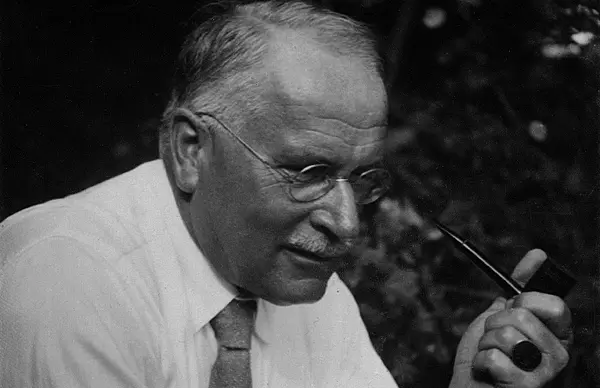
by Stefan Stenudd |
 Archetypes of Mythology
 Psychoanalysis of Mythology
Psychology of the Unconscious
The definite break between them came with Jung's 1912 book Wandlungen und Symbole der Libido, published in English in 1916 with the title Psychology of the Unconscious. In this book, Jung contradicted some of Freud's theories about the psyche, especially by giving less importance to sexuality as the root to just about all problems of the psyche.From then on, Jung was definitely on his own course, and there was no stopping his own theory of psychology from taking its form. As he says in the author's note of the book:
My task in this work has been to investigate an individual phantasy system, and in the doing of it problems of such magnitude have been uncovered, that my endeavor to grasp them in their entirety has necessarily meant only a superficial orientation toward those paths, the opening and exploration of which may possibly crown the work of future investigators with success.[1]
Of course, that future investigator was none other than Jung himself.
The Longing for Rebirth
In the book, Jung spends 560 pages discussing the dynamics between the conscious and the unconscious, and what they imply about the dilemmas of the human psyche. It is an extensive text. The end notes alone cover 76 pages.Jung bases his treatment of the subject on the "poetical unconsciously formed phantasies" of Miss Frank Miller, published in 1906 in Archives de Psychologie, with the title "Quelque faits d'imagination créatrice subconsciente."[2] In the following year it was translated into English by Miss Miller and published with the title "Some Instances of Subconscious Creative Imagination" in an American journal on parapsychology.
The theme of Miss Miller's text is what can be called a strong sense of empathy, "at certain moments, and for a few instants only, the impressions and feelings of another suggest themselves so vividly to me that they appear to be mine."[3] She goes on to describe dreams and fantasies that made lasting impressions on her, sometimes inspiring her to write poems in her sketchbook, and speculates about where she got the ideas to them.
She finds quite natural explanations — they are all fragments in her memory of past experiences, be that her own or from what she has read. She can even list those specific memories, and it comes as no surprise to her:
It is alleged that whatever enters into the mind is never completely lost, that the association of ideas, or a certain combination of circumstances suffices to bring back the faintest impression.[4]
That would make her experiences examples of cryptomnesia, forgotten memories reappearing and believed to be new thoughts. This was a phenomenon Jung had treated already in his first book On the Psychology and Pathology of So-Called Occult Phenomena, the dissertation from 1902, where he used it to explain odd instances with the young medium examined.
Regarding Miss Miller, though, Jung had a completely different take — in spite of her own conclusions.
It is puzzling that Jung would venture to analyze the thoughts and emotions of a woman he had never met, based only on a text of hers. Otherwise, he had numerous experiences of patients from his practice, and frequently referred to these in his writing. Although Miss Miller was a complete stranger, it did not stop him from making firm assumptions about her state of mind.
Not only that, but while his own patients remained anonymous when he wrote about them, this was not a discretion he granted Miss Miller, although his text explores her psyche intimately, to say the least. Jung simply assumed — wrongly — that she used a pseudonym.[5] The oddity of her male first name Frank might have convinced him of it.[6]
Analyzing Miss Miller's text with its dream-like fantasies, visions, and poetry, Jung traces a psychological process he regards as a basic human conflict — the unconscious libido urges versus the inhibitions of the conscious. In particular, he points out the human longing to return to childhood, thereby escaping decay and death:
But man wishes to remain a child too long; he would fain stop the turning of the wheel, which, rolling, bears along with it the years; man wishes to keep his childhood and eternal youth, rather than to die and suffer corruption in the grave.[7]
In the unconscious, this longing becomes an incestuous one directed at the mother, since she is the one who gave birth and therefore, she is also the one holding the key to rebirth. The incestuous urge is not sexual at its core, but symbolic. It represents the wish to return to the maternal uterus, of "coming into the mother once more in order to be born again."[8]
Still, it creates a reaction of denial — because incest, also in a symbolic form, is condemned by society since primeval times, "the original sin of incest weighs heavily for all time upon the human race."[9] The forbidden incest has had a tremendous impact on the evolution of the human mind:
It was only the power of the incest prohibition which created the self-conscious individual, who formerly had been thoughtlessly one with the tribe, and in this way alone did the idea of individual and final death become possible.[10]
Jung sees this dilemma as the root to just about every neurosis. The solution lies not in denying it, but in recognizing it and thereby growing out of it. The conscious needs to be aware of this longing in the unconscious and how it expresses itself. That is the process of the psyche growing up, which is necessary for its health.
This is all quite straightforward, and not that very far from Freud's idea of the Oedipus complex. But there are significant differences, and Jung points them out. He states clearly that he no longer can support Freud's view that every neurotic symptom is caused by oppressed sexuality. Jung even uses biology to oppose Freud's idea of the overall dominance of the sexual influence on the psyche:
Biology, as a science of objective experience, would have to reject unconditionally Freud's proposition, for, as we have made clear above, the function of reality can only be partly sexual; in another equally important part it is self-preservation.[11]
Not even when the unconscious expresses itself in sexual imagery is its content necessarily sexual: "The sexuality of the unconscious is not what it seems to be; it is merely a symbol."[12]
Instead, Jung sees the seemingly sexual expressions from the unconscious as symbols of the true urge — that of rebirth through the mother, which in turn is a confused expression of the longing to return to childhood and thereby avoiding or at least postponing death.
The unconscious uses images that are remnants from man's primitive past. They must be interpreted as representations of basic urges and not assumed to be only what they appear to be on the surface.
This is also how Jung's definition of libido deviates from that of Freud. About Freud's book from 1905 on sexual theory,[13] Jung says: "There the term libido is conceived by him in the original narrow sense of sexual impulse, sexual need." But since then, "a change has taken place in the libido conception; its field of application has been widened. An extremely clear example of this amplification is this present work."[14]
To Jung, libido is not a sexual urge, but urge and longing as such, the energy that drives us onward, much like many ancient ideas of a life force or a primus motor of the human mind. It is what makes us wish, whatever we wish for. Without it, we would complacently sit down and do nothing with our lives. We would be dormant.
Denying this urge can be very detrimental, but it is not a force without its own hazards:
The passionate longing, that is to say, the libido, has its two sides; it is power which beautifies everything, and which under other circumstances destroys everything.[15]
Humongous Excavation
Now, what takes Jung as much as 560 pages is that he sets out to prove his thesis by finding its pattern in numerous myths and legends, as well as in works of poetry and fiction.Among the latter he repeatedly turns to Goethe's Faust and the writings of Friedrich Nietzsche. As for the former, he uses many examples from Mithraism and Christianity, but also explores countless other mythologies from all over the world.
Jung spends several pages analyzing Hiawatha, which he calls "a poetical compilation of Indian myths."[16]
But The Song of Hiawatha by Henry Wadsworth Longfellow from 1855 is a very free compilation of Indian myths turned into a fictional story, ending with Hiawatha adopting Christianity. Speaking about visiting missionaries, he tells his tribe:
Listen to their words of wisdom,
Listen to the truth they tell you,
For the Master of Life has sent them
From the land of light and morning![17]
Then he leaves in his canoe for the land of the Hereafter. There was an historical figure named Hiawatha, but Longfellow's poem does in no way relate to him.
Jung sees mythology and the like as an age-old "phantastic form of thought — of the infantile in general," and explains:
From this type of thinking proceed all those numerous contacts with mythological products, and that which we consider as original and wholly individual creations are very often creations which are comparable with nothing but those of antiquity.[18]
Also, he is fond of utilizing etymology, comparing words and their meanings from different languages and eras. For example, this is what he has to say about the etymological context of the word libido:
libido or lubido (with libet, more ancient lubet), it pleases me, and libens or lubens = gladly, willingly. Sanskrit, lúbhyati = to experience violent longing, lôbhayati = excites longing, lubdha-h = eager, lôbha-h = longing, eagerness. Gothic = liufs, and Old High German liob = love. Moreover, in Gothic, lubains was represented as hope; and Old High German, lobôn = to praise, lob = commendation, praise, glory; Old Bulgarian, ljubiti = to love, ljuby = love; Lithuanian, liáupsinti = to praise.[19]
It is hard to see how this would clarify the concept.
Jung's excavation is humongous, if not to say manic. The book is almost impenetrable with its repeated detours around numerous examples from myth and poetry. And he allows himself great freedom in interpreting all kinds of elements as examples of the unconscious symbols of the human urge for rebirth. Often his explanations are far-fetched, indeed. Often, too, they seem contradictory.
Here is one example of his reasoning, when presenting a creation story from the Brihadaranyaka Upanishad, which he sees as representing the "transition of the sexual libido through the onanistic phase in the preparation of fire." He begins by quoting the text, and then follows his explanation of its meaning:
"In truth, he (Atman) was as large as a woman and a man, when they embrace each other. This, his own self, he divided into two parts, out of which husband and wife were formed. With her, he copulated; from this humanity sprang. She, however, pondered: 'How may he unite with me after he has created me from himself? Now I shall hide!' Then she became a cow; he, however, became a bull and mated with her. From that sprang the horned cattle. Then she became a mare; he, however, became a stallion; she became a she-ass; he, an ass, and mated with her. From these sprang the whole-hoofed animals. She became a goat; he became a buck; she became an ewe; he became a ram, and mated with her. Thus were created goats and sheep. Thus it happened that all that mates, even down to the ants, he created — then he perceived: 'Truly I myself am Creation, for I have created the whole world!' Thereupon he rubbed his hands (held before the mouth) so that he brought forth fire from his mouth, as from the mother womb, and from his hands."[20]
And here is Jung's interpretation of it:
We meet here a peculiar myth of creation which requires a psychologic interpretation. In the beginning the libido was undifferentiated and bisexual; this was followed by differentiation into a male and a female component. From then on man knows what he is. Now follows a gap in the coherence of the thought where belongs that very resistance which we have postulated above for the explanation of the urge for sublimation. Next follows the onanistic act of rubbing or boring (here finger-sucking) transferred from the sexual zone, from which proceeds the production of fire. The libido here leaves its characteristic manifestation as sexual function and regresses to the presexual stage, where, in conformity with the above explanation, it occupies one of the preliminary stages of sexuality, thereby producing, in the view expressed in the Upanishad, the first human art, and from there, as suggested by Kuhn's idea of the root "manth," perhaps the higher intellectual activity in general. This course of development is not strange to the psychiatrist, for it is a well-known psychopathological fact that onanism and excessive activity of phantasy are very closely related. (The sexualizing-autonomizing of the mind through autoerotism is so familiar a fact that examples of that are superfluous.)
Jung has found a myth that contains both an onanistic act of sorts and incest of sorts in the same initial sexual act. Atman copulates with himself in the form of a woman born out of himself. But this is easily explained in other words than those of Jung.
Several creation myths deal with the problem of how one sole initial being can give birth to others. Here he does so by splitting himself into two, who mate. Their first children are human beings, indicating their importance in this cosmogony.[21] Mankind is closest to this supreme deity by being the first ones created. Then the deity has to transform in order to give birth to the lesser creatures in the world, one species after the other. Without these transformations, the children would all be human. The story makes good sense without the psychological symbolism Jung suggests.
There is an Egyptian creation myth that Jung would surely have liked to include on this topic. Here speaks the creator Khepera (usually transliterated Khepri), who was all alone in the beginning. This is what he did to change that:
I, even I, had union with my clenched hand, I joined myself in an embrace with my shadow, I poured seed into my mouth, my own, I sent forth issue in the form of Shu, I sent forth moisture in the form of Tefnut.[22]
Like Atman, he had to find a way to multiply from an original state of solitude. Being the very creator god, Khepera could out of his own seed only create other gods. Human beings came later, created by his tears, a lesser fluid. Plants and animals appeared after that.
The Khepera and Atman myths present similar solutions to the primary problem of creation myths — how was the start, the very start? A sole primordial being is left no other choice than to impregnate itself, in one or other fashion.
One may wonder why it is usually a he instead of a she. If I am allowed to speculate, it is probably due to ancient misunderstanding of reproduction as an act of impregnation of the woman, where she was believed to be nothing more than a vessel for the fetus. Nothing was known of the egg needed. The man's seed alone was thought to be the carrier of new life.
In this very ambitious inventory of mythology and legends, Jung has most definitely been inspired by James George Frazer's The Golden Bough. He does not refer to it that many times in his book, but enough to make it clear that he is familiar with and impressed by it.
This multitude of examples was common in texts about mythology of that period, as the writers searched for universal patterns and explanations to the emergence of myths. So did Edward Burnett Tylor, Andrew Lang, and many others. They had to, because of their subject-matter being mythology. In Jung's text, dealing mainly with aspects of the human psyche, this vast quantity is less convincing. It is like he tries to drown any opposition to his theories by this flood of indicia, none of which is much proof on its own.
The pattern that this quantity forms is one of circular arguments: The myths are supposed to confirm Jung's theory about symbols from the unconscious, since they can be interpreted as such. But there are, of course, alternative interpretations of them.
That goes already for the text of Miss Miller, which is the recurring theme of Jung's book. She explains her visions as stemming from nothing fancier than old memories and past experiences, which would make them examples of cryptomnesia. But Jung discards those explanations, meaning instead that they emerged from the imagery of her unconscious — because they fit his interpretation of them.
That does not mean he must be wrong. But he is still to prove being right. The mere quantity of arguments does not suffice. And his constant unwillingness to try other modes of explanation hardly increases his credibility.
Dream, Chicken, and Egg
Jung starts his book by referring to Freud's The Interpretation of Dreams from 1899, and expanding on what dreams represent and contain. He states that "the dream images are to be understood symbolically," and "the dream arises from a part of the mind unknown to us, but none the less important, and is concerned with the desires for the approaching day." Although the dreams may seem contradictory and nonsensical, they rise from "psychologic material which yields a clear meaning."[23]He goes on to claim that dreams are symbolic for the purpose of not being understood by the dreamer, or specifically "in order that the wish, which is the source of the dream, may remain unknown."[24] It is to protect the conscious mind from what lurks in the unconscious, which would be very hard to face.
Not that these wishes are necessarily abominable in essence, but they may seem so because of the form they take — as is the case with the hidden incestuous urge discussed above. It is a mere representation of the longing for rebirth, which may be naïve, but not as deplorable as its representation.
It is interesting that Jung uses dreaming as an entry to the symbolic workings of the unconscious, and then traces similar symbolism in mythology. Such similarities are not hard to find, as has been pondered both before and after his book by writers on the topics of mythology and religion.
It would not be preposterous to claim that the fact that we dream and how we do it may be what caused us to come up with ideas of an invisible world and parallel realities of some obscure but utter significance. We dream about those who passed away, as if they are alive somewhere and come to visit our dreams. And dreams have their own absurd logic in how one thing leads to another, as if the laws of nature ceased to apply.
So, there may be another reality to find than the one our eyes see when we are awake. Dreams suggest, even insist, that there is more to life than what we perceive with our senses.
But Jung goes further, when he claims that the dreams as well as any material in the unconscious represent something fixed and definable. He gives one explanation to them, refusing alternatives. Maybe he takes it too far already by claiming that they can at all be explained in a rational way.
Furthermore, there is the problem of the chicken and the egg. Is the symbolic nature of the unconscious the source to such patterns in our dreams and in mythology, or can the mythology we have adapted influence how we think and how we perceive our dreams?
We have no trace of the human psyche and its expressions before the emergence of mythology, so we do not know for sure how that happened. But in every culture we can study, we see its mythology and other forms of belief influence the children increasingly by each year they live. Santa Claus is not an invention of each child's own imagination, and the same goes for just about every conceivable mythical narrative and symbol.
I doubt that there is any way to extract from a human mind what has to be a mythical symbol of its own unconscious origin. But it is not too complicated to suggest how any such symbol can have been ingested from the outside world — either from fellow humans or from conclusions through personal observations. Our ideas of the surreal and the unreal are shaped by what is real.
Miss Miller points this out with her matter-of-factly statements of what brought her visions. Maybe Jung would have been inclined to trust her explanations more if the two had actually met.
Our dreams say the same. They consist of material from our experiences when awake, though often twisted and strangely altered, and really nothing else. No hidden clues to our psychological needs, no synthesis of insights reached, no maze by which we can find our true selves. They are just dreams, a haphazard collage of what we have stored in our memories. Their meaning is something we invent in our conscious minds when we are awake.
The many similarities Jung finds between mythologies from all over the world, he wants to explain by their origin in identical unconscious urges we all share, as well as the symbols for them. To him, that is the simple truth about mythology:
We take mythologic symbols much too concretely and wonder at every step about the endless contradictions. These contradictions arise only because we constantly forget that in the realm of phantasy "feeling is all." Whenever we read, therefore, "his mother was a wicked sorcerer," the translation is as follows: The son is in love with her, namely, he is unable to detach his libido from the mother-imago; he therefore suffers from incestuous resistance.[25]
But there are so many other experiences common to people all over the world than incestuous urges, and human observations were even more homogenous in the distant past when mythologies emerged. The sun goes up and down, changing day to night. We are born, we grow and struggle to survive, until we inevitably die. We hunt and we are hunted, we use what we know and fear what we do not know, and so on. We have so much in common with people of other cultures and with our distant ancestors, it would be strange if our mythologies lacked similarities.
But there are also differences in the world we perceive around us, depending on where or when we live, just as there are distinct differences between mythologies. The differences of the latter are often readily explained by the differences of the former. Would the differences be just as easily explained by Jung's model? Hardly. He would need the added component of the outer influence of environment or events.
So, why would he not pursue that line of reasoning, to see how far it might take him? At least once, he should have tried to see if there is anything not explainable by outer influence and the conscious mind's response to it. Granted, that would have taken him quite some time and surely increased the number of pages of his book considerably.
Still, the search for patterns in mythologies and their symbolic imagery is a fruitful one. It has been done by all who researched mythology at any depth. It is also evident that mythologies can give clues to the nature of the human psyche and what needs they might aim to fulfill. The difficult question is what those clues are, and how they are to be interpreted.
The Theory before the Terminology
In his text, Jung does not use the terms later to be central in his theory: the collective unconscious, archetypes, and individuation. But what he describes definitely fits those concepts.He speaks of the unconscious containing material common to us all, expressing itself in symbolic tales of equally symbolic characters, which are "primitive figures of phantasies and religious myths streaming up from the unconscious."[26] But he speaks of the unconscious as a whole, not dividing it into a personal and a collective part. One time he mentions an "individual unconscious" as a retrogressive tendency overcoming the forward strife of the conscious, but does not explore the concept further.[27]
He describes a process of becoming aware of the conflict between unconscious urges and the conscious as a method of healing. And he presents symbolic types of utter significance, staying the same through history, but without using the word archetype. He does speak of a father-imago and a mother-imago, explaining in a note that he chooses "imago" instead of the expression "complex."[28] He makes no use of it for any other type than the parents.
The two types that stand out in the book are the mother and the hero. About the latter he states, "No man is or, indeed, ever was, a hero, for the hero is a god, and, therefore, impersonal and generally applicable to all."[29]
He speaks of "the abundance of ancient symbolic possibilities, latent in the human mind" stimulating it to create mythological figures, adding:
But the products always contain the same old problems of humanity, which rise again and again in new symbolic disguise from the shadowy world of the unconscious.[30]
He touches on individuation, but it seems not to be in the meaning he later gave the term. Here "the veil of 'individuation'" is the individual mask with which each person is equipped.[31] And in a footnote he has another definition:
The separation and differentiation from the mother, the "individuation" creates that transition of the subjective into the objective, that foundation of consciousness. Before this, man was one with the mother. That is to say, with the world as a whole.[32]
In this voluminous text from 1912, Jung clearly moves away from the psychology of Freud and explores in detail his own version of what forms and triggers the human mind. He is to stay on that course, though it takes him a number of years before deciding on a fixed terminology.
In 1952, forty years after Psychology of the Unconscious was published, Jung had edited the work thoroughly and released the new version as Symbole der Wandlung, which was published in English as Symbols of Transformation, in 1956.
Two Essays, Multiple Versions
At this point in searching Jung's development of his theories, it is necessary to have a look at the texts of his known as Two Essays on Analytical Psychology. They have their origin in the 1910s, at least partly, but it gets complicated because of the revisions they have gone through. That goes for most of Jung's texts — changes either by his own hand, by editors and translators, or both.The latest English version of the two essays is found in The Collected Works by C. G. Jung, volume 7, 2nd edition from 1966. It is an edited and expanded version of the 1st edition from 1953. They are based on two German essays, "Über die Psychologie des Unbewussten" originally published in 1917, and "Die Beziehungen zwischen dem Ich und dem Unbewussten" from 1928.
The English titles to the essays in the 1966 version are "On the Psychology of the Unconscious" and "The Relations between the Ego and the Unconscious." Before the publishing in The Collected Works, the essays were translated by H. G. and C. F. Baynes and published as Two Essays on Analytical Psychology in 1928, with slightly different titles.[33] The translator's preface mentions that there was an earlier publication of the essays (in 1917), and there have been substantial changes since then:
Of the first essay only the framework of its earlier form can be recognized, and so much new material has been added to the second essay that both works start afresh, so to speak, full of the amazing vitality of Jung's mind.[34]
As for the second essay, it was originally printed in the Archives de Psychologie, under the title "La structure de l'inconscient" in 1916. It is just 28 pages, whereas the 1928 version is 145 pages. By that time, it was yet to appear in German.[35]
An earlier book, the second edition from 1917 of Collected Papers on Analytical Psychology contains several texts, not just the two above-mentioned essays. The first one is translated by Dora Hecht, with the title "The Psychology of the Unconscious Processes." Jung explains in his foreword to this edition of the book that this part of it "has been fundamentally altered, and I have used the opportunity to incorporate an article that should describe the results of more recent researches."[36]
The first edition of Collected Papers on Analytical Psychology was published the year before, in 1916. The essay is just called "New Paths in Psychology" and contains merely 27 pages, whereas the 1917 edited version has swelled to 93 pages. That is a lot happening in but one year.
In his 1917 foreword to the essay Jung makes it clear why he was so anxious to edit the text substantially: "This essay was originally written in 1913, when I limited myself entirely to presenting an essential part of the psychological point of view inaugurated by Freud."[37] He stepped away from Freudian psychology and was well on the way to replace it with a Jungian one, although still somewhat modestly:
In this new edition some expositions about Freud's theories are shortened, whilst Adler's psychological views are more fully considered, and — so far as the scope of this paper permits — a general outline of my own views are given.
The second essay does not appear in the 1916 edition, but in 1917, with the title "The Conception of the Unconscious." Here it is 31 pages, since it is a translation of the original text in French. I have discussed the essay earlier, using this version of it. The 1966 translation in The Collected Works, based on a 1935 German version, is well over a hundred pages.
The differences between these versions are so substantial that they could, or even should, be regarded as completely separate texts.
Jung had a habit of so to speak recycling old texts. He edited and expanded them to be published again, often with a new title. That may be efficient, but it makes following his track through time utterly complicated and uncertain. He allowed himself to revise his earlier writing so that it would conform to his later views, making the appearance that he always thought the same. That is understandable, but misleading.
Strangely, the problem is the same with The Collected Works of C. G. Jung. This 20 volumes series is not chronological, but divided into themes. Also, the texts have been revised, often quite substantially. Before his death in 1961, Jung himself supervised that process. After his death, new revisions were made, based on manuscripts found on his estate.
For example, the editors have readily admitted to changing the terminology in older texts to make it conform to later practice. As for volume 7, containing the essays discussed here, the editors write: "The texts of the two main essays have also been revised, for consistency."[38] It is a strange practice.
There is no problem defending the established order of collecting the works of an author chronologically. As shown previously in this book, it certainly makes sense also with Jung's writing. To base the order on themes, on the other hand, is particularly questionable with the work of Jung.
Readers of his texts can easily see that he usually dealt with a lot of subjects, whatever the theme of the essay at hand might have been. He would touch on all components of his psychology, apply them to personal therapy as well as cultural phenomena, current events, and what-not. He was not the kind of author to stick to a specific subject-matter slavishly. On the contrary, his texts often give the impression of being random thoughts, with the subject at hand as little more than an excuse.
Of course, that largely has to do with his theories being of the kind that sees correlations just about everywhere. To him, everything was connected by archetypes, and the collective unconscious was never passive in the lives of men. So, how could he stick to a subject containing anything less than all?
Still, it makes the collection of his works based on themes an odd choice. It is hard to see as something else than the effort to create an illusion of order in the lifework of someone happily scouting through chaos.
Already finding Jung's work in books is a bit confusing, since his major writing was in the form or articles, essays, forewords, and the like. His texts rarely exceed, say, a hundred pages. Most of them were originally published in magazines, yearbooks, and anthologies with texts also by other writers.
That is yet another argument for collecting them chronologically instead of by theme. The combination of those essays from different times of his life into books, as if written consecutively with that purpose, is misleading.
Absolutes and Dominants
The first of the two essays, "The Psychology of the Unconscious Processes," represents a turning point in Jung's work and his boldness in proclaiming it. He had decisively left the path of Freud to walk his own way, never to look back.I use the 1917 version of the text. It is an edit and significant expansion (from 27 to 93 pages) of the 1916 version, which is a clear sign of Jung's commitment to his own theories, uncompromisingly, at this point. He had still found neither the final terminology nor the exact workings of the processes he described, but he had definitely decided that this was the path of his research. Although the structures of his psychology were somewhat incomplete, all the elements were there.
The book was published in a setting darkly clouded by World War I. Jung could not leave that uncommented, and his words are bitter. He writes in the foreword to this essay, dated March 1917, "This war has inexorably shown to the man of culture that he is still a barbarian."[39]
Later in the essay he calls the war "an epidemic of madness" and continues, "The several parties project their unconscious upon each other, hence the mad confusion of ideas in every head." He compares it to the legend of the Tower of Babel.[40]
The essay begins by going through the claims of existing psychological theories at the time, especially but not only those of Sigmund Freud. But let us focus on Jung's own theory of the collective unconscious, the archetypes, and how they are applied to mythology.
He does not yet use the terms consistently. The word archetype is never used in the essay. The collective unconscious is mentioned as such, but only in two of the chapters. In the chapter about the two sides of the unconscious he calls them the personal and the impersonal unconscious.[41] But about the latter Jung explains, "that is to say that it is collective."[42] It is quite something:
The collective unconscious is the sediment of all the experience of the universe of all time, and is also an image of the universe that has been in process of formation for untold ages.[43]
He also suggests the expression "absolute unconscious" for it, because it is absolutely universal.[44] This is actually the expression he uses most often for this concept. Another expression used for the same thing is "super-personal unconscious."[45]
Instead of archetypes, he uses "primordial images," giving praise to Jacob Burckhardt for coming up with the expression, and states that these "inherited potentialities of human imagination" have always been "potentially latent in the structure of the brain." Jung continues:
The fact of this inheritance also explains the otherwise incredible phenomenon, that the matter and themes of certain legends are met with all the world over in identical forms.[46]
Because these ancient and universal images are feelings as much as thoughts, Jung suggests they might also be called original thought-feelings.
Jung gives one example of a primordial image from primitive, so-called dynamistic religions — the idea of "some universal magical power upon which everything depends," which is what Tylor and Frazer termed animism. To Jung, this has nothing to do with souls or spirits, but rather "primitive energetics." The image has many manifestations:
This notion comprises the idea of soul, spirit, God, health, physical strength, fertility, magic power, influence, might, prestige, curative remedies, as well as certain states of mind which are characterised by the setting loose of affects.[47]
It is also the first rendering of the concept of god among primitive people, and there are many variations of it through history:
In the Old Testament this magic power is seen in the burning bush, and shines in the face of Moses. It is manifest in the Gospels as the outpouring of the Holy Spirit, as cloven tongues of fire from heaven. In Heraclitus it appears as universal energy, as "eternally living fire"; for the Persians it is the fiery brightness, haôma, divine mercy; for the Stoics it is heimarmene, the power of destiny. In mediæval legend it is seen as the aura, or the halo of the saint.
Jung also sees it in Buddhistic and other conceptions of metempsychosis (transmigration of souls). This wide-spread thought, then, has been "imprinted on the human brain for untold ages," ready to appear under certain conditions.
But the primordial images are far from only pleasant. They contain all sides of what we can be and what we have been through history, "also every deed of shame and devilry of which human beings have ever been capable."[48] Such images can be very detrimental to a person's psyche. They can lead to ideas of demons as well as gods. About the latter, Jung states:
The concept of God is simply a necessary psychological function of an irrational nature that has altogether no connection with the question of God's existence.
While we are on the subject: Jung also presents the concept of dominants of the super-personal unconscious, to which gods would definitely belong.[49] The dominants are particularly powerful figures emerging from the collective unconscious, such as the magician or the demon. Jung accredits them with "not human but mythological qualities." By mythological he means that they stem from the collective and not from the individual psyche.[50]
By these figures from the collective unconscious Jung obviously refers to what he later was to call archetypes. Their traits are the same. Their forms are easily, if not to say intuitively, associated with certain specific qualities, they emerge from the same place, and Jung treats them the same way in his therapy sessions with patients.
In this essay, he claims that the dominants usually make their appearance as projections on persons in the patient's immediate surrounding, by abnormal under- or over-valuations of them. Furthermore, "They also give rise to the formation of modern myths, that is, fantastic rumours, suspicions and prejudices."[51]
The dominant almost always encountered in psychoanalysis of projections is the magical demon, of which Jung says, "The picture of this demon is the lowest and most elementary concept of God."[52] But there are also images from an even more distant past:
The animal symbol specially refers to what is extra human, that is super-personal; for the contents of the absolute unconscious are not merely the residue of archaic human functions, but also the residue of functions of the animal ancestry of mankind.[53]
The personal struggle to overcome the projections of those dominants from the collective unconscious, Jung finds strikingly similar to the hero-myth. He goes on to describe the typical hero-myth in those terms: "The typical combat of the hero with the monster (the unconscious content) frequently takes place on the banks of some water; sometimes at a ford." In this battle, the hero is swallowed by the monster, but kills it by cutting off a valuable piece of the viscera, such as the heart, "that is, the valuable energy by which the unconscious was activated." The monster drifts ashore and the hero steps forth, "born anew through the transcendental function."
This enables the normal state to be restored, as the unconscious having been robbed of its energy no longer occupies a preponderating position. [54]
In a footnote, Jung points out that he has treated the parallels of hero-myths in great detail in The Psychology of the Unconscious from 1912, discussed here earlier.
In the conclusion at the end of the essay, Jung admits that his findings are likely to be questioned. He knows that their merit is still to be proven. But things that are not yet true may be true tomorrow. He regards himself as a pioneer and can handle scorn, because he is pleased with what he has done:
Our age is seeking a new spring of life. I found one and drank of it and the water tasted good. That is all that I can or want to say.[55]
Men, Women, and Races
In 1927, contributing to the symposium Mensch und Erde (Man and Earth), Jung wrote the essay "Die Erdbedingtheit der Psyche" ("The Earth Conditioning of the Psyche") on the subject of mind and earth, which was used for the title it got in the English translation published the following year.It is a strange text, where Jung intends to shed light on "the question of the conditioning of mind by the earth."[56]
In the text, he expresses his basic psychological principles with clarity and bold certainty. He states, "The whole of mythology could be taken as a kind of projection of the collective unconscious."[57] And he explains that "the unconscious, as the totality of all archetypes, is the deposit of all human experience back to its most remote beginnings."[58]
He sees archetypes as forms that the instincts have assumed, at the same time images and emotions, working as systems of preparedness, stemming from prehistoric irrational psychology.[59] And he presents a simple recipe for what constitutes an archetype:
I would like to suggest that every psychic reaction that is out of proportion to its exciting cause should be investigated as to whether it is not in part conditioned by an unconscious archetype.[60]
The problem for man's psyche is to adapt to these demands from deep within, especially since they are invisible to his conscious.
If consciousness had never split off from the unconscious — an event eternally repeated, and symbolized as the fall of the angels and the disobedience of the first parents — this problem would never have arisen, nor would there be a question of environmental adaption.[61]
He claims that there is a feminine archetype in man, and a masculine archetype in woman, which he has given the names anima and animus.[62] Then follow several pages of generalizations about the masculine, and even more so the feminine, also their respective archetypes. These descriptions are dated, to put it mildly.
For example, he calls self-mastery a typically masculine ideal, achieved by repressed feelings, while feeling is instead a feminine virtue. The anima in man balances this by bringing out feelings according to need: "As is well known it is just the most masculine men who inwardly are most subject to feminine feeling." The animus in women, though, does not make her feelings disappear, but she begins to discuss and rationalize. Yet, "these feminine arguments are illogical and unreasonable."[63]
Jung also claims that biological differences of the sexes include these behavioral patterns:
On the biological level woman's chief interest is to hold a man, whereas the interest of the man is to conquer a woman, and nature does not encourage him to stick to a conquest.[64]
That would make infidelity a male activity, which can indeed be discussed. To Jung, it also makes man "emphasize the legal and social aspects of marriage, whereas the woman sees it as an exclusively personal relation." That, too, is balanced by the anima and animus. But consciously, men and women are far apart:
Man, in his conscious activity, plans ahead and seeks to create the future, whereas it is specifically feminine to belabour the mind with such questions as, who was somebody's great great aunt.[65]
One must wonder what his conversations with women were like.
Even more disturbing is what follows about race, as he speaks about how European immigrants to America were unconsciously influenced by both the natives they conquered and the Africans they brought to be slaves. Describing that influence, he reveals an alarming prejudice, which he sadly shared with many in that time. He even refers to the absurd nonsense of measurements of the skull.[66]
Racial biology was still regarded as proper science at the universities and as legitimate cause for political decisions. So were ideas along the line of social Darwinism. In Jung's use, it is a warning example of how "the earth" influences people:
Certain Australian primitives assert that one cannot conquer foreign land, for in foreign soil live strange ancestor spirits, and therefore the strange spirits will inhabit the new-born. There is a great psychological truth in this. The strange land assimilates the conqueror.[67]
Strictly speaking, that would not be the land but its people. Furthermore, Jung neglects that he has also pointed out the influence of the African Americans, although they were moved to foreign soil, too. Not to mention the striking fact that in the 1920s, the influence of the European immigrants on both the other groups was even more obvious.
I mention this text of Jung because it shows how he, at the time of writing it, had become accustomed to the use of archetypes and the collective unconscious in the way he was to keep and propagate. It is obvious also in what playful delight he applied them.
As for his views on gender and race, one would hope he soon abandoned them.
Individuation, Alchemy, and Tao
In the 1930s Jung produces several texts devoted to his ideas of individuation, the archetypes, and the collective unconscious, no longer the least hesitant about the terms and their use. He seems to have reached his conviction in three steps. Establishing the idea of the collective unconscious, he found the archetypes to be its building blocks, and individuation its ultimate function.In 1934, his essay "A Study in the Process of Individuation" was published in German. The English translation appeared five years later.[68] He describes the case of a woman whom he guides through a step-by-step realization of what emerges from her collective unconscious and how to understand it. They do so by drawings of hers, which upon Jung's examination are found filled with mythical, archetypal ingredients of considerable age and spread across otherwise very different human cultures.
He elaborately compares the woman's imagery to alchemy, finding them to use identical symbols and describe an identical process — that of making gold as an allegory for personal development. The alchemist philosophers "understood by it a spiritual transmutation, or what we would today call a psychological transformation or readjustment."[69] This revelation was not just new to the woman, but also to Jung: "As a matter of fact, it was this very case that led me to the study of alchemy."[70]
He doesn't only compare the individuation process and its symbols to alchemy. He starts his text by quoting the 20th chapter of the Tao Te Ching, where its legendary author Lao Tzu ponders his isolation in being the only one to see clearly how the world really works. Lao Tzu ends the chapter by finding comfort in being nourished by the great mother, which is Tao, the Way.[71]
It is easy to see how Jung finds this illustrative of the individuation process, and how lost people are who have not commenced it. He goes on to quote the next chapter of the Tao Te Ching, which is about Tao as the origin of all, and its evasive nature. Jung regards this chapter as the answer to the questions contained in the previous one. It appears that Jung sees Tao as identical to the collective unconscious.
This is significant to Jung's reasoning, and an unsurprising consequence of his theories about the psyche's components. His definitions are so vague and wide that they can smoothly be applied to just about anything equally vague and wide. The devil, though, is in the detail.
Regarding the Tao Te Ching, the book as a whole does not at all point to an inner psychological entity, other than human misconception of the nature of the world, as described in chapter 20.
Lao Tzu presents a cosmology, the basic principle by which all of nature works and out of which it came to be. It describes what can be called a natural law.
If anything, the Tao concept relates to Einstein's dream of a unified field theory. Lao Tzu writes in chapter 25: "Man is ruled by Earth. Earth is ruled by Heaven. Heaven is ruled by the Way. The Way is ruled by itself."[72]
Lao Tzu would most likely have discarded the idea of a tumultuous and myth-laden unconscious undercurrent. His text is famously straightforward, not even bothering about things like gods and the afterlife. If people are confused, it is because their minds are misled by nonsense. The chapter right before the one with which Jung starts his essay states, "Behave simply and hold on to purity. Lessen selfishness and restrain desires. Abandon knowledge and your worries are over."[73]
Alchemy, on the other hand, does fit Jung's application more readily. That is of no surprise, since it is a European tradition consisting of philosophical and mythological materials that are deeply entwined in the history of Western culture.
But when he claims it to be closely comparable to Taoist alchemy in China, he is jumping to conclusions.[74] The Chinese version is by no means some self-realization process. It is simply a search for longevity, which was inspired by a misconception of another Tao Te Ching chapter.
The last line of chapter 33 was thought to say, "Those who die without perishing get longevity." Therefore, some Taoists started to experiment with potions supposed to have that effect. Heavy metals were used, so the potions had the opposite effect. Findings in the 1970s of Tao Te Ching manuscripts older than the ones known before, showed that the line actually reads, "Those who die without being forgotten get longevity."[75] Taoism is definitely no alchemy.
Jung's theories need to be applicable through time and across any borders, since they make statements about the nature of the human mind in general. But that remains to be proven. He did no such thing in his 1934 study of individuation. Claiming the words of Lao Tzu to support his case is twisting them beyond reason.
Archetypes in Transformation
The year after the above-mentioned essay, in 1935, Jung had another text in the same publication, Eranos, this time on archetypes of the collective unconscious, which was its title in the English translation, published in the same book as the previously discussed essay.In this text, he explores the archetypes in some depth, with several examples. He credits them with a lot. Every important idea and view have their historical antecedent:
They are all founded upon archetypal, primordial forms, whose sensuous nature dates from a time when consciousness did not yet think, but merely perceived.[76]
The archetypes are such primordial types. They surface from the collective unconscious to the conscious in myth, esoteric teaching, and fairy tale. But they also have their immediate manifestations by dreams and visions, which are "much more natural, less understandable or naiver than in the myth, for example. In this respect the fairy tale is, no doubt, much truer to nature."[77]
To Jung, myths are first and foremost psychic manifestations that represent the nature of the psyche. They have nothing to do with explanations of natural and other phenomena, for which the primitive mind of man in the past had little concern. Instead, "its unconscious psyche has an irresistible urge to assimilate all experience through the outer senses into inner, psychic happening."
It is not the mind trying to understand what is outside of it, but making the outside connect to man's inner life, or even copy it:
All the mythologized occurrences of nature, such as summer and winter, the phases of the moon, the rainy seasons, and so forth, are anything but allegories of these same objective experiences, nor are they to be understood as "explanations" of sunrise, sunset, and the rest of the natural phenomena. They are, rather, symbolic expressions for the inner and unconscious psychic drama that becomes accessible to human consciousness by way of projection — that is, mirrored in the events of nature.[78]
Esoteric teachings have the same inward focus. They "try to grasp the unseen happening of the psyche." That is true for primitive lore, and even more so for the world religions: "They contain what was originally the hidden knowledge of revelation and have set forth the secrets of the psyche in glorious images."[79]
Doing so, the religions drain the unconscious of its powerful imagery to substitute it by dogma: "Dogma advises us not to have an unconscious."[80] Jung regards Catholicism as most successful in this, baring the collective unconscious completely of its functions:
The whole life of the collective unconscious has been absorbed without remainder, so to speak, in the dogmatic archetypes, and flows like a well-controlled stream in the symbolism of ritual and of the church calendar.
He goes on to describe how Protestantism has failed to do the same, by gradually removing that powerful imagery. Sure enough, "the power of the church has gone with that loss of symbolism, too."[81]
Jung gives an example from his own childhood of this weakening of Protestantism, as it has been stripped of its esoteric components. His father, who was a priest, was giving him a confirmation lesson that he found utterly boring, except for the idea of the Trinity. But when they reached that particular subject, his father just said, "We will skip this section; I cannot make anything out of it myself."[82]
The bulk of his text is about a few patients struggling with this alienation from the collective unconscious, and the transformation processes they go through, by means of archetypes, to reestablish a connection to it — at least some understanding of its workings. That process is through dreams and fantasies, not myths, but they are filled with mythical figures and objects.
Jung uses these cases to present some of those archetypes in detail and explore their complexity. First and foremost in this exploration is anima, the female archetype in males. That automatically excludes woman from the analysis, and Jung's explanation for this is simply absurd: "But traditional symbolism is chiefly a product of the masculine psyche and is, therefore, not a suitable object of imitation for woman." He even has the audacity to add in Latin: "Exempla sunt otiosa!" (Examples are odious!)[83]
We are left with having to take his words for it. Well, we don't.
In addition to the anima, Jung also describes the workings of the archetypes the shadow and the old wise man. But the archetypes are not separate in the unconscious. Normally, the shadow is largely identical with the anima. Still, "the shadow, according to its definition, is the historically older human being."[84] It is the meeting with the shadow by which a transformation begins. Already at this stage, a person can get completely lost into the distant past and its ideals, i.e., the domain of the shadow:
For the shadow is a formidable thing. The harder and more disappointing are the conditions of life, and the more despondent consciousness becomes, so much the more grows the shadow, till the darkness at last is overpowering.[85]
As an example of this, Jung mentions France in the 11th century, tormented by famines and plagues, where disillusioned people invented the cult of Satan and the Black Mass. Jung states that "the attempt to escape to the metaphysical and spiritual was right, but the regression to the past and to the dark, opposite principle was wrong." This archetype is a dangerous one, but also a tremendous resource in a transformation:
Taking it in its deepest sense, the shadow is the invisible saurian tail that man still drags behind him. Carefully amputated, it becomes the serpent of healing of the mystery.[86]
So, the shadow seems to be the remainder in the collective unconscious of primeval man, perhaps even before he had become man.
The old wise man is a different kind of old. Here age is an indication of acquired wisdom. This archetype appears as the magician or the medicine man of primitive society. It is an enlightener and teaching master, who "penetrates the chaotic darkness of mere life with the light of meaning."[87]
By far the most complex of these archetypes is the anima. It plays shifting roles in Jung's process of transformation, being involved in just about all of it. Actually, it is always the a priori element in "moods, reactions, impulses and whatever else is spontaneous in psychic life." The anima is the major archetype in the male psyche, which "satisfactorily subsumes every pronouncement of the unconscious and of the primitive mind that gave form to language and religion."[88]
Jung finds the anima in the mythical nixie, a half-woman fish dragging men into the deep, also in the siren, the wood nymph, and succubus — all of them seductive but lethal to young men. The anima is "the serpent in the paradise of the harmless man with good resolutions and still better intentions." For the child, it lurks in the supremacy of the mother.[89]
In addition to archetypes with personalities, like the three mentioned above, there is another class that Jung calls the archetypes of transformation, because they appear in that process. They are "typical situations, places, ways, animals, plants, and so forth that symbolize the kind of change, whatever it is,"[90] and they can be as ambiguous as the personal ones. Their meaning is just as manifold.
By the end of his text, Jung lists a number of such archetypes of transformation, readily admitting that his rapid survey is far too brief. He sorts them according to what phase of the transformation process they tend to appear in.[91]
In the beginning they are mostly in animal form, such as a bird, horse, wolf, bull, lion, or serpent, which has a kinship in myth with the dragon. Also symbols like the cellar and cave, watery depths and the sea, fire, weapons, and instruments belong to this phase. They represent different aspects of this phase and of the person going through it.
To the phase Jung calls intermediate belong the frog, the hermaphrodite, the crossing, the dangerous passage, the transitus, corpse, tree, cross, hanging, soaring, and swimming.
To the last phase belong all the symbols of the self in its various aspects. Among them he mentions the cross with equal arms, the circle, the square, the fourfold opposed to the threefold in all possible forms, the flower, the wheel, star, egg, sun, and the child. He also mentions negative forms, presumably when the transformation is about to fail: the spider, the net, and the prison.
What Is Not an Archetype?
This listing is unusually generous. In most of his texts, Jung discussed archetypes one at a time, here and there, frequently stating that there are many more of them, but without making any effort to list them. No doubt, it would be a very long list, maybe even impossible to complete. And that is the main problem with Jung's theory.Neither in the text discussed here or other ones, as far as I have seen, does Jung define what an archetype is in such a way that it would be possible to state what is not an archetype. His description of the concept is so vague, and his examples so haphazard, his claim cannot be falsified. Anything could be an archetype — or not.
The only way to decide is to track if it plays a role in the psychological process of personal development. But that is circular reasoning. An archetype is an archetype if it can be described as one. Then, what cannot be described as one? Are there characters or objects that can never have an archetypal role? For example, how about a middle-aged woman or man, a zebra or hippopotamus, a kitchen, a spoon, a blade of grass, a promenade, parallel lines, and so on?
Furthermore, when is an old man an archetype and when is he simply an old man? The same question can be asked about every archetype Jung mentions. He gives no definition by which to decide.
Another weakness in his theory of the archetypes is his claim that they reside in the unconscious, and therefore they are uninfluenced by the conscious. But that, too, remains to be proven. Why can't they be symbols created and fostered by the conscious mind?
Looking at Jung's list, most — if not all — of the archetypes need no hidden unconscious design to get their significance. Our perception of snakes, spiders, dark cellars, lions, deep seas, weapons, the sun, and children, is full of significance already to the conscious mind, without any need for hidden amplifications. The hermaphrodite is an obvious symbol of an in-between stage, a child of both fragility and potential, a burning fire is an image of destruction and renewal, a serpent of danger, a crossing of options, a prison of confinement, of course, and so forth.
There is no need for an unconscious process to explain the symbolic meanings of such things. It is easily explained by our conscious perception and impressions we consciously share with each other. The burden of proof is on Jung. He must show how such symbolic meanings could not have appeared in the conscious mind alone. He does not.
Jung's perspective all through the essay is that of the psyche and experience of the individual, although he regards these things as common human conditions. He does not explore myths as such, but mentions their connection to the archetypes and their dynamics.
This continued to be his recurring focus in later works, but he turned increasing attention to how these processes of the psyche have created and formed myths and whole mythologies — if not all our perception of life and the world we live in. Even more so did his followers.
Notes
- Carl G. Jung, Psychology of the Unconscious: A Study of the Transformations and Symbolisms of the Libido, A Contribution to the History of the Evolution of Thought, transl. Beatrice M. Hinkle, New York 1916, p. xlvii. ⟰
- Ibid., p. 41. ⟰
- Miss Frank Miller, "Some Instances of Subconscious Creative Imagination", Journal of the American Society for Psychical Research, vol. 1 no. 6, New York 1907, pp. 293-308. ⟰
- Ibid., p. 307. ⟰
- In the foreword to the second German edition, 1924, Jung writes: "an unknown young American woman, pseudonymously known as Frank Miller." Collected Works of C. G. Jung, volume 5, 2nd edition, transl. R. F. C. Hull, Princeton 1976, p. xxviii. ⟰
- The facts in the case of Miss Miller have been examined in Sonu Shamdasani, "A woman called Frank," Spring: Journal of Archetype and Culture, volume 50 (1990), New York 1991, pp. 25-56. ⟰
- Jung, Psychology of the Unconscious, p. 434. ⟰
- Ibid., p. 251. ⟰
- Ibid., p. 63. ⟰
- Ibid., pp. 303f. ⟰
- Ibid., p. 459. ⟰
- Ibid., p. 433. ⟰
- Sigmund Freud, Drei Abhandlungen zur Sexualtheorie, 1905, translated into English 1910 by A. A. Brill as Three Contributions to the Sexual Theory. ⟰
- Jung, Psychology of the Unconscious, pp. 139f. ⟰
- Ibid., p. 116. ⟰
- Ibid., pp. 347ff. ⟰
- Henry Wadsworth Longfellow, The Song of Hiawatha, London 1855, p. 294. ⟰
- Jung, Psychology of the Unconscious, p. 159. ⟰
- Ibid., pp. 137f. ⟰
- Ibid., pp. 174f. In the original German text, Jung quoted from Paul Deussen, Die Geheimlehre des Veda, probably the 2nd ed., Leipzig 1907. ⟰
- Cosmogony, theory about the origin of the cosmos. ⟰
- E. A. Wallis Budge, The Gods of the Egyptians: Studies in Egyptian Mythology, volume 1, London 1904, pp. 310f. ⟰
- Jung, Psychology of the Unconscious, pp. 8f. ⟰
- Ibid., p. 12. ⟰
- Ibid., p. 249. ⟰
- Ibid., p. 456. ⟰
- Ibid., pp. 335f. ⟰
- Ibid., p. 492. ⟰
- Ibid., p. 379. ⟰
- Ibid., p. 391. ⟰
- Ibid., p. 433. ⟰
- Ibid., p. 554. ⟰
- "The Unconscious in the Normal and Pathological Mind" and "The Relation of the Ego to the Unconscious." ⟰
- Carl G. Jung, Two Essays on Analytical Psychology, transl. H. G. and C. F. Baynes, London 1928, p. v. ⟰
- Ibid., p. 125. ⟰
- Carl G. Jung, Collected Papers on Analytical Psychology, 2nd edition, London 1917, p. ix. ⟰
- Ibid., p. 352. ⟰
- "Editorial Note to the Second Edition", The Collected Works of C. G. Jung, volume 7, Princeton 1972. ⟰
- Carl G. Jung, "The Psychology of the Unconscious Processes", transl. Dora Hecht, Collected Papers on Analytical Psychology, 2nd edition, London 1917, p. 353. ⟰
- Ibid., p. 416. ⟰
- Ibid., p. 408. ⟰
- Ibid., p. 457. ⟰
- Ibid., p. 432. ⟰
- Ibid., p. 410. ⟰
- Ibid., p. 426. ⟰
- Ibid., p. 410. ⟰
- Ibid., p. 413. ⟰
- Ibid., p. 414. ⟰
- Ibid., p. 426. ⟰
- Ibid., p. 430. ⟰
- Ibid., pp. 432f. ⟰
- Ibid., pp. 433f. ⟰
- Ibid., p. 435. ⟰
- Ibid., p. 436. ⟰
- Ibid., p. 444. ⟰
- Carl G. Jung, "Mind and the Earth", Contributions to Analytical Psychology, transl. H. G and C. F. Baynes, London 1928, p. 100. ⟰
- Ibid., p. 111. ⟰
- Ibid., p. 116. ⟰
- Ibid., pp. 117f. ⟰
- Ibid., p. 120. ⟰
- Ibid., p. 117. ⟰
- Ibid., p. 127. ⟰
- Ibid., p. 130. ⟰
- Ibid., p. 131. ⟰
- Ibid., p. 133. ⟰
- Ibid., p. 136. ⟰
- Ibid., p. 139. ⟰
- The German title of his text was "Zur Empirie des Individuationsprozesses" and it was published in Eranos-Jahrbuch 1933, Zürich 1934. The English translation was published in New York 1939 and London 1940, in the book The Integration of the Personality, transl. Stanley Dell. ⟰
- Carl G. Jung, "A Study in the Process of Individuation", The Integration of the Personality, transl. Stanley Dell, London 1940, p. 49. ⟰
- Ibid., p. 51. ⟰
- Ibid., p. 30. ⟰
- Stefan Stenudd, Tao Te Ching: The Taoism of Lao Tzu Explained, Malmö 2015, p. 123. ⟰
- Ibid., p. 100. ⟰
- Jung, "A Study in the Process of Individuation", p. 50. ⟰
- Stenudd 2015, p. 150. ⟰
- Carl G. Jung, "Archetypes of the Collective Unconscious", The Integration of the Personality, transl. Stanley Dell, London 1940, p. 83. ⟰
- Ibid., p. 54. ⟰
- Ibid., pp. 54f. ⟰
- Ibid., p. 56. ⟰
- Ibid., p. 60. ⟰
- Ibid., p. 61. ⟰
- Ibid., p. 64. ⟰
- Ibid., p. 95. ⟰
- Ibid., p. 91. ⟰
- Ibid., p. 92. ⟰
- Ibid., p. 93. ⟰
- Ibid., p. 87. ⟰
- Ibid., p. 76. ⟰
- Ibid., pp. 73, 77, and 79. ⟰
- Ibid., 89. ⟰
- Ibid., pp. 93f. ⟰
Carl G. Jung on Myth and Religion
Introduction
A Theory Takes Form
The Blessing and Curse of Religion
The Elusive Unconscious
Archetypes Beyond Jung
Myth as Self-Realization
Jungians on Myth and Religion
Introduction
Carl G. Jung
Erich Neumann
Károly Kerényi
Joseph L. Henderson
Joseph Campbell
Mircea Eliade
Marie-Louise von Franz
Charles H. Long
James Hillman
Anthony Stevens
David Adams Leeming
Jordan B. Peterson
Literature
This text is an excerpt from my book Archetypes of Mythology: Jungian Theories on Myth and Religion Examined, from 2022. The excerpt was published on this website in February, 2026.
MYTH
Introduction
Creation Myths: Emergence and Meanings
Psychoanalysis of Myth: Freud and Jung
Jungian Theories on Myth and Religion
Freudian Theories on Myth and Religion
Archetypes of Mythology - the book
Psychoanalysis of Mythology - the book
Ideas and Learning
Cosmos of the Ancients
Life Energy Encyclopedia
On my Creation Myths website:
Creation Myths Around the World
The Logics of Myth
Theories through History about Myth and Fable
Genesis 1: The First Creation of the Bible
Enuma Elish, Babylonian Creation
The Paradox of Creation: Rig Veda 10:129
Xingu Creation
Archetypes in Myth
About Cookies
My Other Websites
CREATION MYTHS
Mythology in general and creation myths in particular.
TAOISM
The wisdom of Taoism and the Tao Te Ching, its ancient source.
LIFE ENERGY
An encyclopedia of life energy concepts around the world.
QI ENERGY EXERCISES
Qi (also spelled chi or ki) explained, with exercises to increase it.
I CHING
The ancient Chinese system of divination and free online reading.
TAROT
Tarot card meanings in divination and a free online spread.
ASTROLOGY
The complete horoscope chart and how to read it.
MY AMAZON PAGE
MY YOUTUBE AIKIDO
MY YOUTUBE ART
MY FACEBOOK
MY INSTAGRAM
STENUDD PÅ SVENSKA

Stefan Stenudd
About me
I'm a Swedish author of fiction and non-fiction books in both English and Swedish. I'm also an artist, a historian of ideas, and a 7 dan Aikikai Shihan aikido instructor. Click the header to read my full bio.