Tanto doriAikido knife defense techniquesSometimes on seminars I ask the students what they want me to teach, and mostly the answer is: "Tantodori!" It seems that defense techniques against knife attacks are not done enough in any dojo. Compared to the other aikido curriculum, I would also say that it's a particularly serious matter. I am not one to propagate aikido as only a self defense training. Such a goal is far too limited to keep my interest alive. But in the case of tantodori I believe we have to consider those aspects of it. Sadly, it can happen that the aikidoka is attacked by somebody armed with a knife, and then not to have some trustworthy basic training behind oneself may prove to be fatal.
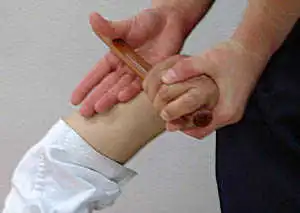
Still, unfortunately, the tantodori of aikido is mostly not very precise when it comes to the details of the techniques — I have seen some terrifying lack of precision and consideration in keiko, even among high grade teachers — and the functionality of what is being practiced can often be questioned. This is particularly true about the method with which the knife is taken away from the attacker.
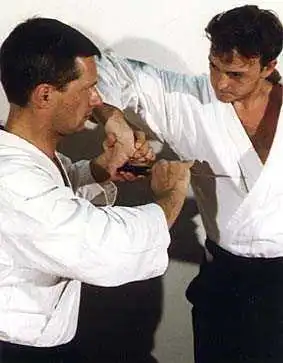 The photo above has raised some questions. It seems to be a very risky way of dealing with the sharp blade of a knife, when snapping it from the attacker. Maybe so. Nevertheless, I prefer this way for two reasons: One is that trying to get the knife by grabbing it inside the attacker's fist, risks getting so to speak "into the hands" of the attacker — going to where the attacker is strong. The other reason is that one has to understand, when attacked by a knife, that one should not primarily try to protect one's hands and arms, but one's body. It is exactly when people instinctively pull their hands back, to protect them from being cut, that the knife easily reaches the body. To avoid this, the hands must learn to risk being cut, to move in between the blade and one's own body.
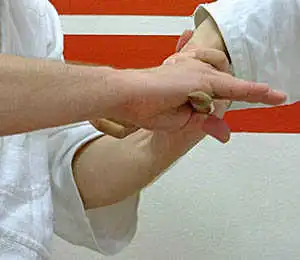 Please have a look at the few examples of tantodori techniques on the links below, and let me know what you think of them. Maybe you have better solutions? On the photos I only show the actual taking of the knife from the attacker, at the end of the aikido technique. On the video above, though, I show complete techniques. Certainly, there are other ways of doing the aikido techniques. I simply show how I do it. In addition to this video, I have also made some video clips of tantodori ikkyo, which can be found here: tantodori ikkyo There is a lot of repetition in the explanatory texts, for reasons of safety: what I regard as important instructions are included in every technique, when applicable, in case some readers do not go through them all. The photos were taken by Charlotte Wiström, with Anders Heinonen as uke, at the Enighet dojo. We used a wooden tanto, because I do not want to encourage people to practice with sharp steel knives, unless very aware of what they are doing. On the video above, on the other hand, a steel knife is used — for clarity.
Stefan Stenudd
TantodoriSankyo on tsukiSankyo on yokomen uchiShihonage on yokomen uchiShihonage on tsukiKotegaeshiIkkyo
AIKIDO PRACTICEIntroductionAikido Techniques — all the basic movesAttacks in Aikido
Tantodori — knife defenseAikiken — aikido sword techniquesJo 31 Kata in four directionsAikibatto sword and staff exercisesAiki — joining energiesKi exercisesAikido Video ClipsAikido PhotosMy aikido dojo in Malmö, SwedenMy aikido seminarsAIKIDO THEORYMy Aikido BioAikido GlossaryTanden, the CenterAikido InksAikido as Self-DefenseRunning a DojoAikido is TrueOsensei and EinsteinAikiWeb ColumnsAikido Books ReviewedDie deutsche Version meines Aikido-Buches onlineAikido på svenskaAbout CookiesMy Other WebsitesCREATION MYTHSMyths in general and myths of creation in particular.
TAOISMThe wisdom of Taoism and the Tao Te Ching, its ancient source.
LIFE ENERGYAn encyclopedia of life energy concepts around the world.
QI ENERGY EXERCISESQi (also spelled chi or ki) explained, with exercises to increase it.
I CHINGThe ancient Chinese system of divination and free online reading.
TAROTTarot card meanings in divination and a free online spread.
ASTROLOGYThe complete horoscope chart and how to read it.
MY AMAZON PAGE
MY YOUTUBE AIKIDO
MY YOUTUBE ART
MY FACEBOOK
MY INSTAGRAM
MY TWITTER
STENUDD PÅ SVENSKA
|
 Aikido Principles
 Attacks in Aikido
 Aikibatto