Osensei and Einstein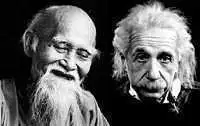 What the Aikido Founder and Physicist Have in CommonThe secret of Aikido, said Osensei, "is to harmonize ourselves with the movement of the universe and bring ourselves into accord with the universe itself." This is, of course, easier said than done. Still, I find Osensei's perspective to be rewarding in Aikido practice, as well as remarkably accurate even from a scientific viewpoint. For Aikido not to be but an execution of smart tricks to fell an opponent, or an ever so pleasant physical exercise where two persons push each other around (although this is in itself quite amusing), we have to concentrate on the mysterious visions that were Osensei's. Then we notice a sweet accord between the ideals of Aikido and the cosmic world order. In fact, the principles of Aikido fit very well with the modern astronomical theories.
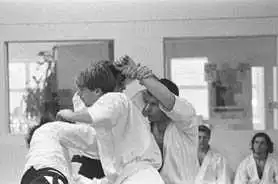 Taninzugake, several attackers, at Enighet dojo. Photo by Ulf Lundquist. In space, when two celestial bodies move close to one another, it's the force of gravity that governs them. Gravity makes the earth orbit around the sun, instead of taking off into the vast emptiness of space. When in the 1680s Isaac Newton was the first to calculate the laws of gravity, he described it as a force pulling the celestial bodies towards each other — not unlike when a wild horse is tamed by help of a rope around its neck, forcing it to run in circles instead of fleeing. Through its enormous mass, the sun could pull the earth into a continuously curved route, although the planet was aiming for a straight line. This unending power play, with the celestial giants in eternal conflict, was not particularly likable. In the beginning of our century, Albert Einstein introduced his theories of relativity, and changed this perspective completely. He showed that gravity was not a tug of war, but a curving of the very space-time continuum: when the earth orbits around the sun, it's all the time travelling on its own straight course — instead it is space itself that's curved around the sun. Therefore planet earth doesn't disappear into deep space, without the sun having to pull it. The orbit of the earth could be compared to the miniature Ferris-wheel for caged pet rodents, where they run and run, straight ahead, without getting anywhere at all.
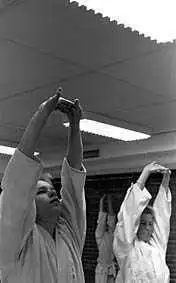 Aiki taiso, warmup, at Brandbergen Aikido dojo. Photo by Gunilla Welin. This may be utterly frustrating to celestial bodies and small pets alike, but it's undeniably a harmonious guiding star for Aikido practice. The uke should not be thrown by being forced out of his course, but through curving the space-time continuum, so that he feels as if the route he's being lead is exactly the route he had himself chosen. As this is the way of the cosmos itself, and everything within, it could not be too difficult to learn, could it?
Stefan Stenudd
AIKIDO PRACTICEIntroductionAikido Techniques — all the basic movesAttacks in Aikido
Tantodori — knife defenseAikiken — aikido sword techniquesJo 31 Kata in four directionsAikibatto sword and staff exercisesAiki — joining energiesKi exercisesAikido Video ClipsAikido PhotosMy aikido dojo in Malmö, SwedenMy aikido seminarsAIKIDO THEORYMy Aikido BioAikido GlossaryTanden, the CenterAikido InksAikido as Self-DefenseRunning a DojoAikido is TrueOsensei and EinsteinAikiWeb ColumnsAikido Books ReviewedDie deutsche Version meines Aikido-Buches onlineAikido på svenskaAbout CookiesMy Other WebsitesCREATION MYTHSMythology in general and creation myths in particular.
TAOISMThe wisdom of Taoism and the Tao Te Ching, its ancient source.
LIFE ENERGYAn encyclopedia of life energy concepts around the world.
QI ENERGY EXERCISESQi (also spelled chi or ki) explained, with exercises to increase it.
I CHINGThe ancient Chinese system of divination and free online reading.
TAROTTarot card meanings in divination and a free online spread.
ASTROLOGYThe complete horoscope chart and how to read it.
MY AMAZON PAGE
MY YOUTUBE AIKIDO
MY YOUTUBE ART
MY FACEBOOK
MY INSTAGRAM
STENUDD PÅ SVENSKA
|
 Aikido Principles
 Attacks in Aikido
 Aikibatto