Nikyo, "the second technique", is one of the basic pinning techniques of aikido. It contains a wrist twist that can be quite painful, if done with too much force. For regular training in the dojo, it is important not to overdo the nikyo, or members of the dojo will soon get their wrists damaged. To improve your nikyo, work on precision and sensitivity, instead of force.
In a way, nikyo can be compared to the sword technique kote, a strike to the opponent's wrist. In some applications of nikyo, this is more evident than in others. Still, thinking about the similarity to kote helps making the nikyo technique precise and effective.
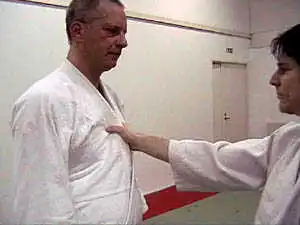
At the wrist twist of nikyo, you should have uke's hand firmly pressed on the soft area right below your collar bone, so that there is an angle between uke's hand and lower arm. This angle exposes and weakens the wrist. Uke's arm should be bent. If it is straight, you need to do hijikime osae (sometimes called rokkyo) instead.
When you apply pressure to uke's wrist, this should be done in the direction of uke's center. The more you pay attention to this, the more effective the nikyo will be. Apply the pressure in the exact direction of uke's center. Otherwise, the twisting of uke's wrist is much less distinct, and the control of uke much less certain.
Apply the pressure until uke has at least one knee on the floor, and is bending the body significantly. This is to avoid uke bouncing right up again, when you release the pressure and spin around to get to the pinning at the end.
On some attacks nikyo is particularly difficult to do. That is true for katadori, the shoulder grip, and munedori, the collar grip, because of the firmness of those grips, and the strength of uke's wrist in them. Therefore, I present both below. The third example below, shomenate, is included to show a relaxed way of doing nikyo, almost sort of playing with it. Notice that the little movie projector in each header is a link to a short video clip, where I show how I do the nikyo in question — several times on each video clip. Under the header is a YouTube embedding of the same video. Nikyo can be done both omote and ura, but it is the latter that is most common — and most tricky to do — so it's the only one shown here. Also, I exclude the actual pinning at the end, except for in the third video. Below each header are some of my views and pointers on it. I hope you find it of interest.
In the first two videos, the attacker is Nicklas Wikström from Shirakawa Aikido in Skellefteå. Behind the camera is Mathias Hultman from my dojo Enighet in Malmö, Sweden. The third video is from a seminar in the Czech Republic, filmed by Larry Kwolek. Uke is Gabriel Jurcak from Slovakia.
Katadori is the shoulder grip. Here, uke's hand has a firm position, making the wrist strong and resistant to any moving or bending. You need to turn uke's hand upside down, in order to do the nikyo, but that is not easy if uke has applied this grip firmly.
Don't try to turn uke's hand around, using only your hand. This is too weak, if you are not much stronger than uke. Instead, press your hand onto uke's, to fix it on your shoulder, and then turn your whole shoulder around. You should be able to see on the video what I mean. Make a circular turning move with your shoulder, so that uke's hand is turned upside down, because it is fixed on your shoulder.
Before this turning of my shoulder, I make sure to extend uke's arm, and also to bend uke's wrist, so that there is an angle between uke's hand and lower arm — although uke's grip on the shoulder remains. This I do with my taisabaki entrance step, and with the circular movements of my arms, as seen on the video. One arm moves toward uke's face, to distract uke and avoid additional attacks. The other arm strikes at uke's wrist, so that it bends. Uke's grip weakens when the arm is extended and the wrist is bent.
Notice that you need to make several taisabaki, evasive body movements. The first one is when you enter and extend uke's arm. The second one is when you move away, and turn your shoulder around in order to turn uke's hand upside down. The third is when you move to uke's side, in order to apply the nikyo pressure. The fourth is when you make the circular movement to get uke down on the floor for the pinning at the end. Each movement should get you out of the way of a possible strike from uke's free hand.
Munedori, the collar grip, is even more tricky than katadori, when you want to do nikyo. The reason is because that grip is even more firm, making uke's hand very difficult to move, and uke's wrist very difficult to bend. Also, it is at your body, so arm or shoulder movements are not enough.
My way of doing the technique is very similar to the one on katadori above, with the difference that now I have to make a circular movement with my whole body, instead of just my shoulder.
I make the same taisabaki entrance as in katadori, and the same circular movements with my arms, where one hand ends in front of uke's face to distract him, and the other extends uke's arm and makes his wrist bend. Then, I press uke's hand onto my chest to fix it, and make a big circular movement with my body, to be able to flip uke's hand upside down. This should be visible on the video clip.
Once you have flipped uke's hand around, you have a very strong position for the nikyo, so be careful not to hurt uke when you apply the nikyo pressure. The direction of the nikyo pressure should be toward uke's center, to be the most effective. Use your elbow, as seen on the video, to give additional power to the nikyo movement.
You don't need to release uke's grip to be able to do the pinning at the end (not shown on the video). Uke's arm is in such a position that you can do the seated pinning anyway. Actually, it is difficult for uke to let go of your collar, since the turning movements of the nikyo sort of wraps your collar around his hand. This is one more reason for being careful not to damage uke's wrist in this technique.
Check what is said about katadori above. Most of it applies also to munedori.
In this video I focus on a relaxed way of doing nikyo, using my body movement to apply the nikyo pressure. This way of doing nikyo is similar to what Yamaguchi sensei of Aikikai Hombu dojo used to do. I think that Endo sensei is doing something like this, too.
Be careful, because it is a much more powerful way of applying the nikyo pressure than it seems to be.
Instead of pressing uke's elbow down in the nikyo, you sort of squeeze his arm closer to you. You can see on the video what I mean. Sort of like a hug. You can also do it by simply bowing to uke, in the direction of his center. A combination of the two is the most effective, of course.
The attack used here is shomenate, a forward strike with an open hand, tegana style (hand sword). It is done rather slowly, for clarity, but the technique is the same if the attack is fast and strong. You do taisabaki to the outside of uke's arm, and lead the attack on forward, then downward into a circle, as you apply your nikyo grip. This leading of uke in a circle, is so that you have time to apply the nikyo grip.
Once you have the grip, and uke's hand is pressed to your body, right below the shoulder, you can immediately do the nikyo. It can be done quite fast, but be careful so that you don't hurt uke.
My Aikido Books
Click the images to see the books at Amazon (paid link).
Aikiken Sword Exercises for Aikido. The aikibatto exercises, practical and spiritual aspects of the sword arts, advice on equipment for training. More about the book here.
About me
I'm a Swedish author of fiction and non-fiction books in both English and Swedish. I'm also an artist, a historian of ideas, and a 7 dan Aikikai Shihan aikido instructor. Click the header to read my full bio.
 At each heading, click on this symbol to see that video clip.
 Aikido Principles
 Attacks in Aikido
 Aikibatto