Sankyo in Tantodori TsukiSankyo against several different tantodori attacks. Many more aikido videos on my YouTube Channel. The Aikido Technique Sankyo on Tsuki Knife AttackWhen taking the knife from the attacker in the sankyo technique, first make sure that you have applied a good sankyo grip on uke's knife hand, twisting it firmly, as shown in the picture above. In tantodori I recommend a stronger application of the sankyo wrist turn, than what is needed in regular aikido training. Uke's arm should be stretched in an arch, in such an angle that the elbow is pointing slightly forward, not backward, or uke would be able to pull the arm down. Your position should not be in front of uke, but to the side, where uke cannot reach you, neither with the free arm nor the feet — at least not easily. Also, keep your elbows low, both for additional strength in the sankyo grip, as your body supports it this way, and for protecting your own body. This position should be attentive. If uke tries, for example, a side kick, you can stop this move and make uke bend over by making a sword cutting move with your sankyo grip — or you could force uke to trip backward in a circle, by turning the wrist additionally toward uke. Watch the knife carefully — how it is held by uke and in what direction the edge of it is pointing. In the case of a tsuki attack the knife should normally be positioned as on these pictures, but it is not certain. If the attack had been done from a knife grip where the edge of it was initially upward, it would be in a reverse position here, and removing it would have to be done slightly differently from what is shown below. The knife here is single-edge, which is more easy to handle than a double edge one. This too must be carefully observed before taking it from uke.
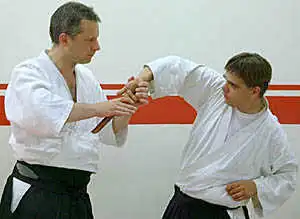 Now it is time to take the knife. Release your hand with the lower grip on uke's fist, and form it into a fork shape, like the letter U, as shown on the picture above. Do not bend your fingers, neither the thumb nor the others. This shape of the hand should be kept until the knife is safely removed from uke's grip.
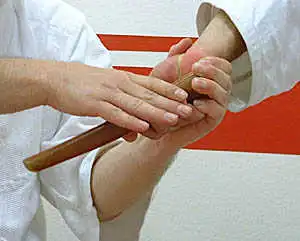 To avoid the knife falling out of your reach, pinch it a little at the base of your fork grip. If you do this already when you apply the fork hand to the knife, you will be sure to get hold of it whenever uke drops it.
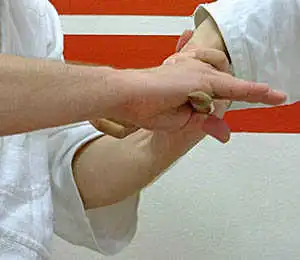 Press the knife up to a horizontal position, then move your hand in a semi-circle toward uke, allowing the backside of the knife blade to press against the bottom of the U, that is the area between the thumb and the index finger. The semi-circle should be done with uke's hand as the center — fixed at the same spot all through. It is very important not to let uke's arm or hand move, or uke may very well get a better grip on the knife.
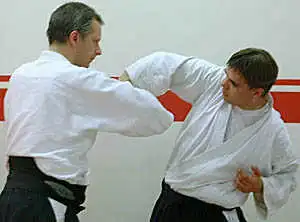 Never try to pull the knife away, before completing this semi-circle, even if uke's grip seems to be loosening. The knife will surely break free at the end of this movement, if not before. When doing the semi-circle, turn your whole body the same way, for additional strength and control in the movement.
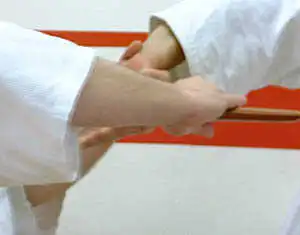 Apply a good grip on the knife, before moving away from your position or releasing uke's arm. This technique is almost identical to that of sankyo in the yokomen uchi attack, and so are therefore most of the instructions.
Stefan Stenudd
TantodoriSankyo on tsukiSankyo on yokomen uchiShihonage on yokomen uchiShihonage on tsukiKotegaeshiIkkyo
AIKIDO PRACTICEIntroductionAikido Techniques — all the basic movesAttacks in Aikido
Tantodori — knife defenseAikiken — aikido sword techniquesJo 31 Kata in four directionsAikibatto sword and staff exercisesAiki — joining energiesKi exercisesAikido Video ClipsAikido PhotosMy aikido dojo in Malmö, SwedenMy aikido seminarsAIKIDO THEORYMy Aikido BioAikido GlossaryTanden, the CenterAikido InksAikido as Self-DefenseRunning a DojoAikido is TrueOsensei and EinsteinAikiWeb ColumnsAikido Books ReviewedDie deutsche Version meines Aikido-Buches onlineAikido på svenskaAbout CookiesMy Other WebsitesCREATION MYTHSMyths in general and myths of creation in particular.
TAOISMThe wisdom of Taoism and the Tao Te Ching, its ancient source.
LIFE ENERGYAn encyclopedia of life energy concepts around the world.
QI ENERGY EXERCISESQi (also spelled chi or ki) explained, with exercises to increase it.
I CHINGThe ancient Chinese system of divination and free online reading.
TAROTTarot card meanings in divination and a free online spread.
ASTROLOGYThe complete horoscope chart and how to read it.
MY AMAZON PAGE
MY YOUTUBE AIKIDO
MY YOUTUBE ART
MY FACEBOOK
MY INSTAGRAM
STENUDD PÅ SVENSKA
|
 Aikido Principles
 Attacks in Aikido
 Aikibatto