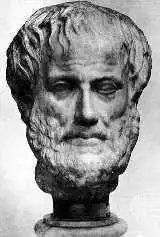
Aristotle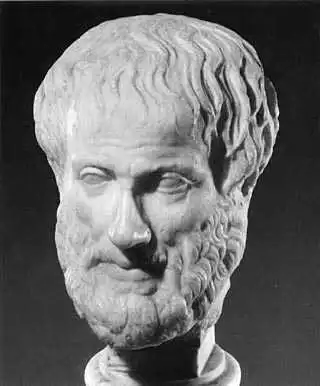 His Life, Cosmology, and PoeticsAristotle and His LegacyAristotle (384-322 BC) is one of the most famous and influential philosophers of Ancient Greece. The only other one with equal reputation is Plato, who was Aristotle's teacher. But their philosophies differ greatly.Aristotle is the father of cause and effect, leading their links all the way back to a first cause, a Primus Motor, which we are still to find. Aristotle also wrote the bible of narration and dramaturgy: The Poetics, still setting the rules for drama on stage as well as in the movies. The webpages below present Aristotle's life and work, his cosmology, and The Poetics.
It's almost impossible to overestimate the influence of Aristotle on human thought ever since the time of his own life in Ancient Greece. His basic principle of cause and effect is the rule also for science today, from cosmology down to particle physics — although discoveries within quantum physics seem to challenge it in parts. But Aristotle's importance extends over other fields of thought with the same lasting dominance. That goes for his ethics, his observations in biology, and his priniciples for the structure of drama and storytelling, just to mention a few fields in which Aristotle made the very foundation for all the following generations to start from. That was also true, though indirectly, during the more than one thousand years Aristotle's texts were lost to the Western world. In that long period, Aristotle's thoughts were only known through fragments, quotes, and comments in old texts by others. Not until the late Middle Ages were his texts recovered — from Arabia, where they had been carefully preserved. When they reached Europe, they spread like modern bestsellers and revolutionized human thought and science, to the extent that they played a significant part in sparking the Renaissance. There's another obstacle in regard to Aristotle's texts than the long time they spent in obscurity. They're not written in an immediately readable style. All the Aristotle texts we have are in the form of notes — whether by Aristotle himself in preparation for his teaching or by students in his classes is unknown to us. This comprised style of writing makes them very hard indeed to interpret and translate in a meaningful way, but it also makes them easily adaptable to each era of human civilization reexamining them. Because they need so much editing to be readable, they automatically become updated by each translation. On the other hand, that also makes it almost impossible to assert exactly what Aristotle actually had in mind.
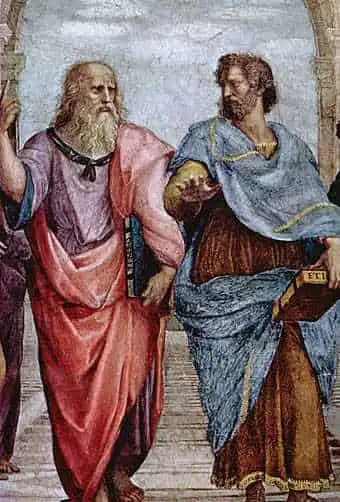 Plato and Aristotle. Detail from School of Athens, by Raphael.
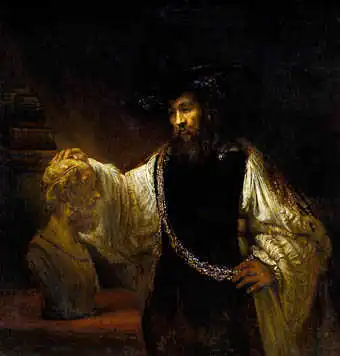 Aristotle with a bust of Homer, by Rembrandt 1653.
My text on Aristotle's Poetics presents the text and the principles for drama it contains. I've also written about the influence of The Poetics on drama and playwriting after the time of Aristotle. So far, I've only reached the Renaissance, but I hope to complete the history eventually. Click the header to read my texts on the Poetics of Aristotle.
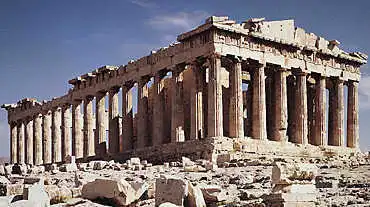 Parthenon in Athens.
AristotleIntroductionAristotle's LifeTimelineAristotle's PoeticsAristotle's Cosmology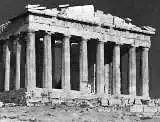
The Greek PhilosophersAbout CookiesMy Other WebsitesCREATION MYTHSMyths in general and myths of creation in particular.
TAOISMThe wisdom of Taoism and the Tao Te Ching, its ancient source.
LIFE ENERGYAn encyclopedia of life energy concepts around the world.
QI ENERGY EXERCISESQi (also spelled chi or ki) explained, with exercises to increase it.
I CHINGThe ancient Chinese system of divination and free online reading.
TAROTTarot card meanings in divination and a free online spread.
ASTROLOGYThe complete horoscope chart and how to read it.
MY AMAZON PAGE
MY YOUTUBE AIKIDO
MY YOUTUBE ART
MY FACEBOOK
MY INSTAGRAM
MY TWITTER
STENUDD PÅ SVENSKA
|
 Cosmos of the Ancients