Cosmos of the Ancients The Greek Philosophers on Myth and CosmologyPythagoras o Pythagoras (circa 582-500 BC) it seems the gods were both factual and worthy of reverence, if the later commentators are to be trusted. Of his own words nothing remains.
According to Hieronymus, Pythagoras had descended into Hades, where:
he saw the soul of Hesiod bound fast to a brazen pillar and gibbering, and the soul of Homer hung on a tree with serpents writhing about it, this being their punishment for what they had said about the gods.
Pythagoras' teaching was strict, full of rules to live by, some peculiar and some expressions of piety. He was secretive of his learning and demanded much of those who wanted to be his disciples, among other things a long waiting before being accepted. Not only did Pythagoras avoid meat, but for several reasons he refused beans, to the extent that he was reported to have died because of it — when fleeing from his enemies he stopped before a field of beans, not wanting to cross it, whereby they caught and killed him. 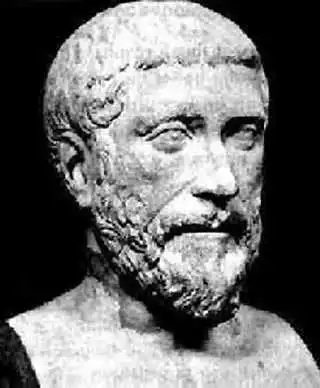
This wandering of the soul was not exclusive to man, nor was the soul itself. Pythagoras avoided meat and "forbade even the killing, let alone the eating, of animals which share with us the privilege of having a soul."
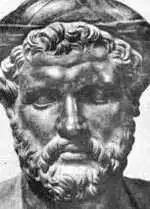
The principle of all things is the monad or unit; arising from this monad the undefined dyad or two serves as material substratum to the monad, which is cause; from the monad and the undefined dyad spring numbers; from numbers, points; from points, lines; from lines, plane figures; from plane figures, solid figures; from solid figures, sensible bodies, the elements of which are four, fire, water, earth and air; these elements interchange and turn into one another completely, and combine to produce a universe animate, intelligent, spherical, with the earth at its centre, the earth itself too being spherical and inhabited round about. There are also antipodes, and our 'down' is their 'up'. Such a strictly ordered universe has little room for gods and their adventurous ways of creating the world, as told by Hesiod. It seems therefore, though Pythagoras fondled mythological ingredients in his relation to himself and his calling, in his cosmology Pythagoras replaced them with principles of higher purity and precision, numbers and their relations rather than anthropomorphic creatures. The Pythagoreans, his followers, frequently used allegorical concepts for essential matters in their teachings, claiming this practice to stem directly from their founder Pythagoras, and if indeed their master did the same, mythology could to him have been nothing but a colorful way of expressing his meaning. Then the mathematical cosmogony of Pythagoras would rightly be categorized as an atheist one.
LiteratureDiogenes Laertius, Lives of Eminent Philosophers, translated by R. D. Hicks, volume II, Loeb, London 1950.Freeman, Kathleen, The Pre-Socratic Philosophers, Oxford 1946.
© Stefan Stenudd 2000
The Greek Philosophers
AristotleIntroductionAristotle's LifeTimelineAristotle's PoeticsAristotle's CosmologyAbout CookiesMy Other WebsitesCREATION MYTHSMythology in general and creation myths in particular.
TAOISMThe wisdom of Taoism and the Tao Te Ching, its ancient source.
LIFE ENERGYAn encyclopedia of life energy concepts around the world.
QI ENERGY EXERCISESQi (also spelled chi or ki) explained, with exercises to increase it.
I CHINGThe ancient Chinese system of divination and free online reading.
TAROTTarot card meanings in divination and a free online spread.
ASTROLOGYThe complete horoscope chart and how to read it.
MY AMAZON PAGE
MY YOUTUBE AIKIDO
MY YOUTUBE ART
MY FACEBOOK
MY INSTAGRAM
STENUDD PÅ SVENSKA
|
 Cosmos of the Ancients
 From Alexander's book Successions of Philosophers, Diogenes Laertius receives the mathematical cosmology of Pythagoras: