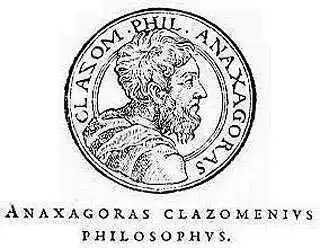
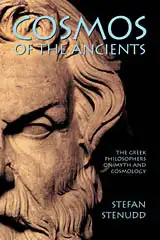
Cosmos of the Ancients The Greek Philosophers on Myth and CosmologyAnaxagoras naxagoras (500-428 BC) was a student of Anaximenes, and according to Diogenes Laertius: "the first who set mind above matter", quoting his — perchance only — book to begin: "All things were together; then came Mind and set them in order." Therefore, according to the same source, he was given the nickname Nous (mind).
No nickname could honor him more, since this Nous was to Anaxagoras a most elevated thing, like a god — and a monotheistic god at that. He saw the primordial world as one homogenous cluster, where everything in it was truly part of everything else, so that none was a separate, independent entity — except for Nous, reason, which was in no way part of that world: While other things have a share of everything, Nous is infinite, self-governing, and has been mixed with nothing, but is alone unto itself. Separated this way, it was able to rule the world, and to begin its process of differentiation and development, by means of a revolving movement, starting in a small area and expanding. By this, the world started breaking up in smaller parts, whereby the heavenly bodies were born, and warm separated from cold, bright from dark, dry from moist. In this revolving movement, some things were separated and others joined, and that is really all that takes place in the world: The Greeks do not employ (the words) 'coming to be' and 'perishing' correctly, for nothing comes into being or is even destroyed; rather, from (pre-) existing things there is combining and breaking up. They would, therefore, be correct to call coming-to-be 'combining' and perishing 'breaking up'.
The dense and the moist and the cold and the dark came together here where the earth is now; the rare and the warm and the dry (and the bright) moved outward into the far-off limits of the aither. On the microscopic perspective he stated that there is no thing which is the smallest, since there can always be something smaller and no matter how small a part is, it cannot be cut away to nothing. Anaxagoras was tried in court, probably for declaring that the sun was a mass of red-hot metal, larger than Peloponnesus, and expelled from Athens, where he had lived for 30 years.
LiteratureDiogenes Laertius, Lives of Eminent Philosophers, translated by R. D. Hicks, volume I, Loeb, London 1942.Sider, David, The Fragments of Anaxagoras, Beiträge zur Klassischen Philologie 118, Hain 1981.
© Stefan Stenudd 2000
The Greek Philosophers
AristotleIntroductionAristotle's LifeTimelineAristotle's PoeticsAristotle's CosmologyAbout CookiesMy Other WebsitesCREATION MYTHSMythology in general and creation myths in particular.
TAOISMThe wisdom of Taoism and the Tao Te Ching, its ancient source.
LIFE ENERGYAn encyclopedia of life energy concepts around the world.
QI ENERGY EXERCISESQi (also spelled chi or ki) explained, with exercises to increase it.
I CHINGThe ancient Chinese system of divination and free online reading.
TAROTTarot card meanings in divination and a free online spread.
ASTROLOGYThe complete horoscope chart and how to read it.
MY AMAZON PAGE
MY YOUTUBE AIKIDO
MY YOUTUBE ART
MY FACEBOOK
MY INSTAGRAM
STENUDD PÅ SVENSKA
|
 Cosmos of the Ancients