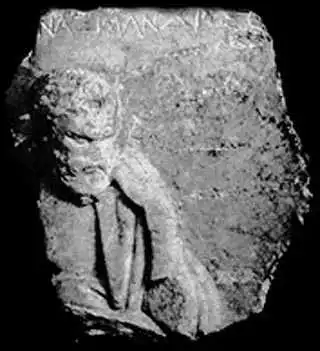
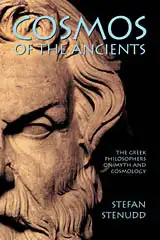
Cosmos of the Ancients The Greek Philosophers on Myth and CosmologyAnaximander o Anaximander (611-546 BC) the boundless (apeiron) was a basic principle of the world, the parts of which may be changing but itself as a whole remaining the same, eternally. This the boundless he gave no element or other significant character, instead clearly stating it to be something else: "it is neither water nor any other of the so-called elements, but some different, boundless nature, from which all the heavens arise", and out of this all existing things are formed as well as destroyed, "according to what must needs be; for they make amends and give reparations to one another for their offense, according to the ordinance of time."
Aristotle points out that the boundless of Anaximander could not have any beginning, or it would have a limit. Thereby follows also, that it cannot change significantly, in its own essence, but all the things of the world, formed out of it, still can — as can clearly be seen in Anaximander's cosmogony.
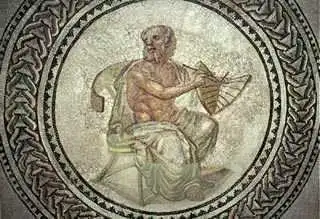
Something capable of generating Hot and Cold was separated off from the eternal (Boundless) in the formation of this world, and a sphere of fire from this source grew around the air about the earth like bark around a tree. When this sphere was torn off and closed up into certain circles, the sun and moon and stars came into being. The sea Anaximander regarded as a remaining first moisture, not dried up by the fire of the world formation. He seemed to believe that the sun continues to dry up the seas, so that in the future the earth will be barren. The primeval moisture also figures in his view that animals at first arose from moisture, later to move toward drier land, changing shape in the process — as did man: "In the beginning man was similar to a different animal, namely, a fish." About the earth he stated: The earth is aloft, not dominated by anything; it remains in place because of the similar distance from all points. Aristotle was deeply appreciative to this argument for why the earth did not seem to move at all, without being held by something else, explaining it: "a thing established in the middle, with a similar relationship to the extremes, has no reason to move up rather than down or laterally; but since it cannot proceed in opposite directions at the same time, it will necessarily remain where it is." The same is expressed by Socrates in Plato's Phaedo, where he says that he is "persuaded", not unlikely by the thoughts of Anaximander: "since the earth is round and in the middle of the heaven, it has no need either of Air or any other Necessity in order not to fall, but the similarity of the heaven to itself in every way and the equilibrium of the earth suffice to hold it still." Regarding the roundness of the earth, though, Anaximander sees it as a cylinder, "with a depth one third of its width".
LiteratureKahn, Charles H., Anaximander and the Origins of Greek Cosmology, New York 1960.
© Stefan Stenudd 2000
The Greek Philosophers
AristotleIntroductionAristotle's LifeTimelineAristotle's PoeticsAristotle's CosmologyAbout CookiesMy Other WebsitesCREATION MYTHSMythology in general and creation myths in particular.
TAOISMThe wisdom of Taoism and the Tao Te Ching, its ancient source.
LIFE ENERGYAn encyclopedia of life energy concepts around the world.
QI ENERGY EXERCISESQi (also spelled chi or ki) explained, with exercises to increase it.
I CHINGThe ancient Chinese system of divination and free online reading.
TAROTTarot card meanings in divination and a free online spread.
ASTROLOGYThe complete horoscope chart and how to read it.
MY AMAZON PAGE
MY YOUTUBE AIKIDO
MY YOUTUBE ART
MY FACEBOOK
MY INSTAGRAM
STENUDD PÅ SVENSKA
|
 Cosmos of the Ancients