Aristotle Biography 2: Sources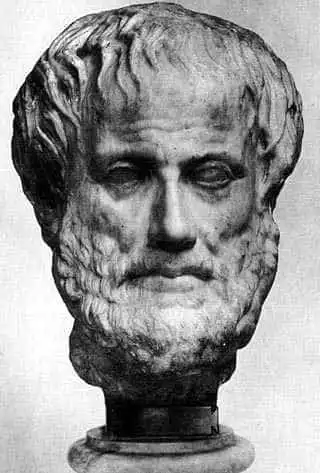 The life and time of the Greek PhilosopherSources to Aristotle's life
Though Aristotle is such a magnificent figure in philosophy, the sources to his life are scarce indeed. Except for fragments here and there, two texts of old contain more than brief wordings on the subject — that of Dionysius of Halicarnassus in the 1st century BC, and of Diogenes Laertius in the 3nd century AD. The former is only a page of text in a letter on another subject than the life of Aristotle, the latter several pages in a broad presentation of Aristotle, his life, work and philosophy.
Later texts on Aristotle lean on little but the above writings, for the facts about his life. This is still true today. Aristotle mentions nothing about himself in his own books, nor is he mentioned in the works of Plato — not even in his letters, the authenticity of which is in doubt. Of course, there is no reason why it should be different in their writing, and it is understandable why others in their time or the subsequent years would not have come to write substantially on the subject: Aristotle was not regarded as a person of historical significance by his contemporaries. That would take centuries. In the reconstruction of Aristotle's life, then, writers have used what little material there is, and filled in the rest with speculation. The results of the guess-works have varied through the years, significantly so during the last century, when nearly all about Aristotle's life has been questioned — such as his tutorship of a young Alexander the Great, his fidelity to the ideas of his own teacher Plato, even whether Aristotle was indeed the writer of the texts credited to him. For such assumptions, though, it has been necessary to move far beyond the existing sources — actually quite contrary to them.
Diogenes LaertiusThe most substantial source to the life of Aristotle, is that of Diogenes Laertius in his work Lives of Eminent Philosophers. Nothing is known of Diogenes, except what he mentions in his own work, but by deduction from what thinkers he mentions or not, the book is estimated to have been written around 225-250 AD.Diogenes' text can best be compared to modern biographies for a general audience, where entertainment is a central ambition. His treatment of philosophy is generally regarded as of light weight. Regarding his biographical information about the philosophers, though, his book is in many cases the dominant or even sole source of information. The quality of it has been questioned, as well, but he seems to have taken the job seriously enough, frequently mentioning his own sources and pointing out where they contradict each other. He was obviously familiar with a rich literature, great parts of which no longer remains. His book makes explicit reference to 365 books by about 250 authors. Most of his favored sources come from the third and second century BC, or the first century AD — in between these periods his sources are strikingly scarce.
As for Aristotle, he mentions ten sources, appearing in his text in the following order:
Those details can often be of both questionable and quite peripheral nature. In the first paragraph on his text about Aristotle, Diogenes mentions that he spoke with a lisp, had slender calves, small eyes, and was conspicuous about his attire, his rings and haircut.
Well, the lisp could not have been a severe speech impediment, nor a big embarrassment, or Aristotle would have been more eager to write books than to give lectures. The slender calves imply that Aristotle did not walk that much in his Peripatetic, or they would have become more muscular. The size of his eyes were of little significance, compared to his eyesight, for reading and writing. Finally, his striking way of dressing up may have come from his general interest in the physical world and its workings. Aristotle may have enjoyed to experiment with how to attract attention to his appearance, as a way of playing on people's irrational responses. Coming to think of it, his lisp may have been another gimmick of that kind. In those days, as well as ours, the importance of being noticed could not be overly emphasized. Dionysius of HalicarnassusDionysius of Halicarnassus (-7 BC) wrote a long letter to Ammaeus, where he aimed to prove that the famous orator Demosthenes was not inspired by Aristotle's Rhetoric. His argument was simple: Demosthenes was an acclaimed speaker before Rhetoric was written. In order to prove this, Dionysius gave a rhapsodic biography of Aristotle, and specified the time in which Aristotle must have written the book in question. This letter remains, and contains a substantial, though brief, biography of Aristotle.The historian and critic Dionysius was born at Halicarnassus in the first century BC. What is known about his life is what he has written about it. He came to Rome in about 29 BC, and remained there until his death. His major work is that on Roman antiquities, relating the history of Rome from ancient times to the beginning of the First Punic War, in 265 BC. The ten first of its original twenty books remain in their entirety.
The biography on Aristotle is just one page of text, but a very important document, considering the scarce classical sources on the subject. Therefore, I include it in its entirety: NEXT
AristotleIntroductionAristotle's LifeTimelineAristotle's PoeticsAristotle's Cosmology
The Greek PhilosophersAbout CookiesMy Other WebsitesCREATION MYTHSMythology in general and creation myths in particular.
TAOISMThe wisdom of Taoism and the Tao Te Ching, its ancient source.
LIFE ENERGYAn encyclopedia of life energy concepts around the world.
QI ENERGY EXERCISESQi (also spelled chi or ki) explained, with exercises to increase it.
I CHINGThe ancient Chinese system of divination and free online reading.
TAROTTarot card meanings in divination and a free online spread.
ASTROLOGYThe complete horoscope chart and how to read it.
MY AMAZON PAGE
MY YOUTUBE AIKIDO
MY YOUTUBE ART
MY FACEBOOK
MY INSTAGRAM
STENUDD PÅ SVENSKA
|
 Cosmos of the Ancients