Aristotle Biography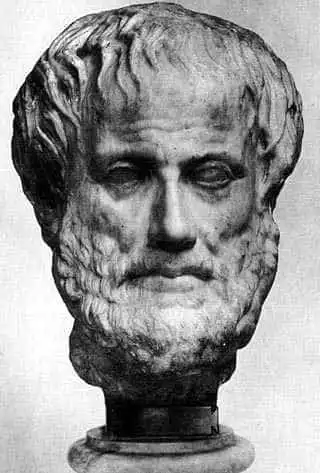 The life and time of the Greek PhilosopherTable of Contents
1 Ordinary livesAlthough Aristotle is such an outstanding figure in world history, and there were several remarkable ingredients in his life, as well as formidable people around him, the biographical literature on Aristotle is scarce. A strict biography is very hard to find, and those books devoted to presenting a complete picture of Aristotle begin with a sketch of his lifetime, insignificantly more detailed than the ones given in just about any work on the philosopher, or for that matter a regular entry in an encyclopedia. What the monographers fill most of their pages with, is Aristotle's philosophy.
It is understandable. What is the life of a philosopher, especially one of such dignity as Aristotle, but his or her philosophy? A generalization hides here, not sufficiently questioned, and its workings can be seen in all lines of biographical material. The philosopher, the thinker, is presumed to have lived a life devoted to that, alone, or at least with no other significant emphasis. There are few exceptions to the rule, one being Nietzsche, whose life has been allowed to be portrayed as just as bizarre and dramatic as the thoughts in his writing. In the biographies of dramatists and fiction writers, on the other hand, their lives are usually portrayed as being similar to the stories they made up in their works. Quite accurate in the case of Cervantes or Dostoevsky, but not necessarily so with all the rest of them. This is a bias, a prejudice, very difficult for the biographer to avoid. When a significant person from history is contemplated, that which put him or her in the history books tends to overshadow all else, and what can be perceived through it is colored and shaped by that major accomplishment. The renowned Swedish writer of fiction for children, Astrid Lindgren, was in her early nineties asked by a reporter what she regarded as her most important achievement. Her books about Pippi Longstocking, and other pleasantly memorable characters, have been printed in vast numbers and many languages. In Sweden she was praised like a kind of grandmother for several generations of Swedes. Astrid Lindgren paused a moment in confusion, before replying: "Why, my children, of course. What else could it be?" People are children, lovers, parents, grandparents — and that part of their existence is normally regarded as dominant. Not so for the famous. With them we take for granted that the reason for their fame dominates their lives. That might be true for some, especially if their fame is unquestionable in their own lifetime. In most cases, though, few of them would dare to wager that their memory survives their death — in any other way than through their children. So, a biographer would be wise to regard even the most formidable of historical figures as a commoner, a human acting as humans do, living, feeling and thinking pretty much like the rest of us, unless something else is evident. Not that we would care too much to write down the everyday drab reality of the greats, and settle with that, but it would aid to understanding their lives better. When they are raised to an elevated existence by biographers, their famous deeds may make sense, but little else. Even with their cherished accomplishments, I doubt that the extraordinary perspective leads to trustworthy explanations. Maybe the lives of the philosophers were not that philosophical, the adventures of the poets not that adventurous, the days of the emperors not that glorious. We can see what they came to mean to mankind, but could they? Usually not. Picasso must have realized, around the time of his life that the Greeks called flourishing, the age of 40, that he would not be easily forgotten. So would Einstein, and the Beatles. Going further back, it is likely that Voltaire had the same trust, and Isaac Newton, Martin Luther, maybe Leonardo da Vinci, Charlemagne, and so on. Probably, there are also hundreds of names of giants in their times, now all but forgotten, who were convinced of making it to posterity. Certainly, most of them had no idea. Shakespeare would never dream of it, Galileo Galilei would never count on it, van Gogh could not see it. Jesus would have no clue at all, if not indeed being informed by a heavenly father. History may make sense in rear view, but is rarely predictable. There is even a natural conflict between the present and the future: what conforms to the presiding order is praised and elevated in the former, but what is singled out in the latter is change, the deviation from the standard. So, that which is cherished in the future is mostly neglected or even rejected in the present. Most innovators, of whatever kind, would in their lives only find support for a conviction of being erased by time. What are the odds of becoming a historical figure? Infinitesimal. Nothing to base one's life on. Returning to Aristotle, if we consider the indications we have about his time and the modest role he played in it, Aristotle would have been very un-Aristotelian to assume a lasting influence. Not that he was unknown to the population of Athens and beyond, but modestly so. Most of Aristotle's writing was not even published during his lifetime. What was, had won him some respect, but far from devotion. It took centuries before Aristotle was regarded as anything but an eloquent student of Plato. Since Plato already in those days had quite another reputation, and through his writing also Socrates, if Aristotle pondered the question at all, he would conclude that those names might remain, but his own be dust even quicker than his body would. It is even likely that Aristotle regarded himself as somewhat a failure, fleeing Athens at the end of his life, leaving little of proven perseverance. Aristotle's will, quoted to us by Diogenes Laertius, implies a most modest care about his family, his slaves, and little else. In his life, Aristotle shunned political activity, and had little faith in seeing his philosophy contribute to society. His teacher's endeavor along those lines must have convinced Aristotle of its futility. What of his own work could Aristotle see that would have any chance of lasting? Only his early works, predominantly defending and explaining the ideas of Plato — significantly different from his own, as they matured. Whatever Aristotle might have thought about it, as he progressed in years, he saw no other role for him in history, than that of yet another voice in the choir praising Plato's thoughts. And he could not even have been convinced of Plato's lasting impression.
Aristotle would have concentrated on living a decent life, and made no plans for eternity. NEXT
AristotleIntroductionAristotle's LifeTimelineAristotle's PoeticsAristotle's Cosmology
The Greek PhilosophersAbout CookiesMy Other WebsitesCREATION MYTHSMythology in general and creation myths in particular.
TAOISMThe wisdom of Taoism and the Tao Te Ching, its ancient source.
LIFE ENERGYAn encyclopedia of life energy concepts around the world.
QI ENERGY EXERCISESQi (also spelled chi or ki) explained, with exercises to increase it.
I CHINGThe ancient Chinese system of divination and free online reading.
TAROTTarot card meanings in divination and a free online spread.
ASTROLOGYThe complete horoscope chart and how to read it.
MY AMAZON PAGE
MY YOUTUBE AIKIDO
MY YOUTUBE ART
MY FACEBOOK
MY INSTAGRAM
STENUDD PÅ SVENSKA
|
 Cosmos of the Ancients