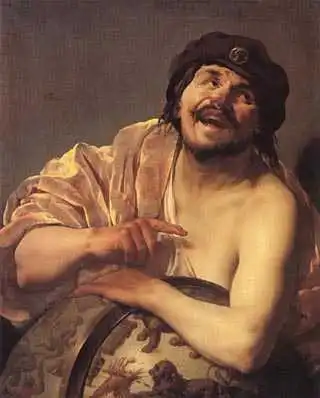
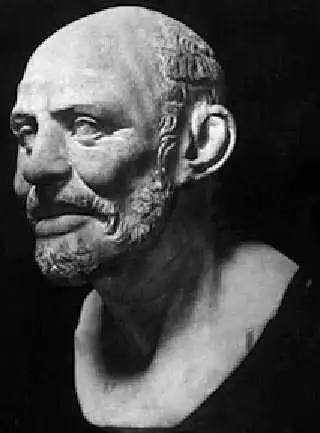
Cosmos of the Ancients The Greek Philosophers on Myth and CosmologyDemocritus hat Leucippus thought about cosmology and its atomic structure is generally assumed to be identical with the views of his student Democritus (c. 460-357 BC), who elaborated further on the subject, being the one mostly quoted on it.
Diogenes Laertius gives a long list of books written by Democritus, dividing them into the groups ethics, virtue, physics, "no head", mathematics, literature and music, and the arts. Most famous were The Great Diacosmos (world order) and The Lesser Diacosmos, though Diogenes says the former is by some attributed to Leucippus.
We know nothing accurately in reality, but (only) as it changes according to the bodily condition, and the constitution of those things that flow upon (the body) and impinge upon it.
No more than his teacher did Democritus involve the gods in his cosmos, and so also with him it can be said that we have no statement of his swearing to it, but at least in all cosmological matters he should be regarded as an atheist.
LiteratureAristotle, Metaphysics, 1009b, translated by Hugh Lawson-Tancred, London 1998.Freeman, Kathleen, Ancilla to The Pre-Socratic Philosophers, Oxford 1952.
© Stefan Stenudd 2000
The Greek Philosophers
AristotleIntroductionAristotle's LifeTimelineAristotle's PoeticsAristotle's CosmologyAbout CookiesMy Other WebsitesCREATION MYTHSMythology in general and creation myths in particular.
TAOISMThe wisdom of Taoism and the Tao Te Ching, its ancient source.
LIFE ENERGYAn encyclopedia of life energy concepts around the world.
QI ENERGY EXERCISESQi (also spelled chi or ki) explained, with exercises to increase it.
I CHINGThe ancient Chinese system of divination and free online reading.
TAROTTarot card meanings in divination and a free online spread.
ASTROLOGYThe complete horoscope chart and how to read it.
MY AMAZON PAGE
MY YOUTUBE AIKIDO
MY YOUTUBE ART
MY FACEBOOK
MY INSTAGRAM
STENUDD PÅ SVENSKA
|
 Cosmos of the Ancients