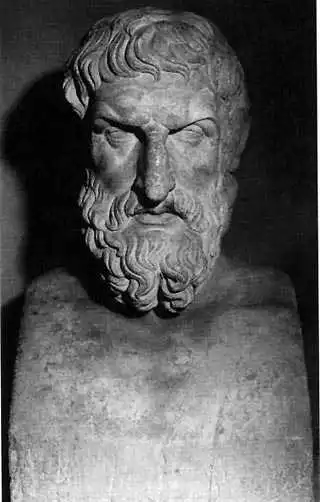
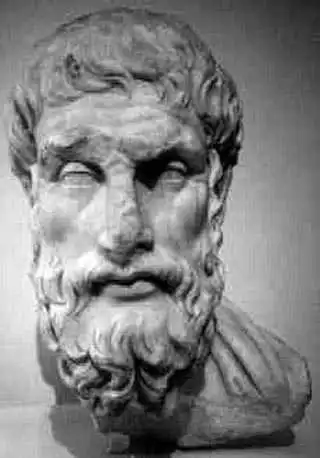
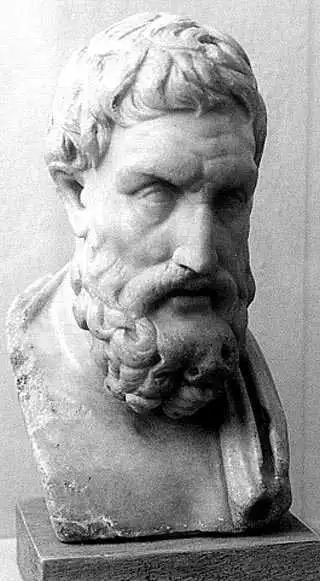
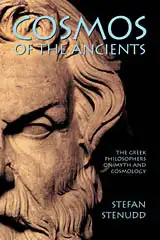
Cosmos of the Ancients The Greek Philosophers on Myth and CosmologyEpicurus picurus (341-270 BC) had two principal teachers — the Platonist Pamphilus in his teens, and Nausiphanes of Teos, who introduced him to the atomism of Democritus, in his twenties — but he distanced them firmly, calling the latter a "scoundrel", to form his own school of thought, which was extraordinary in allowing both sexes as students.
The principal source to his life and theories is Diogenes Laertius, who wrote appreciatively and extensively about him in Lives of Eminent Philosophers. Epicurus is said to have written some 300 books, but what remains is principally some letters of his, and fragments mostly in the form of aphorisms. Among the letters, one known as the Lesser Epitome, written to his student Herodotus, later to break with and loudly criticize him, lays out the general lines of his cosmology as well as his ethics. Letters to some other students also remain, giving additional confirmations to the views of Epicurus.
the soul is a corporeal thing, composed of fine particles, dispersed all over the frame, most nearly resembling wind with an admixture of heat, in some respects like wind, in others like heat. But again, there is the third part which exceeds the other two in the fineness of its particles and thereby keeps in closer touch with the rest of the frame.
Death, therefore, the most awful of evils, is nothing to us, seeing that, when we are, death is not come, and, when death is come, we are not. Therefore, learning to live well is not different from learning to die well — the only reasonable way to prepare for the latter is to make the former, in itself and for itself, the fullest. It is in regards to celestial perspectives that Epicurus gives his views on the gods. The dynamics of the heavens, such as planetary movements, eclipses and so forth "take place without the ministration or command, either now or in the future, of any being who at the same time enjoys perfect bliss along with immortality." He has a slightly humorous way of robbing the gods of their powers by complimenting them, stating that such blissful creatures could not be dealing with troublesome worldly matters, or they would not be so blissful. They are above the world — thereby, it is implied but not outspoken by Epicurus, completely without role in, or relevance to, existence: "the divine nature must not on any account be adduced to explain this, but must be kept free from the task and in perfect bliss." It is as much saying that they do not exist at all, as is possible without actually saying it. So he dares to go on stating that misconceptions on this matter is a chief frustration to man: the greatest anxiety of the human mind arises through the belief that the heavenly bodies are blessed and indestructible, and that at the same time they have volitions and actions and causality inconsistent with this belief.
The size of the sun and the remaining stars relatively to us is just as great as it appears. But in itself and actually it may be a little larger or a little smaller, or precisely as great as it is seen to be. What he strongly objects to is stating one theory to be true and not the other, although there is no actual proof of it: But one must not be so much in love with the explanation by a single way as wrongly to reject all the others from ignorance of what can, and what cannot, be within human knowledge, and consequent longing to discover the indiscoverable. Certainly, both mythology and philosophy is blamed for this.
LiteratureO'Connor, Eugene, The Essential Epicurus, New York 1993.Diogenes Laertius, Lives of Eminent Philosophers, translated by R. D. Hicks, volume II, Loeb, London 1950.
© Stefan Stenudd 2000
The Greek Philosophers
AristotleIntroductionAristotle's LifeTimelineAristotle's PoeticsAristotle's CosmologyAbout CookiesMy Other WebsitesCREATION MYTHSMythology in general and creation myths in particular.
TAOISMThe wisdom of Taoism and the Tao Te Ching, its ancient source.
LIFE ENERGYAn encyclopedia of life energy concepts around the world.
QI ENERGY EXERCISESQi (also spelled chi or ki) explained, with exercises to increase it.
I CHINGThe ancient Chinese system of divination and free online reading.
TAROTTarot card meanings in divination and a free online spread.
ASTROLOGYThe complete horoscope chart and how to read it.
MY AMAZON PAGE
MY YOUTUBE AIKIDO
MY YOUTUBE ART
MY FACEBOOK
MY INSTAGRAM
STENUDD PÅ SVENSKA
|
 Cosmos of the Ancients