Cosmos of the Ancients The Greek Philosophers on Myth and Cosmology
|
 hen the ancient day Greeks discussed matters of gods and their doings, the sources they primarily referred to were Homer and Hesiod. As far back as we have traces of such a discussion, their writings have been regarded ambiguously, to say the least.
by Stefan Stenudd |
 Cosmos of the Ancients
The adventurous gods portrayed in the Iliad and the Odyssey, as well as those majestic beings roaming in the Theogony, are often beastly, monstrous, and the way they allow their emotions to rule their actions — more often than not resulting in mayhem — is nothing commendable in the mind of a Greek philosopher.
Below I present twenty-eight of them — not nearly a complete listing, although regarding the presocratics not far from it — chosen mainly because they are mentioned in literature on mythology and religion, as having in some way discussed it.
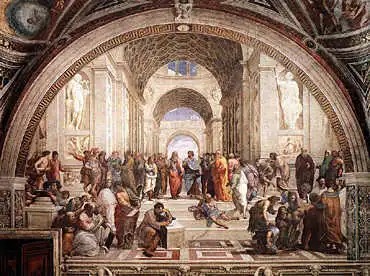
The school of Athens, by Raphael.
A number of them, like Euhemerus and Theagenes, just to name two, always pop up in historical introductions to the theory of myth and religion, whereas others included here are almost never mentioned, but I find their views of value in this resume.
In many books on the subject, there is an unquestioning transport of the names frequently mentioned, so that they appear in most texts but are analyzed in very few of them — standard statements about them, not always accurate, are simply passed on. That goes for the two mentioned above, as well as for example Protagoras and Antisthenes.
To avoid this, I have tried as much as possible to examine the fragments of their own words, and looked at their cosmological views in general, to find how they might fit with what we believe about their relation to the gods.
Flourishing
For the same reason, that of not just repeating the conventional reports on the old Greeks and their myths, I have not grouped them according to periods, schools, teachers or any other system introduced after their own days.Below, the only order is that of their date of flourishing, when they were forty years of age, as well as it can be established. This way, I wish each and everyone of them to reveal what he himself might have thought on the matter, as far as can be determined from what remains of their words.
Certainly, some of them are next to impossible to treat altogether apart, such as Leucippus and Democritus, and others are so much linked in our minds that we cannot think about one without reflecting on the other — who would not put Plato and Aristotle in such a pair, no matter how far apart their theories might be? Still, I need not stress this additionally by grouping them likewise in this text, but my presentations and comments may very well reflect their links, just the same.
Many of the philosophers do in the following text appear to have similar, if not sometimes identical views, on the matters in focus here. Several of them show equal doubts about what can at all be stated about reality, or what can or cannot be said about the gods, and so forth — but in spite of this, I do not move them out of the order of their flourishing, nor do I bother to mention their similarities, which must anyway be apparent to the reader in this comprised presentation of them.
The myths were alive
What is of particular interest here, is their views on mythological narration of how the world came to be, and what powers may rule its continued existence — the cosmogony and cosmology of it all.The myths in question, mainly those of Homer and Hesiod, are additionally interesting in this perspective, since they were so to speak alive in the days of the philosophers. The gods were actually worshiped — feared, too — and the myths about them were not told as fairytales to children, but as actual events having taken place in this world, some recently and some long ago, but nevertheless credited with authenticity.
It is a rare thing being able to study a setting of living myth, with numerous contemporary commentators to it, people in that setting at the very time of its flourishing. The Greek philosopher may have been a group having little in common with ordinary citizens of Athens, but they do anyway bear witness to some human relations to the myths, the religious apparatus, at the time when it was integrated with social life.
For this reason, I allow more room for their thoughts than their actual mythological theories may call for, and I sketch their cosmological views, whether they contain gods and myths about them or not, whether they express opinions about Homer and Hesiod or not. Their discussions reveal what intellectual framework existed at their time, be it only for the most learned, and what it may tell about their beliefs.
To read about each philosopher's thoughts on cosmology and the myths, see the links on the top of the left menu.
This article was originally written in the year 2000 for a seminar at the Department of History of Ideas, Lund University, as a part of my dissertation in progress on Creation Myths and their patterns of thought. Transforming the text to webpages, I have excluded footnotes. Published on this website October 6, 2001.
The Greek Philosophers
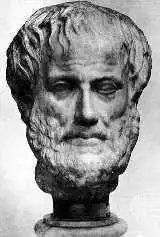
Aristotle
Introduction
Aristotle's Life
Timeline
Aristotle's Poetics
Aristotle's Cosmology
About Cookies
My Other Websites
CREATION MYTHS
Mythology in general and creation myths in particular.
TAOISM
The wisdom of Taoism and the Tao Te Ching, its ancient source.
LIFE ENERGY
An encyclopedia of life energy concepts around the world.
QI ENERGY EXERCISES
Qi (also spelled chi or ki) explained, with exercises to increase it.
I CHING
The ancient Chinese system of divination and free online reading.
TAROT
Tarot card meanings in divination and a free online spread.
ASTROLOGY
The complete horoscope chart and how to read it.
MY AMAZON PAGE
MY YOUTUBE AIKIDO
MY YOUTUBE ART
MY FACEBOOK
MY INSTAGRAM
STENUDD PÅ SVENSKA

Stefan Stenudd
About me
I'm a Swedish author of fiction and non-fiction books in both English and Swedish. I'm also an artist, a historian of ideas, and a 7 dan Aikikai Shihan aikido instructor. Click the header to read my full bio.