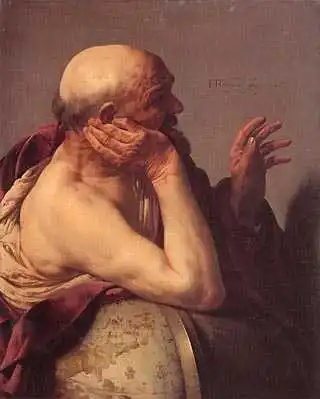
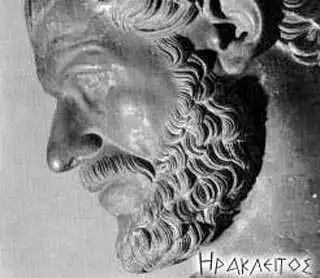
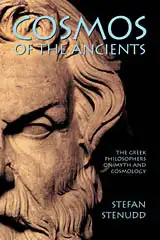
Cosmos of the Ancients The Greek Philosophers on Myth and CosmologyHeraclitus eraclitus (flourished circa 502 BC), famous for the expression "panta rhei", all things flow, and for his cryptic way of expressing his thoughts, as well as his consistently bad mood and obnoxious comments.
He thought that Homer "ought by rights to be ejected from the lists and thrashed" for his weak understanding of cosmological matters, and no higher was his opinion on Hesiod: For very many people Hesiod is (their) teacher. They are certain he knew a great number of things — he who continually failed to recognize (even) day and night (for what they are)! For they are one. Hesiod said that night "produced" day, whereas to Heraclitus there is no more difference between the two than the lack of sunlight in the former, but also — bearing in mind both the poisonous tongue and delight in innuendo of Heraclitus — this fundamental misconception of Hesiod would be a way of stating that not even this he got right, thereby portraying him as mentally little more than a child even among children. The worship of the gods he found outright mad, where people believed themselves to be purified with the blood from sacrifice, "as if one who had stepped into mud should wash himself off with mud", and that was not all: Furthermore, they pray to these statues — as though one were to carry on a conversation with houses.
God (is) day (and) night, winter (and) summer, war (and) peace, satiety (and) famine, and undergoes change in the way that (fire?), whenever it is mixed with spices, gets called by the name that accords with (the) bouquet of each. Instead of "fire" in this fragment of his works, interpreters have also suggested "air", "myrrh" or "olive oil". What seems most likely in the drastic comparison between god's spread over celestial opposites on the one hand, and the bouquet of spices on the other, would be something in the line of olive oil. Heraclitus does, though, give fire a central place: "Fire, having come suddenly upon all things, will judge and convict them." Although to Hippolytus this seemed to point directly to the fires of hell and a punishing god, it should rather be interpreted as a cosmological statement, since Heraclitus also stated: "To god all things are fair and just, whereas humans have supposed that some things are unjust, other things just." The god of Heraclitus is of a cosmological nature, a natural order, not bothering with human affaires — somewhat the same as the all encompassing meaning his interpreters have given to his use of 'logos'. It seems as passive as a formula, not in any way a personality with a will of its own, not even responsible for the making of the world, which to Heraclitus is: "the same for all, no god or man made, but it always was, is, and will be, an ever living fire, being kindled in measures and being put out in measures." This is an automatic cosmos, governed only by its own natural laws, where fire is the basic element and its dynamics are what make things appear as well as dissolve. This grand, eternal process is completely impersonal: Things grasped together: things whole, things not whole; being brought together, being separated; consonant, dissonant. Out of all things one thing, and out of one thing all things. Another fragment has him simply stating: "All things are one." When man accredits meaning to it all, traces a higher will in what takes place and how things behave, he is merely fondling illusions, dreaming. And dreaming evidently intrigues Heraclitus — the strange difference between being asleep and awake — as to what the world really is: "for those who are awake there is a single, common universe, whereas in sleep each person turns away into (his) own, private (universe)." The implication of those opposite states of mind goes further: A person in (the) night kindles a light for himself, since his vision has been extinguished. In his sleep he touches that which is dead, though (himself) alive, when awake touches that which sleeps. This cryptic fragment has been interpreted in several directions, sometimes as night signifying the night of death, but also when read more directly it shows how Heraclitus marvels at the borders of being awake and asleep, implying clues to what death may be.
Immortality he treats mostly as a paradox: "Immortals mortal, mortals immortal, these living the death of those, those dead in the life of these." This saying has been discussed by interpreters as to its meaning, and although the expression immortals was generally used by the Greek for their gods, this need not be the case here. What Heraclitus states, no doubt, is the uncertainty of it all — life ending or not, death real or not, a puzzle impossible to solve. If it is to refer to the gods being alive only in the imaginations of the people, then the immortals are mortal in the sense that they die when the people believing in them do, and at the same time people dreaming of eternal gods do in a sense make themselves immortal, if only in this way, akin to a dream. Heraclitus is vague on those grand matters, because he is uncertain, and what he can state firmly is little but the disillusioning fact that none can know any better. The world being such an uncertain thing, illusive and elusive, his research found a single means: "I investigated myself." It did not make him jolly.
LiteratureDiogenes Laertius, Lives of Eminent Philosophers, translated by R. D. Hicks, volume II, Loeb, London 1950.Robinson, T. M., Heraclitus: Fragments, Toronto 1987.
© Stefan Stenudd 2000
The Greek Philosophers
AristotleIntroductionAristotle's LifeTimelineAristotle's PoeticsAristotle's CosmologyAbout CookiesMy Other WebsitesCREATION MYTHSMythology in general and creation myths in particular.
TAOISMThe wisdom of Taoism and the Tao Te Ching, its ancient source.
LIFE ENERGYAn encyclopedia of life energy concepts around the world.
QI ENERGY EXERCISESQi (also spelled chi or ki) explained, with exercises to increase it.
I CHINGThe ancient Chinese system of divination and free online reading.
TAROTTarot card meanings in divination and a free online spread.
ASTROLOGYThe complete horoscope chart and how to read it.
MY AMAZON PAGE
MY YOUTUBE AIKIDO
MY YOUTUBE ART
MY FACEBOOK
MY INSTAGRAM
STENUDD PÅ SVENSKA
|
 Cosmos of the Ancients