Aikido AttacksAi hanmi relation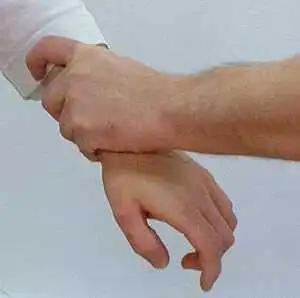 Kogeki, the Attack Techniques in Aikido.Aihanmi RelationThe aihanmi relation is when both persons have the same foot and arm forward. This is the traditional and typical guard between two adversaries in almost any martial art. Most right-handed persons want to stand with their left leg and arm forward, in unarmed combat. In the sword arts, though, it is usually the right side forward.
Aihanmi relation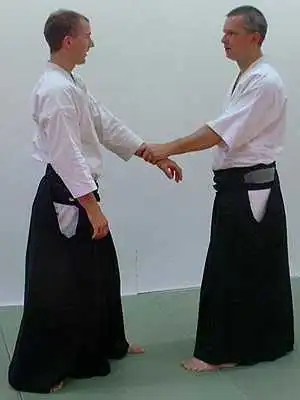 Aihanmi katatedoriAihanmi katatedori is a right hand grip of tori's right wrist, or a left hand grip of tori's left. In the basic form, the same hand and foot should be forward in the stance of both tori and uke.You get the best posture and relation to the partner if you compare it to the chudan kamae sword guard. Extend your hand from your center (tanden), not to the side, and face tori straight on. Think of it as an initial attack, fully alert, which can easily be followed up by other attacks. It is very important not to think of it as only a grip of tori's wrist, but as a connection to control his or her whole body. You grip the arm, but you focus on tori's whole body, in particular his or her center. There should be a rather straight line from your center, through the grip and to tori's center.
Your grip on tori's wrist should also be very similar to that on a sword: the upward angle between your hand and arm, the back of your hand up and your fingers below. Some people grip from the side, which is weaker and less of a protection, since tori can easier move his or her arm up, toward your face. You should not press down, but hold so that the most difficult direction for tori to move the arm is upward. Again, the grip is like on a sword when it comes to the roles of the fingers. Concentrate on gripping with your little finger, and don't worry about the rest. This way, your grip will be better anchored in your center. If you grip with the most force in your index finger, your shoulder will stiffen and you will lose the connection between your center and your grip. A good way of describing the ideal grip on a wrist (as well as on a sword) is to think that the little finger is leading the wrist into the palm of your hand. When your palm is tightly connected to the wrist, so to speak air tight, your control of tori through the grip is optimal. This attack form is unreasonably neglected in many aikido dojos. It may seem almost awkward as a grip, compared to gyakuhanmi, but the aihanmi relation is by far the most common between the adversaries in any other Martial art. With the grip you have a clear and concrete way of getting familiar with this relation. You may also be surprised by how practical it can be as an attack. For example, when the adversaries stand in karate or boxing style guards against each other, one can quite easily snap the opponent's wrist, which is a good way of penetrating the opponent's guard.
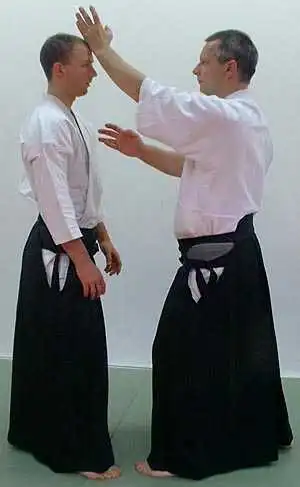 ShomenuchiShomenuchi is a strike to the top of tori's head, with the ridge of the hand. It is done as a symbol of a sword attack, where the hand is tegatana (hand sword) with the hand ridge as the sword's edge. The relation to tori is of aihanmi nature, so that both have the right or the left foot forward, in the basic form. Also, uke has the same foot forward as the striking hand.In the shomenuchi strike, it is recommendable to hold the other hand slightly behind the striking one, so as to resemble the two-hand swordgrip. This also helps you to remain centered through the attack. The strike should be done with the whole arm, in the unbendable arm extension, and not just the forearm — again, to resemble the sword cut. Lift the hand to above your head, like the jodan kamae position with the sword, before the strike, but don't do that before advancing toward tori. To advance in a jodan kamae position gives less protection than to do so in chudan kamae (in front of your center). You raise the hand at the end of your final step toward tori, so that the strike follows almost immediately.
I have noticed that many aikidoka shift front hand in their shomenuchi attack, so that they start with one hand in front but do the strike with the other. This is simply not possible when you hold a sword — you would just strike yourself with it (try it, if you don't believe me). Therefore, I strongly recommend that you keep the same hand forward through the attack. If you begin with your right hand forward, then that is the hand you strike with. Of course, the shomenuchi attack has no meaning when done with an unarmed hand. The head is hard, especially at the forehead, so there are not many tegatana that can hit it without more damage being done to the hand than to tori's head. This is simply a way of training aikido against the sword attack, or any other armed attack to the head from above, in a safe way.
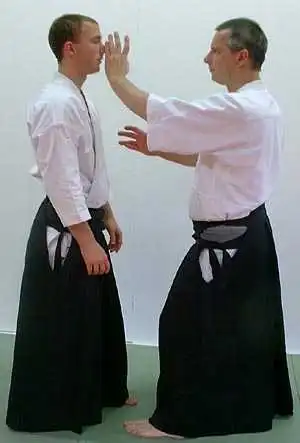 ShomenateShomenate is a strike to the front of tori's head, with the ridge of the hand. It is done as a symbol of a sword or knife forward strike (tsuki). The relation to tori is of aihanmi nature, so that both have the right or the left foot forward, in the basic form. Also, uke has the same foot forward as the striking hand.In this attack (just like with shomen), it is recommendable to hold the other hand slightly behind the striking one, so as to resemble the two-hand swordgrip. Begin from chudan kamae, in front of your center, and thrust the hand forward and upward, to tori's face. This is not really a basic attack form in aikido, but it is anyway used quite frequently in training — often as a substitute for shomenuchi, which is unfortunate, since the two attacks cannot always be treated the same way by tori. It is also frequently used by tori as an atemi technique. For example, some practice shomenate so that tori initiates by a shomenate toward uke, who blocks with the same movement. Tori then does the technique on uke's blocking arm. I am not too fond of that, since it comes very near to making tori an attacker. Make sure to stiffen the hand, just like with shomenuchi, and make sure that you advance so that you reach an actual striking distance. Use the idea of the unbendable arm to make the attack strong. Unlike shomenuchi, this attack is meaningful even when done unarmed. You only need to change the form of the hand to make it a very effective attack indeed. No need to get into detail about that here, you're sure to figure it out.
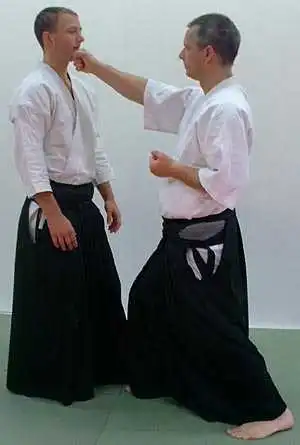 TsukiTsuki is a fist strike either to the face (jodan tsuki) or to the solar plexus (chudan tsuki). It needs to be trained substantially, to be a good attack for tori to work on with aikido techniques. Much more can be said about it, than what is room for here. In karatedo the constant training of tsuki can be compared to the training of the basic cut in the sword arts. It takes time to learn well.
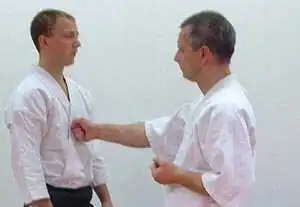 A few pointers: The power of the strike is in the acceleration of it, which is reached by relaxing in the movement, to harden your fist and arm only at impact. The direction of the strike must be straight, and end so that the fist is directly in front of your center. This means that you need to angle your body a bit, but not much, so that the side of your body with the striking arm is slightly more forward than the other. This body turn is done so that it adds force to the strike. Moreover, it is the index finger and middle finger knuckles that are aimed at the target, so that they hit first. Form the fist by most firmly closing your little finger — the other fingers are not as important — and make sure that the thumb is tightly connected to the fist, for its protection. The fist is held in an angle that prevents it from bending on impact. In traditional karatedo, the fist rotates some 180° during the strike — from fingers up to fingers down. This increases stability and effect (somewhat like the spinning bullet from a gun). At full extension of the tsuki, there should be a 90° angle between the arm and the body, again for stability. The arm should not be completely stretched, since that can damage the elbow when you miss the target (and you should miss, if tori is doing taisabaki properly).
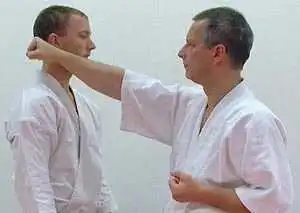 Remember to advance so that the tsuki would really reach tori properly, if he or she were to stay on the spot (see the picture above). Otherwise, tori has no chance of learning the right timing and distance. When you advance, don't strike until you have reached tori, that is at the end of your last step.
I think that the aikidoka should practice gyakutsuki as well as oitsuki, because it's there — and also because uke ends up in a slightly different position depending on what tsuki is used. This is particularly evident with the feet. Some aikido techniques take for granted that the same arm and leg are forward, and can become awkward when this is not the case. That needs to be experienced.
AIKIDO PRACTICEIntroductionAikido Techniques — all the basic movesAttacks in Aikido
Tantodori — knife defenseAikiken — aikido sword techniquesJo 31 Kata in four directionsAikibatto sword and staff exercisesAiki — joining energiesKi exercisesAikido Video ClipsAikido PhotosMy aikido dojo in Malmö, SwedenMy aikido seminarsAIKIDO THEORYMy Aikido BioAikido GlossaryTanden, the CenterAikido InksAikido as Self-DefenseRunning a DojoAikido is TrueOsensei and EinsteinAikiWeb ColumnsAikido Books ReviewedDie deutsche Version meines Aikido-Buches onlineAikido på svenskaAbout CookiesMy Other WebsitesCREATION MYTHSMythology in general and creation myths in particular.
TAOISMThe wisdom of Taoism and the Tao Te Ching, its ancient source.
LIFE ENERGYAn encyclopedia of life energy concepts around the world.
QI ENERGY EXERCISESQi (also spelled chi or ki) explained, with exercises to increase it.
I CHINGThe ancient Chinese system of divination and free online reading.
TAROTTarot card meanings in divination and a free online spread.
ASTROLOGYThe complete horoscope chart and how to read it.
MY AMAZON PAGE
MY YOUTUBE AIKIDO
MY YOUTUBE ART
MY FACEBOOK
MY INSTAGRAM
STENUDD PÅ SVENSKA
|
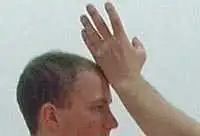 Don't relax the striking hand, but stiffen it — especially the little finger, so that the hand ridge muscle hardens. Otherwise the hand is quite fragile in such a strike. Remeber also to approach to actual striking distance. Tori cannot learn timing and distance properly, if the strike is done too far away, where it would not reach tori even if he or she remained at the spot.
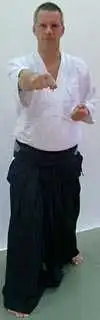 There are two basic forms of tsuki in karatedo, depending on the foot position compared to that of the striking arm. To the left here is oitsuki, where the foot forward is the same as the striking arm. This is most common in aikido — in some dojos no other tsuki is ever trained. Surely, this is because the arm and foot relation here is the same as in the most common sword techniques and gripping techniques. In aikido it is rare to attack with one arm and the opposite foot forward, for reasons of balance and reach (and habit).
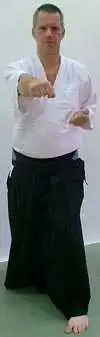 However, in karatedo the most appreciated tsuki is gyakutsuki, where the foot forward is the opposite from the striking arm. If you strike with your right arm, then the left foot is forward, and vice versa, like the picture to the right here. The gyakutsuki is very practical and popular in kumite, karate contest, because by this you can approach the opponent slightly to the side and thereby avoid his or her attack.
 Aikido Principles
 Attacks in Aikido
 Aikibatto