Ikkyo Complete 2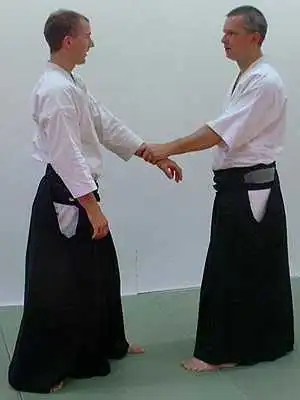 Aihanmi — Straight relationAi Hanmi RelationThe aihanmi relation is when both persons have the same foot and arm forward. This is the traditional and typical guard between two adversaries in almost any martial art. Most right-handed persons want to stand with their left leg and arm forward, in unarmed combat. In the sword arts, though, it is usually the right side forward.
Aihanmi relation
Ikkyo on the shomenate attack, in a relaxed way of training.  At each heading, click on this symbol to see that video clip. At each heading, click on this symbol to see that video clip.
The aihanmi katatedori attack is often neglected in aikido. For example, when aikidoka say only "katatedori", they usually mean gyakuhanmi. But aihanmi is the natural guard position between two opponents — each extending the same arm and foot. This is very clear in the sword arts, like kendo, but actually in almost any martial art. So, this relation should be studied thoroughly.
It's important to make the taisabaki movement forward to the side, at the same time as you do the uke nagashi twist with the hand. If you are late with the taisabaki, you may not escape the attack, and if you wait with the hand move, you will have trouble bringing it with you in the big circular ikkyo movement. Notice that all through the technique you keep your hands in front of you. That is to be able to use power from your center, tanden. Pay attention to the importance of your free hand, which pushes the attacker's arm by the elbow (above it, not on or below it). If you don't extend your arm properly in doing this, the attacker can reach you, and you will have trouble bringing him or her down. In the pinning at the end of the technique, keep the attacker's arm at least 90° from his or her body, to avoid the attacker spinning around. Place one knee by the attacker's wrist, and the other knee pressing at the attacker's side. Your hands should be on each side of the attacker's elbow — not on it — and press them down and forward, not just down. Sit on your toes, so that you can get up quickly.
Many aikido students have problems with bringing the attacker down, in the rotating movement of ikkyo ura. They find themselves pushing the attacker's arm in futility, while the attacker is standing straight and solid as a rock. You have to lead the attacker's arm in a big circle that begins toward him or her, approximately in the direction of the attacker's temple. That will make the attacker bend, lose the posture and the balance, to be easily led to the floor. If the attacker is able to stand still and straight through your ura turning with his or her arm, then your movement is too small. It is also very important that you stay near the attacker when you spin around in the sort of corkscrew ending of the ikkyo ura. If you stay near, your arms need to do little else but go down, as you spin your body around. You don't need to pull at all. All through the technique, keep your arms in front of you, to be able to use the power from your center. Many aikido students are sloppy with this, and their technique becomes weak, with a lack of control.
Aihanmi — uchikaiten — omoteMany aikidoka do uchikaiten, the inner rotation under the attacker's arm, only with a few techniques — maybe just kaitennage and sankyo. But it is very difficult to make a trustworthy uchikaiten, so why not practice it on additional techniques? Here is how I do it with ikkyo.Passing under the attacker's arm is risky. If the attacker has got good balance and quick reflexes, he or she might pin you with the elbow, just as you try to pass. Then you're really stuck. Get the attacker moving, and pass under his or her arm with a decided step in the opposite direction. Then the passing under the arm will be done in half the time, and with the attacker out of balance. Right after passing under the attacker's arm, make sure to turn toward him or her, with a firm position of your body, and extended arms, so that he or she cannot turn on you. If the attacker manages to bring the elbow down at that position, you have to shift to another technique, but if you extend your arms well, it is not likely to happen. Nor will the attacker be able to reach you with his or her free arm.
When you start to lead the attacker in the circular movement, do not pull. Step in beside him or her, turn your fingers forward and extend, so that it feel like you both head the same way. This goes for the omote variation too, of course. When you are about to go under the attacker's arm, you actually pull him or her right toward you, but make a taisabaki evasion to the side, as you go under the arm. Again, this is true also for the omote.
Shomen uchi — omote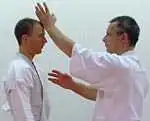 I put the shomen uchi ikkyo right after aihanmi, because they are so closely related. In the initial guard positions of both involved, their relation is the same in shomen uchi as in aihanmi — it's just the distance between them that differs.
Shomen uchi is a sword art attack form, of course, so it is important not to try to block the attack, but step out of its way. The uke nagashi parry, done with the hand, is not to stop the shomen uchi attack, but to get contact with the attacker's arm, so that you can lead it in the ikkyo movement. Since you turn your hand backward, your fingers point in the direction of the attack, not against it. Don't do this technique too quickly, or you will have to block the shomen attack, and try to reverse it when it's at its strongest. You must let the attacker complete the shomen uchi, before you lead his or her arm in the opposite direction. When you step forward for the big ikkyo circular movement, you pass very close to the attacker, and not out to the side. If there is too much space between you in this step, the attacker may be able to escape your ikkyo technique, for example by pulling back his or her arm.
When you make the spinning ura step, it is important to lead the attacker's arm in such a way that his or her elbow points upward and away from you, not down and toward you. You should not need to grip the attacker's arm to accomplish this, but you should be able to, if you find it necessary.
Jodan tsuki — omote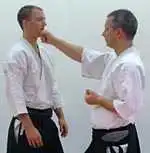 Ikkyo on tsuki, whether it be jodan, to the head, or chudan, to the stomach, is pretty much the same as shomen uchi or aihanmi. Here, the video clip shows jodan tsuki. I do the same uke nagashi parry with my hand. Don't try to block the tsuki, or ward it off — the parry movement with the hand is just to get in contact with it. At the moment of contact it actually moves in the same direction as the attacker's tsuki, not against it.
I would not recommend you to grab the attacker's hand or wrist, in the beginning — although I know many aikidoka do that. When you grab it, you may happen to give momentum and power back to the attacker — and you don't really need to. It's not with the attacker's wrist you do ikkyo, but with the whole arm and the body. In addition, you can easily miss a grab for the wrist, when the tsuki is fast. If you still feel like grabbing the wrist, do so in a movement with the same direction as the tsuki, or you will hurt your fingers, and push that movement on, so that the attacker looses balance. Actually, I regard this way of doing ikkyo as more of a gokyo. It is important to have good timing, so that you start your ikkyo movement at the same time as the attacker's tsuki is completed — no later. If you are delayed, the attacker might pull his or her arm back for a new tsuki, or something else. Also, it is important that you step in close to the attacker. If you do that, you may be able to complete your ikkyo even if he or she has started to pull back the arm. Even if you don't, you advance into a superior position, where there are other techniques you can apply, if necessary.
Remember to stay close to the attacker, all through the technique, or you will not have as good control of him or her as needed. That is also the way to increase your chances of not having the attacker's arm escape you, if the attacker pulls it back. And if you still miss the arm, up this close to the attacker you can easily make another technique — for example iriminage.
Chudan tsuki — omote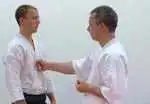 Here is chudan tsuki, a straight punch at middle level, which is at solar plexus. Ikkyo omote is done the same as against jodan tsuki, a punch to the face. The uke nagashi style warding off of the tsuki easily adapts to chudan or jodan level, even at the speed of this attack. Actually, the difference between jodan and chudan is not that big at all, so it doesn't make much difference in how the aikido technique is done. For more about ikkyo against tsuki, see the text about jodan tsuki above.
Chudan maegeri — omoteAikido people don't kick much. I dare say that it's because it takes so much training to learn it decently, and in aikido there is so much else to learn — there's simply not enough time. I've heard other explanations, some ringing quite silly in my ears, such as the statement that noble people don't kick. Well, noble people don't hit each other in the face, either.Some kicks one can learn, without spending too much time on it. The straight forward kick, maegeri, is the easiest one. I recommend that it be included in the aikido attack technique curriculum. The roundhouse kick, mawashigeri, is possible to learn somewhat, if not aiming above waist level. Also the sidekick, yokogeri, but that one is pretty much like maegeri when applying defense against it, so it's not that important. If just one: make it maegeri. Anyone can learn to kick maegeri to stomach height, chudan. The trick to get it up a bit is not to stand on your toes, but to lean back when kicking. But now, the defense: just like with sword attacks, don't try to block it. Try it and you know why not. Make a taisabaki evasion. It's also good, but not necessary, to sweep with your arm in the direction of the kick, to sort of brush it onward. That extends it a bit beyond the attacker's balance, which is already not ideal, since one foot is up from the floor. Don't grab the leg. What to do with it, and how to protect from the attacker's fists, if you hold on to the leg? Instead, grab the arm. If the kick is done with the left foot, then the left arm will surely be up and extended as well, or the right foot and the right arm. As soon as the kick passes, go for the arm. If the arm is held high, you can get it from below, like in the shomen uchi defense above. If the arm is held low, by the waist or so, it can be grabbed from above in a gokyo fashion. Grab it with a sweeping hand movement that begins close to the attacker's body and moves out from it and down toward the attacker's arm. Grab at the wrist. The rest of the ikkyo is not difficult at all.
In this video clip you can see that I apply a wrist lock at the end. This is an additional possibility in the ikkyo pinning, depending on what kind of grip you have on the attacker's wrist. In some grips, the angle is such that you easily apply the wrist bending lock, and in others not. When it comes naturally, just do it. In other cases the basic ikkyo arm lock, with your hands on each side of the attacker's elbow, will do.
Stefan Stenudd
IKKYO COMPLETE
AIKIDO PRACTICEIntroductionAikido Techniques — all the basic movesAttacks in Aikido
Tantodori — knife defenseAikiken — aikido sword techniquesJo 31 Kata in four directionsAikibatto sword and staff exercisesAiki — joining energiesKi exercisesAikido Video ClipsAikido PhotosMy aikido dojo in Malmö, SwedenMy aikido seminarsAIKIDO THEORYMy Aikido BioAikido GlossaryTanden, the CenterAikido InksAikido as Self-DefenseRunning a DojoAikido is TrueOsensei and EinsteinAikiWeb ColumnsAikido Books ReviewedDie deutsche Version meines Aikido-Buches onlineAikido på svenskaAbout CookiesMy Other WebsitesCREATION MYTHSMyths in general and myths of creation in particular.
TAOISMThe wisdom of Taoism and the Tao Te Ching, its ancient source.
LIFE ENERGYAn encyclopedia of life energy concepts around the world.
QI ENERGY EXERCISESQi (also spelled chi or ki) explained, with exercises to increase it.
I CHINGThe ancient Chinese system of divination and free online reading.
TAROTTarot card meanings in divination and a free online spread.
ASTROLOGYThe complete horoscope chart and how to read it.
MY AMAZON PAGE
MY YOUTUBE AIKIDO
MY YOUTUBE ART
MY FACEBOOK
MY INSTAGRAM
STENUDD PÅ SVENSKA
|
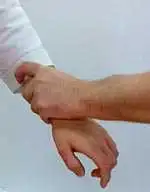 On the video clip, the technique starts in gotai, ie. from a static position. That is done for clarity. The normal timing would be jutai, where the technique looks exactly the same, but starts right before the attacker grabs your wrist. Still, it's good to practice a lot of gotai, not to get stuck when the attacker manages to get hold of your wrist.
 Aikido Principles
 Attacks in Aikido
 Aikibatto