Ernest Jones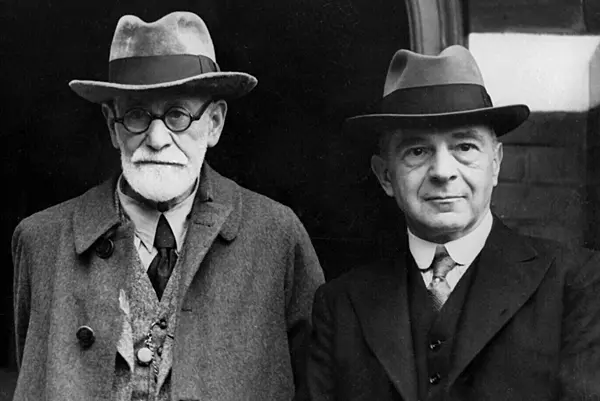 Ernest Jones (to the right) with Sigmund Freud, 1938. His theories about mythology and religion examined by Stefan Stenudd
Apart from The Life and Work of Sigmund Freud in three volumes, published between 1953 and 1957, Jones's writing on psychoanalysis was neither as voluminous nor as significant as that of some of his colleagues. But he did write some essays about psychoanalytical perspectives on certain themes in folklore, mythology, and superstition. Also, he analyzed Hamlet as an expression of the Oedipus complex. His initial text on this subject was from 1910, with expanded revisions in 1911 and 1949.
Spilling SaltIn his 1912 essay "The Symbolic Significance of Salt in Folklore and Superstition," Ernest Jones made a psychoanalytical examination of the old superstition that it brings bad luck to spill salt. In spite of the seemingly marginal subject, his text spans almost a hundred pages, where he goes through a great number of beliefs, folklore fragments, and rituals surrounding the real or imagined potency of salt and its significance in human culture.He concludes from all of this that "the idea of salt has derived much of its significance from its being unconsciously associated with that of semen."[2] Oddly, he is not very clear on how that would lead to the superstition about spilling salt, but it is implied that it could have to do with premature ejaculation: "It acts, in other words, by disturbing the harmony of two people previously engaged in amicable intercourse."[3] Therefore:
Ancient beliefs have linked semen to the other bodily fluids, though they were always understood to have different functions. The superstition regarding spilling salt finds a much easier explanation in the fact that in the past it was precious and in many parts of the world difficult to come by. Having it was fortunate and losing it unfortunate. Mystery solved. Jones also touches on the custom of reversing the bad luck by throwing salt over one's shoulder as a counter-charm, but he admits to not exploring that aspect fully:
There is another thing with superstitions, which tends to be ignored by the psychoanalysts. By time, many superstitious activities become customs, even when people have since long stopped believing in them. Instead of being thought of as charms or counter-charms, they have simply become little rituals done for no other reason than that they conform to the ways of old. There is comfort in that, and much can be said about our need to link to the habits of our predecessors. It is a significant part of our cultural behavior and our reason for it. But it is irrelevant to treat it as superstition. This is shown in our relation to salt. In modern society it is easily accessible in quantity, consequently old symbolic and magical values formerly assigned to it fade away. Some of the customs regarding salt remain, though depraved of their urgency and importance. They are nowadays mere amusements. That in turn raises the question if superstitions were ever firm convictions, or just shared figments of imagination, elements of "what if" more than beliefs.
A Dove in the EarIn 1914, two years after the previous essay, Ernest Jones published a text with similar theme and approach: The Madonna's Conception through the Ear. This time he examined psychoanalytical aspects of the peculiarities of the Annunciation, especially — as stated by some medieval church fathers and shown in some medieval art — the Madonna's impregnation through the ear.He quotes what he mistakenly believes to be written by Augustine: "Deus per angelum loquebatur et Virgo per aurem impraegnebatur" ("God spoke through the angel and the Virgin was impregnated by ear").[8] Among the art works mentioned are Annunciation paintings by Filippo Lippi, Benozzo Gozzoli, and Simone Martini. The painting by Martini is discussed in detail and reproduced on the frontispiece of the 1923 book. Jones's choice of mythological subjects is quite particular. In this case, it gives the impression that there is also a sense of humor involved. He examines the depicting of how Mary got impregnated with Jesus through the ear, by the agents of the archangel Gabriel and a dove. The latter was, of course, the classical representation of the Holy Spirit. So, the conception was done by God's breath. Jones, though, has a take on it that deviates radically from the Christian view. Coming to his own conclusions, he has the same method as with the previous essay — a lengthy list of examples from mythology, superstitions, and art history selected to support his case. The quantity of examples has little weight, since it is evident cherry picking all through. From the multitude of myths and artistic objects, he only chooses those in support of his theory and does not investigate even one that lacks this support or contradicts it. As evidence it is of no value. Also, he insists on the Freudian idea that unconscious impressions and beliefs are formed in early childhood and therefore based on its misconceptions of sexuality and bodily functions. That, too, is in dire need of confirmation. He has none other than that it has been stated by Freud and his disciples in writing, and supposedly supported by experiences from therapy work. His conclusions, from this dubious research, are spectacular to the point of absurd. He claims that the wind of God's breath really refers to the breaking of wind humans do from their anal orifice, the white dove is a phallus, and Maria's ear is a symbol of her anus. The reason for all of this is that these things represent ignorant childish beliefs about human reproduction, stuck in the unconscious all through adulthood. In other words, it is based on the ABC of Freudian doctrine. He states:
But while the latter is occasional and of minor importance, the upper breath is both constant and so vital that it is impossible to persevere for more than a few minutes without it. Jones admits to breath as a symbol of life and the presence or absence of it is the simplest and most primitive test of death.[12] Indeed, it is the foremost expression of being alive and staying alive. Even a child can get that. Furthermore, any child is able to produce a much louder sound from its mouth than from its anus, already in its infancy. The white dove as a symbol of the Holy Spirit is equally evident without any reference to sexual organs. It flies through the air, its color is that of purity, like the clouds in heaven that carry no threats, and it is regarded as a messenger since the time of Noah. As for the tradition of conception through the ear, it was necessary to be another bodily orifice than the usual one, since Mary was in Christian dogma firmly stated to be a virgin also after this act. Moreover, Mary is informed of her pregnancy by the words of Gabriel, just as God had performed the whole world creation by words. She is impregnated by hearing God's command. It is clearly indicated by the Simone Martini Annunciation painting used as a frontispiece to Jones's book. There, the words from Gabriel's mouth are written on a line right at Mary's ear. There is a general objection to be made against the Freudian claim of childish misconceptions taking form in the unconscious, which is also Jones's claim. He shows in his text reasons for these misconceptions that are, however faulty, results of logical assumptions. Children make conclusions from observations, which must be a conscious process also by psychoanalytical standards. Children are aware of them and would therefore be continuously aware of facts learned later, correcting their previous errors. That contradicts the idea of a petrified unconscious influence unbeknownst to the growing child even into adulthood. On a sidenote, in this text from 1914 Jones makes use of the term archetype, which is five years before Jung would do the same in his writing. It is just once, when describing incest as "the great archetype" of sin.[13]
Effeminate GodErnest Jones returned to the subject of Mary's conception by the ear in a lecture given at a psychoanalytical congress in 1922: A Psycho-Analytic Study of the Holy Ghost. He repeats his claims about the nature of God's creative breath and Mary's ear, but then he goes on with additional interpretations of the Holy Ghost and its implications, none less radical than his previous views.Jones states that Christianity has replaced an original trinity of the father, the mother, and the son with one that excludes the mother to insert the Holy Ghost, which emanates from the father. To no surprise, he finds the reason for it in the Oedipus complex:
A milder deity replaces the stern and fearsome father of the Old Testament. Furthermore, "the opportunity is given of winning the Father's love by the adoption of a feminine attitude towards him."[15] This leads to something of a homosexual cult, "the extensive part played by sublimated homosexuality throughout the Christian religion,"[16] as seen by the importance of brotherly love, monks denying their male traits in what Jones describes as a symbolic self-castration, as well as in the celibacy of Catholic priests and the fanciful attire with which they dress themselves. But the worship of the mother was partly reinstated, since "the human need for a Mother to worship was too strong." Mariolatry emerged, leading to the papal decree that she herself was also conceived immaculately. Still, this reinstatement of the mother did not change the homosexual attitude in religion. Instead, "all the self-castrating tendencies are more evident where Mariolatry is highly developed."[17] Protestantism, on the other hand, seeks to regain the male characteristics, by allowing priests to marry, cleaning their attire as well as the churches from exaggerated decorations, and so on. They succeed in this by resisting the Catholic tendency of Mariolatry. Jones ends his lecture:
As for Jones's theories about homosexuality, they might be excused by the prejudice of the time in which his text was written, were it not for their prominence also in the texts of other Freudians, including those of their mentor. The doctrine of psychoanalysis was not only persistently prejudiced against women, but also in its treatment of homosexuality — to the point where it would not be completely irrelevant to apply the modern term homophobia.[18]
Notes
Freudians on Myth and Religion
This text is an excerpt from my book Psychoanalysis of Mythology: Freudian Theories on Myth and Religion Examined, from 2022. The excerpt was published on this website in February, 2026.
MYTH
IntroductionCreation Myths: Emergence and MeaningsPsychoanalysis of Myth: Freud and JungJungian Theories on Myth and ReligionFreudian Theories on Myth and ReligionArchetypes of Mythology - the bookPsychoanalysis of Mythology - the bookIdeas and LearningCosmos of the AncientsLife Energy EncyclopediaOn my Creation Myths website:
Creation Myths Around the WorldThe Logics of MythTheories through History about Myth and FableGenesis 1: The First Creation of the BibleEnuma Elish, Babylonian CreationThe Paradox of Creation: Rig Veda 10:129Xingu CreationArchetypes in MythAbout CookiesMy Other WebsitesCREATION MYTHSMythology in general and creation myths in particular.
TAOISMThe wisdom of Taoism and the Tao Te Ching, its ancient source.
LIFE ENERGYAn encyclopedia of life energy concepts around the world.
QI ENERGY EXERCISESQi (also spelled chi or ki) explained, with exercises to increase it.
I CHINGThe ancient Chinese system of divination and free online reading.
TAROTTarot card meanings in divination and a free online spread.
ASTROLOGYThe complete horoscope chart and how to read it.
MY AMAZON PAGE
MY YOUTUBE AIKIDO
MY YOUTUBE ART
MY FACEBOOK
MY INSTAGRAM
STENUDD PÅ SVENSKA
|
 Archetypes of Mythology
 Psychoanalysis of Mythology