Helene Deutsch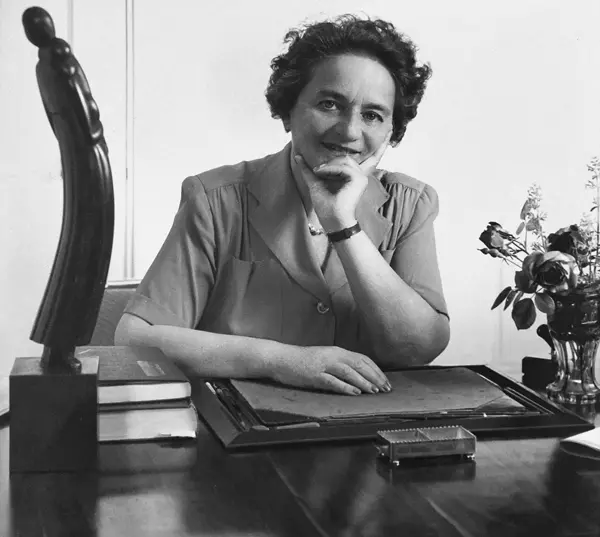
Her theories about mythology and religion examined by Stefan Stenudd
She was analyzed by Freud and also by Karl Abraham, becoming in 1918 the second woman to be admitted to the Vienna Psychoanalytic Society. The first one was Hermine Hug-Hellmuth, who was also the first child psychoanalyst. In 1935, Deutsch moved to the United States, where she remained for the rest of her long life. She stayed expressly loyal to Freud all her life, but that did not stop her from venturing into her own theories, sometimes deviating slightly from those of Freud, though remaining within the paradigm of psychoanalysis. The main portion of her writing deals with the psychology of women, which was treated sparsely by Freud and most of his followers. As for the subject of mythology, she dedicated one book to the myths of Dionysus and Apollo rather late in her professional life — A Psychoanalytic Study of the Myth of Dionysus and Apollo, published in1969. Though the two main characters of her book are men, the theme is their relation to their mothers, which is confirmed already by the subtitle Two Variants of the Son-Mother Relationship. Those are indeed opposite variants, where Dionysus is portrayed as saving his mother and Apollo as killing mothers. The Oedipus complex, so dear to Freud, she dismisses as irrelevant here:
Dionysus Saving his MotherDeutsch starts her chapter about Dionysus by praising his contributions to agriculture, especially that of wine, and to "the emancipation of mortal women."[2] Therefore his statue should be in every agricultural organization and at the entrance to girls' dormitories, but with a distinct note that "the statue is not to commemorate Dionysus's orgastic rites."In order to find the rationality behind the irrational nonsense of the myth, and understand its meaning, she applies psychoanalysis:
Not to mention Jung — but he is not mentioned at all in Deutsch's book, although the Jungian mythologist Joseph Campbell is, as well as Károly Kerényi, together with whom Jung wrote a book in 1942 on mythology where Dionysus is discussed at length.[4] It must have ben her loyalty to Freud that made her shun from even mentioning the foremost disciple of his to desert him. But it is an omission that casts doubts on her scientific honesty. Dionysus is a complicated mythological figure already by having alternative versions even regarding his birth and lineage. Deutsch combines a couple of them, seeing those as describing different aspects of the story, i.e., of its psychological meaning. At the core of the Dionysian myths, she finds two topics, "Dionysus's bisexuality and his struggle for immortality."[5] There is also his relation to his mother playing a role in both those topics, mainly by being absent during his childhood and because she was a mere human, which would make him less of a god. Here, Deutsch uses the version of the myth where the mother is Semele. The father, in just about all versions, is Zeus. As for his bisexuality, Deutsch finds it indicated by "his not always masculine behavior," which in turn was caused by his childhood "lacking in objects for masculine identification."[6] His personal struggle, then, is one between his masculinity and femininity. This is a strange and outdated view on bisexuality. It is not the result of femininity in men, or for that matter masculinity in women. That doesn't even make any sense. Such a line of reasoning would instead lead to the equally fallacious idea of homosexuality caused by femininity in men and masculinity in women. Also, what is that femininity and masculinity really? There are no character traits being exclusively female or male. Those are just stereotypes that fall apart upon closer examination. Bisexuality is the attraction towards both genders, and it is proven to exist among both "female" and "male" personalities, as also Greek mythology tells us. Zeus was by all stereotype standards exceptionally "male" but still bisexual, which Deutsch herself mentions in the following chapter about Apollo.[7] So were several other deities. That was not an issue in Ancient Greece, which is frequently made clear in the writing of Plato. It was more of a sensitive issue in Deutsch's days, but she could hardly claim to make sense of ancient mythology by applying modern conventions and prejudice to it. That would certainly trigger the wrath of Zeus. Still, she goes so far as to interpret the outcome of the story, with Dionysus bringing his mother to Olympus:
Apollo Killing MothersAbout Apollo, too, there are many myths describing his background and activities differently, and Helene Deutsch uses bits and pieces from several of them. She explains that it is not her goal to compare these versions and estimate their validity, but:
In her view, Apollo nourished hostility towards women, especially mothers, and had several of them killed. Not his own mother, though. Deutsch sees this as a process in which a darker, pre-Homeric period ruled by female deities connected to earth were conquered by the male rulers of heaven. Apollo played the major role in this, and he won a lot by it: "Apollo's mythological status as sun-god was achieved through matricidal acts against earth-goddesses"[10] That description of primeval events in Greek mythology can certainly be discussed. Interestingly, though, she does not see this change of rulership as negative. She calls these earth-goddesses the dark rulers of the world and representatives of death, and paints a discouraging picture of the world before Apollo's conquest:
As with Dionysus, Deutsch discusses the bisexuality of Apollo, but sees that of the former as within himself and manifested by projection, whereas that of Apollo is more complicated: "He is psychologically androgynous, both homosexual and heterosexual." She does not expand on what that might mean, but calls his love "mostly narcissistic; he loves men like himself."[15] The narcissism is not hard to spot. It is a prominent characteristic of any deity, regardless of gender, maybe even unavoidable because of their elevated status and superhuman powers. Just by them acknowledging their own grandeur, they can be described as narcissistic. But Deutsch links it to homosexuality,[16] as if homosexual love would be a covert kind of self-love. That is highly doubtful, especially since narcissistic behavior is found among heterosexuals as well. Calling Apollo both homo- and heterosexual is a strange way of using those labels. What can it mean other than bisexuality? Deutsch regards Apollo's sexuality as androgynous, as if he needed to be part male to love women, and part female to love men. This link between sexual preferences and gender identity is common among psychoanalysts, but it remains to be proven. It seems to be firmly rooted in the Freudian — and Jungian — paradigm that anything but heterosexuality is some kind of dysfunction. Regarding both Apollo and Dionysus, Helene Deutsch makes a number of claims that in their lack of arguments are little more than opinions. She interprets characters and their actions quite freely, and draws conclusions from those interpretations. That would still be fine, if those interpretations and conclusions were reasonable. But they are full of contradictions and far-fetched assumptions, mostly because of her obvious prejudice about gender as well as sexuality. She even calls bisexuality an eternal problem of mankind.[17] It would be more adequate to call it an eternal problem of psychoanalysis.
Notes
Freudians on Myth and Religion
This text is an excerpt from my book Psychoanalysis of Mythology: Freudian Theories on Myth and Religion Examined, from 2022. The excerpt was published on this website in February, 2026.
MYTH
IntroductionCreation Myths: Emergence and MeaningsPsychoanalysis of Myth: Freud and JungJungian Theories on Myth and ReligionFreudian Theories on Myth and ReligionArchetypes of Mythology - the bookPsychoanalysis of Mythology - the bookIdeas and LearningCosmos of the AncientsLife Energy EncyclopediaOn my Creation Myths website:
Creation Myths Around the WorldThe Logics of MythTheories through History about Myth and FableGenesis 1: The First Creation of the BibleEnuma Elish, Babylonian CreationThe Paradox of Creation: Rig Veda 10:129Xingu CreationArchetypes in MythAbout CookiesMy Other WebsitesCREATION MYTHSMythology in general and creation myths in particular.
TAOISMThe wisdom of Taoism and the Tao Te Ching, its ancient source.
LIFE ENERGYAn encyclopedia of life energy concepts around the world.
QI ENERGY EXERCISESQi (also spelled chi or ki) explained, with exercises to increase it.
I CHINGThe ancient Chinese system of divination and free online reading.
TAROTTarot card meanings in divination and a free online spread.
ASTROLOGYThe complete horoscope chart and how to read it.
MY AMAZON PAGE
MY YOUTUBE AIKIDO
MY YOUTUBE ART
MY FACEBOOK
MY INSTAGRAM
STENUDD PÅ SVENSKA
|
 Archetypes of Mythology
 Psychoanalysis of Mythology