The aikido technique ikkyo in hanmi handachiwaza against different attacks. Many more aikido videos on my YouTube Channel.
Tori sitting, uke standing
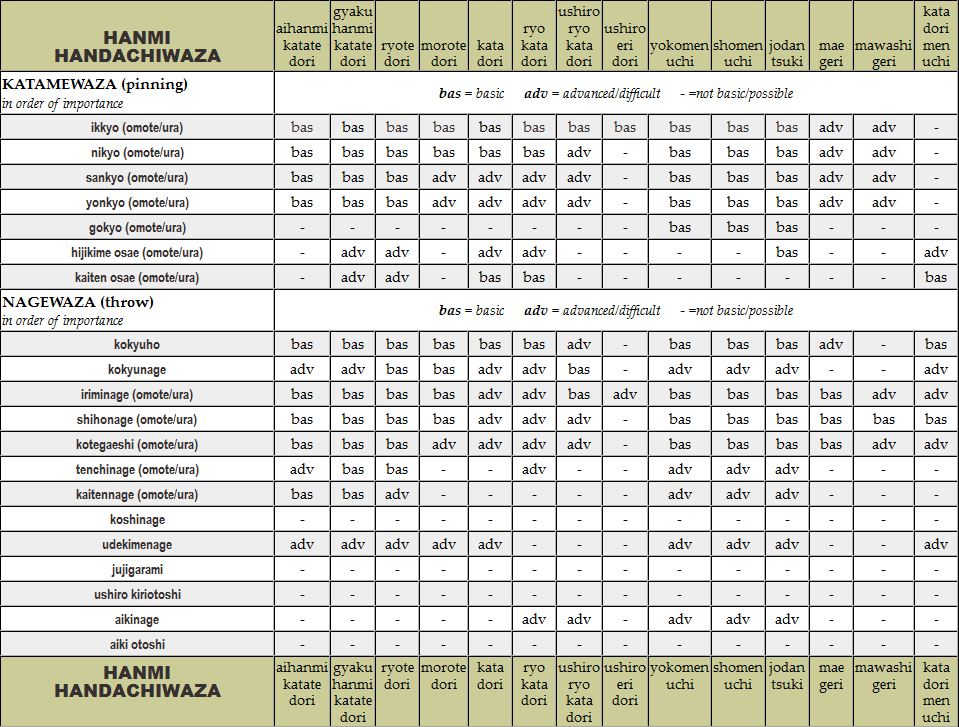
Hanmi handachiwaza: all attacks and aikido techniques. Click the image to see the table enlarged.
Notes on hanmi handachiwaza attacks
Attack forms that are very impractical are excluded from the table. They are not basic, in some cases hardly possible at all.
Both aihanmi and gyakuhanmi katatedori are odd attack forms for uke to do in hanmi handachiwaza, if tori does not raise the arm for uke to reach — which is, of course, odd for tori to do. The same is true for ryotedori. Still they are all basic.
In hanmi handachiwaza, the attack morotedori is done from the side.
Katadori and ryokatadori are reasonable attacks for uke to do in hanmi handachiwaza — contrary to the wrist grips — so they should be trained frequently. This is also true for ushiro ryokatadori, and to a lesser extent for ushiro eridori.
Additional comments on hanmi handachiwaza techniques are below.
IKKYO needs to start with bringing uke down considerably, which is true for almost all hanmi handachiwaza techniques. In ushiro eridori tori needs to stand up to complete the technique, because of the grip in the collar. Against kicks, it can be difficult to get control of uke's wrist, which is hard to reach from sitting down. This is true for all the pinning techniques. See the video of ikkyo on hanmi handachiwaza above. Much more on ikkyo here.
NIKYO can be done on most attacks, with varying difficulty. In ushiro ryokatadori, tori needs to break free of the grip before doing the nikyo pinning. This is true also for ushiro eridori, where it is even more difficult, so it is excluded from the basics.
SANKYO can be done on most attacks, with varying difficulty. It is always difficult on morotedori, because of uke's two-handed grip on tori's wrist. On katadori, ryokatadori and ushiro ryokatadori, it is necessary to break free of uke's grip, before applying the sankyo pinning. This is also true for ushiro eridori, where it is additionally difficult, therefore excluded from the basics.
YONKYO can be done on most attacks, with varying difficulty. It is always difficult on morotedori, because of uke's two-handed grip on tori's wrist. On katadori, ryokatadori and ushiro ryokatadori, it is necessary to break free of uke's grip, before applying the yonkyo pinning. This is also true for ushiro eridori, where it is additionally difficult, therefore excluded from the basics.
GOKYO is only relevant against striking attacks (especially when done with knife). Therefore, only those attack forms are included in the basics.
HIJIKIME OSAE is not very practical in hanmi handachiwaza, because of tori sitting down. On jodantsuki, though, it is reasonably easy, since uke's arm is straight after the attack. Also on gyakuhanmi katatedori, ryotedori, katadori and ryokatadori, it can be done without too much difficulty.
KAITEN OSAE should be done both soto (outer) and uchi (inner), when possible. Since it is a peripheral technique, it is only included in the basics for the attacks where it is reasonably easy to do.
KOKYUHO can be done on most attacks, but is generally tricky in hanmi handachiwaza, because of tori's need to bring down uke before the throw. On ushiro eridori it is too difficult to bring uke down, and on mawashigeri too difficult to enter into a good position for the throw. Therefore, these are not basic.
KOKYUNAGE can be done on most attacks, with varying difficulty. It is very difficult on ushiro eridori, because of uke's position in relation to tori, and on kicks because of uke's extended foot position, so these are not basic.
IRIMINAGE is quite easy on most attacks, if uke is first brought down properly. Katadori and ryokatadori are a little tricky, because of the difficulty for tori to reach. On mawashigeri the problem is bringing uke down. On katadori menuchi it gets quite difficult, because of uke's arms being in the way.
SHIHONAGE is easy on most attacks. Ura is so difficult in hanmi handachiwaza, because of uke's leg being in the way, that many aikido teachers exclude it. Tori should stand up to complete the throw on ryotedori, ryokatadori and ushiro ryokatadori. It can also be allowed on other attacks. On ushiro eridori it is very difficult to do a regular shihonage, so it is not basic.
KOTEGAESHI can be done on most attacks, with varying difficulty. On ushiro eridori it is very difficult to get to, so it is not basic. On mawashigeri it is tricky to get hold of the wrist, and on katadori menuchi tori needs to do the technique with uke's katadori grip remaining.
TENCHINAGE is difficult on most attacks in hanmi handachiwaza, because of tori sitting down, making it hard to extend uke in two directions. In aihanmi katatedori it is necessary first to break free from uke's wrist grip. It is not practical against kicks.
KAITENNAGE should be done both soto (outer) and uchi (inner), when possible. It is far from basic on most attack forms in hanmi handachiwaza, because of the difficulty in bringing uke down correctly before the throw. It is not practical against kicks, because of uke's arms being difficult to catch and control in the way needed.
KOSHINAGE is not something to do in hanmi handachiwaza, because of tori sitting down.
UDEKIMENAGE can be done rather easily on some attacks. The difficulty lies in advancing to get enough of a pull in the throw. It is because of this difficulty that the technique can't really be basic in hanmi handachiwaza. It is not practical against kicks, although possible.
JUJIGARAMI is very difficult on almost every attack in hanmi handachiwaza, because of tori sitting down, which leads to problems in controlling uke's arms sufficiently. There is no need for including it in the basics.
USHIRO KIRIOTOSHI is not practical at all in hanmi handachiwaza, since it is difficult for tori to reach uke's shoulders from the rear.
AIKINAGE is possible to do on some attacks in hanmi handachiwaza, although there is not much of a surprise effect in going down only from a sitting position. When done on ryokatadori and ushiro ryokatadori, it needs to happen before uke's grips are applied.
AIKI OTOSHI is not possible to do in hanmi handachiwaza, because of tori sitting down.
Aikiken Sword Exercises for Aikido. The aikibatto exercises, practical and spiritual aspects of the sword arts, advice on equipment for training. More about the book here.
About me
I'm a Swedish author of fiction and non-fiction books in both English and Swedish. I'm also an artist, a historian of ideas, and a 7 dan Aikikai Shihan aikido instructor. Click the header to read my full bio.
 Aikido Principles
 Attacks in Aikido
 Aikibatto