Aikido techniques in jodori, defense against staff attacks. Many more aikido videos on my YouTube Channel.
Staff attacks
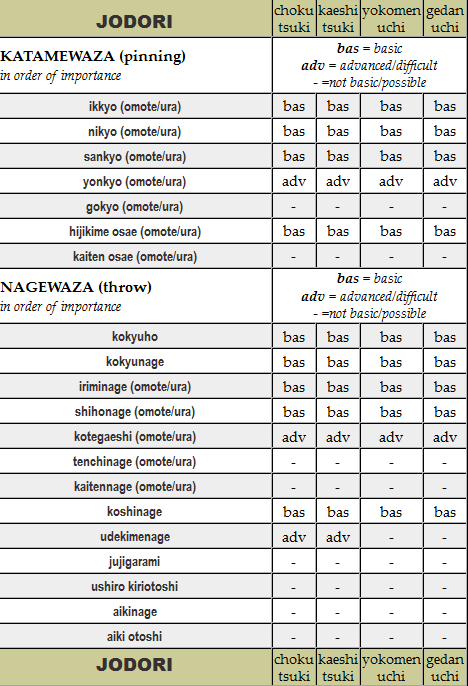
Jodori: all attacks and aikido techniques. Click the image to see the table enlarged.
Notes on jodori defense and attacks
Some techniques should be excluded from jodori, because they lack in control of the jo.
Observe the differences for tori, when uke holds choku, front hand on jo straight like in a sword grip, or kaeshi, front hand on jo reversed.
Kaeshitsuki is sometimes called gyakutsuki.
Techniques on yokomenuchi and gedanuchi are either done like on chokutsuki or like on kaeshitsuki, depending on uke's grip of the jo.
Basic techniques on jodantsuki, to the head or neck, and on gedantsuki, to the knee, are done like on chudantsuki.
Gedanuchi with the jo is a swing strike to the knee. It is rarely trained in aikido jodori, but should be tried.
No shomenuchi with the jo (impractical attack).
No kote, wrist strike, with the jo (the attack is only meaningful against an armed opponent).
Jodori can be practiced in suwariwaza and especially in hanmi handachiwaza, but that is not to be regarded as basic. Anyway, the solutions are quite the same as for tachiwaza.
All attacks in jodori can be done with the right arm in front of the left, or the left arm in front of the right (contrary to tachidori, where the right arm is always in front of the left).
Most jodori techniques can be done either on the hand uke extends in the attack, or on the hand uke holds back. Usually, the former is more basic and easy, but that depends on what side of uke tori enters. A solution similar to that of tachidori is to be regarded as the most basic, when that can be decided.
Do not underestimate the difficulty in applying a technique and unarming uke, whose two-handed grip on the jo can be quite firm and solid.
Jodori should always be done with good control of the jo, and end with disarming.
Returning the jo to uke, should be done with care.
Additional comments on jodori techniques are below.
IKKYO is easy enough on all attacks, and on uke's outer as well as inner arm. The disarming of uke, though, can be tricky. Much more on ikkyo here.
NIKYO is easier to do on uke's inner arm, because of the two-handed grip.
SANKYO is easier to do on uke's inner arm, because of the two-handed grip.
YONKYO is not practical in jodori, because of the lack of control of tori's jo. It needs to be done on the inner arm.
GOKYO is just like ikkyo on uke's outer arm, but it cannot end with the typical gokyo pinning, so there is no reason to include it among the basics.
HIJIKIME OSAE can be done on all jodori attacks, and is quite practical at that. It is slightly easier to do on uke's outer arm.
KAITEN OSAE is just not possible in jodori, because of uke's two-handed grip on the jo. So, it is excluded.
KOKYUHO is quite easy to do on all jodori attack forms, particularly on the side of uke's outer arm.
KOKYUNAGE is easy to do on all jodori attack forms, and on both sides of uke.
IRIMINAGE is easy to do on the side of uke's outer arm, but significantly more difficult on the other side of uke — especially when it comes to controlling the jo.
SHIHONAGE can be done rather easily on both sides of uke. The side of uke's outer arm is most common, although the inner arm side is more practical.
KOTEGAESHI is possible to do on all the jodori attack forms, but difficult because of uke's grips on the jo, stabilizing uke's hands. The technique should be done on uke's outer arm.
TENCHINAGE is not practical in jodori, since it is not possible to extend uke's arms in the way needed.
KAITENNAGE is not possible in jodori, because of uke's two-handed grip on the jo.
KOSHINAGE is quite easy to do in jodori, on both sides of uke. It is the easiest on the side of uke's inner arm.
UDEKIMENAGE is possible, although difficult, on jo tsuki attacks, but should be avoided on the uchi attacks, because the technique needs an entrance to the side of uke's outer arm.
JUJIGARAMI (also called JUJINAGE) is not possible in jodori, because of uke's two-handed grip on the jo, and is therefore excluded.
USHIRO KIRIOTOSHI is possible to do on jodori attacks, but it has no control of the jo and will not lead to the necessary disarming, so it is excluded.
AIKINAGE should not be applied to jodori, for safety reasons. Also, it completely lacks control of the jo, and a possibility to disarm uke.
AIKI OTOSHI does not apply to jodori, because of how uke attacks. Also, it lacks control of the jo.
Aikiken Sword Exercises for Aikido. The aikibatto exercises, practical and spiritual aspects of the sword arts, advice on equipment for training. More about the book here.
About me
I'm a Swedish author of fiction and non-fiction books in both English and Swedish. I'm also an artist, a historian of ideas, and a 7 dan Aikikai Shihan aikido instructor. Click the header to read my full bio.
 Aikido Principles
 Attacks in Aikido
 Aikibatto