The aikido technique kotegaeshi against the tantodori attack chudan tsuki. Many more aikido videos on my YouTube Channel.
Knife defense
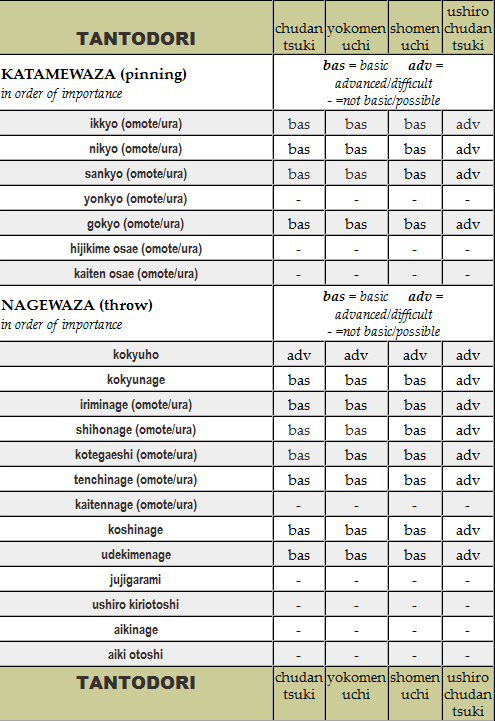
Tantodori: all attacks and aikido techniques. Click the image to see the table enlarged.
Notes on tantodori defense and attacks
Some techniques should be excluded from tantodori, because they lack control of the tanto.
In tantodori, the techniques should be practical and as safe as possible — deviations from this should be clearly pointed out in training.
Tantodori should always be done with good control of the tanto, and end with disarming.
The techniques should also be executable against a double edged tanto.
Returning the tanto to uke, should be done with care.
Entrance on shomenuchi should also protect against yokomenuchi, and vice versa, since it can be very difficult for tori to perceive which one of them uke will attack with. Same with chudantsuki/jodantsuki.
Jodantsuki is not necessary to include with the basic in tantodori, but good to practice now and then. Tori should handle it the same way as chudantsuki.
Tsuki can be done with uke holding the tanto edge down, edge up, or edge to the side.
Shomenuchi attack is usually done with the same grip on the tanto as in tsuki, but in yokomenuchi the grip is reversed. Either grip can be used for both attack forms.
Ushiro chudantsuki is not exactly basic, but should be tried. It is most meaningful in gotai, from a static starting point, with uke already up close from behind, doing tsuki only upon tori's movement.
Certainly, tantodori can be practiced in suwariwaza and hanmi handachiwaza, but that is not to be regarded as basic. Anyway, the solutions are quite the same as for tachiwaza.
Additional comments on tantodori techniques are below.
IKKYO should be done with great care, so as not to get one's wrist or hand cut by the knife. Therefore, the gokyo style grab of uke's wrist is often the most trustworthy — but it is also possible to do ikkyo with the lower arm meeting, like in unarmed shomenuchi and other attacks. If the attacking arm is low, as in chudantsuki, the gokyo grip is the most practical.
NIKYO in tantodori must be done with tori's arms extended, instead of pressing uke's hand to tori's shoulder, for safety reasons. Also, the regular nikyo pinning at the end of the technique is questionable — it is better to do an ikkyo pinning, or a standing kotegaeshi pinning, to disarm uke. See also the comments on ikkyo above.
SANKYO in tantodori can be done disarming the uke already at the sankyo twisting of uke's wrist. The sankyo end pinning is not equally safe for disarming. The gokyo style grip on uke's wrist (as explained in the comments on ikkyo above) is not functional when doing sankyo, which has to start with the lower arm meeting.
YONKYO is not really recommendable in tantodori, for safety reasons. It can be done, but it is not easy. The yonkyo grip is difficult to apply when uke holds a tanto, and the disarming in awkward. When the technique is practiced, this should be kept in mind.
GOKYO is the most basic pinning technique in tantodori, because it is pretty much designed for that purpose, all the way to the end pinning and disarming.
HIJIKIME OSAE is not recommendable in tantodori, for safety reasons. It involves holding uke's knifehand close to tori's neck and chest. But the technique can be modified for increased safety. Some aikido teachers are quite confident about it.
KAITEN OSAE is not recommendable in tantodori, for safety reasons. It involves uke's knifehand moving close to tori's face, neck and chest.
KOKYUHO in tantodori should be done so that it ends with disarming uke. Mostly, a kotegaeshi style ending works the best. Since it is a little tricky to get a good control of uke's tanto hand in kokyuho, it should be regarded as advanced.
KOKYUNAGE in tantodori should be done so that it ends with disarming uke. This means holding on to uke through the throw. Mostly, a kotegaeshi style ending works the best.
IRIMINAGE in tantodori should be done so that it ends with disarming uke. This means keeping contact with uke through the throw. Mostly, a kotegaeshi style ending works the best.
Iriminage on tantodori.
SHIHONAGE in tantodori should be done so that it includes disarming uke. This can be done right before the throw, or immediately after it.
KOTEGAESHI is usually regarded as the easiest and most practical throwing technique in tantodori. It leads to a pinning, where disarming uke can be done in an uncomplicated way. See the video of kotegaeshi on tantodori on the top of this page. More about tantodori kotegaeshi here.
TENCHINAGE in tantodori should be done so that it ends with disarming uke. This means holding on to uke through the throw. A kotegaeshi style ending works the best.
KAITENNAGE is not very practical at all in tantodori, since it does not lead to a pinning where uke can be disarmed. Therefore, it should not be included in the basics.
KOSHINAGE in tantodori should be done so that it ends with disarming uke. This means holding on to uke through the throw. Mostly, a kotegaeshi style ending works the best.
UDEKIMENAGE in tantodori should be done so that it ends with disarming uke. This means holding on to uke through the throw. A kotegaeshi style ending works the best.
JUJIGARAMI does not really apply to tantodori, since it is difficult to get that control of both uke's arms.
USHIRO KIRIOTOSHI is not practical in tantodori, since it lacks the control of uke's knife arm.
AIKINAGE should not be applied to tantodori, for safety reasons. Also, it completely lacks the control of uke's knife arm.
AIKI OTOSHI does not apply to tantodori, because of how uke attacks, and because of the lack of control of uke's knife arm.
Aikiken Sword Exercises for Aikido. The aikibatto exercises, practical and spiritual aspects of the sword arts, advice on equipment for training. More about the book here.
About me
I'm a Swedish author of fiction and non-fiction books in both English and Swedish. I'm also an artist, a historian of ideas, and a 7 dan Aikikai Shihan aikido instructor. Click the header to read my full bio.
 Aikido Principles
 Attacks in Aikido
 Aikibatto