Aikido techniques against different ushiro attacks. Many more aikido videos on my YouTube Channel.
Standing, rear attacks
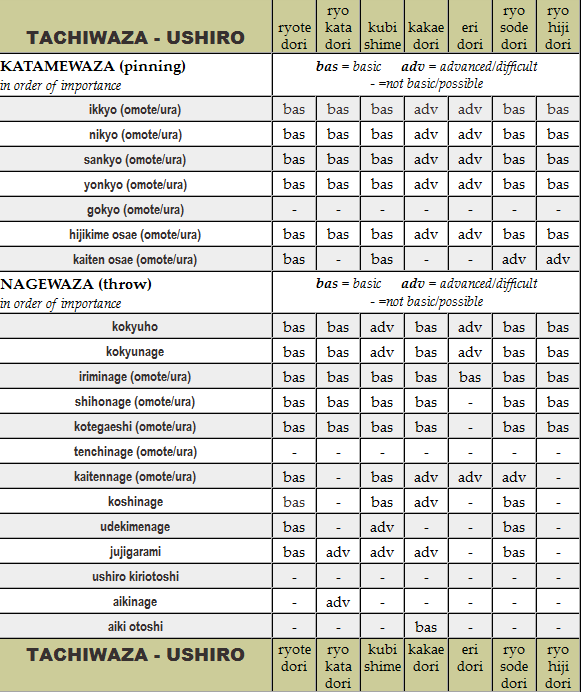
Tachiwaza ushiro: all attacks and aikido techniques. Click the image to see the table enlarged.
Notes on tachiwaza — ushiro attacks
When uke starts in front of tori, on the way to ushiro, tori should do an evasive taisabaki, not to stand in uke's way.
Kubishime as a basic technique is done katatedori kubishime, one hand grabbed.
Kakaedori can be done outside or inside tori's arms. Basic techniques are done with a grip outside tori's arms.
Of course, also strikes can be practiced ushiro, from behind, but apart from the initial evasive move, they are done the same way as from the front, mae.
Additional comments on tachiwaza ushiro techniques are below.
IKKYO is easily done on all the above attack forms — although slightly trickier on kakaedori and eridori, because these holds are more difficult to get out of. On ryokatadori and eridori it is necessary to break free from the grip. More about ikkyo here.
GOKYO is not basic in ushiro, since there are no strikes.
HIJIKIME OSAE — see what is said about ikkyo above.
KAITEN OSAE is in ushiro only done as uchikaiten, under the arm, since this is the way tori gets out of the grip. On some attacks it is a very impractical or complicated techniqe to do, thus far from basic.
KOKYUHO (also called sokumen iriminage) is tricky to do on kubishime, because of the positions of uke's arms, tending to get in the way. It can get tricky also on eridori, if uke's arm is firmly held straight, in which case it is difficult to get close enough to uke for kokyuho. More about kokyuho here.
IRIMINAGE is easy to do on most attacks. On ushiro ryokatadori it can get tricky, if uke holds on to the shoulders. Eridori, too. More about iriminage here.
SHIHONAGE is easy to do on most attacks. Against ushiro ryokatadori it is quite tricky to do properly, since tori has to break free of the grip first. There is really no reasonable way to do shihonage properly on eridori. More about shihonage here.
KOTEGAESHI is easy to do on most attacks. It gets a little complicated on ushiro ryokatadori, where tori has to break free of the grip first. There is not really a proper eridori solution for kotegaeshi. More about kotegaeshi here.
TENCHINAGE is difficult or next to impossible against ushiro attacks, since tori needs to separate uke's arms opposite to their positions in the grips.
KAITENNAGE is difficult or next to impossible against several ushiro attacks, usually because of the need to break free and still lead uke into the technique.
KOSHINAGE is reasonably possible to do against a few ushiro attacks, and very difficult against others. Usually, the need for aa certain distance — or closeness — is what creates the problems. More about koshinage here.
UDEKIMENAGE is easy on two ushiro attacks, complicated on one, and close to impossible on the others. The problem is mostly getting uke's arm in position for the throw.
JUJIGARAMI (also called JUJINAGE) is easy to get to in several ushiro attack forms, where uke's arms cross almost automatically. At eridori, though, tori is not likely to get hold of both uke's arms, and at ushiro ryohijidori it is not realistic to get uke's arms crossed.
USHIRO KIRIOTOSHI is not practical in ushiro, since it demands getting behind uke.
AIKINAGE can be done against ushiro ryokatadori, but not really against any of the other ushiro attacks.
AIKI OTOSHI is neither practical nor simple against any other ushiro attack than kakaedori, where it is instead very suitable.
Aikiken Sword Exercises for Aikido. The aikibatto exercises, practical and spiritual aspects of the sword arts, advice on equipment for training. More about the book here.
About me
I'm a Swedish author of fiction and non-fiction books in both English and Swedish. I'm also an artist, a historian of ideas, and a 7 dan Aikikai Shihan aikido instructor. Click the header to read my full bio.
 Aikido Principles
 Attacks in Aikido
 Aikibatto