The aikido technique iriminage against several different attacks. Many more aikido videos on my YouTube Channel.
Standing, frontal attacks
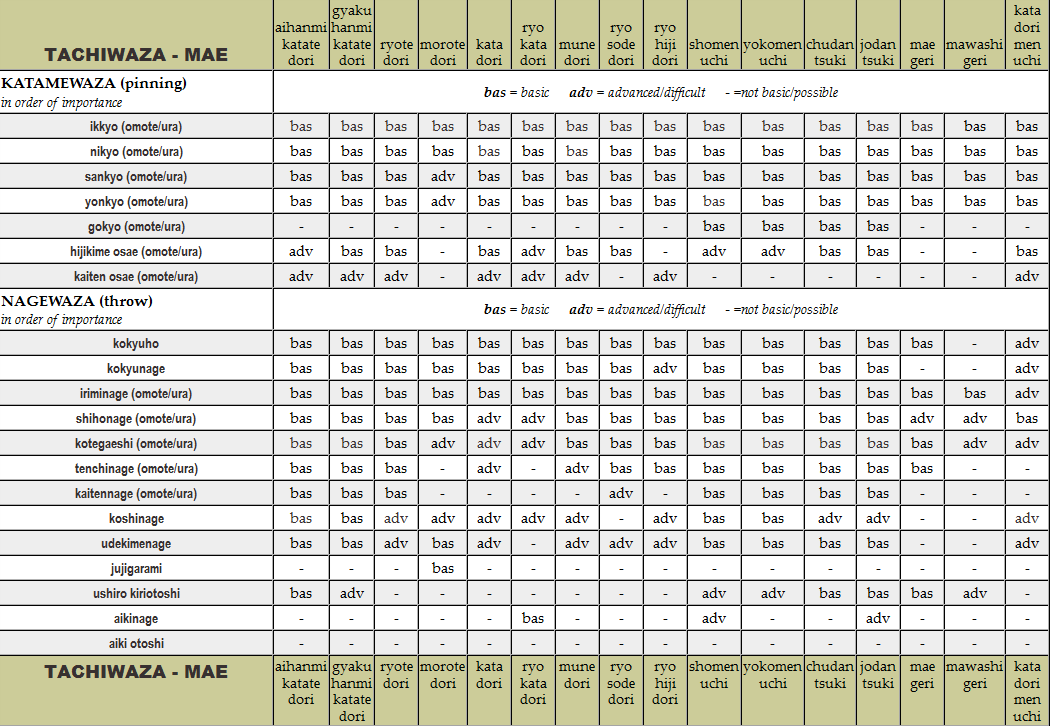
Tachiwaza mae: all attacks and aikido techniques. Click the image to see the table enlarged.
Notes on tachiwaza — mae attacks
Morotedori (also called katate ryotedori) is sometimes dealt with as aihanmi katatedori, and sometimes as gyakuhanmi katatedori, depending on which one of uke's arms tori does the technique on.
Morotedori counts as mae, a front attack, although uke should apply the grip almost behind tori, not to be too vulnerable to a strike from tori.
On katadori and ryokatadori it is usually necessary to break free of the grip, to do the aikido technique.
Same entrance on one hand attack as on ryo, both, and practically the same execution of the technique.
Sodedori and hijidori are usually done as ryo, grip with both hands. If just a one hand grip, they are treated the same as ryo.
Entrance on shomenuchi should also protect against yokomenuchi, and vice versa. Same with jodantsuki/chudantsuki, maegeri/mawashigeri.
Basic techniques on shomenate are done like on shomenuchi. Often in aikido, shomenate is done instead of shomenuchi, also as basics.
Both maegeri, straight kick, and mawashigeri, roundhouse kick, can be done to different height — usually chudan or jodan — but it makes no difference in how the aikido technique is done.
Katadori menuchi would be most effective to always handle as katadori, commencing before the shomen strike, but most common in aikido is to await the shomen and then do the technique on either the shomen or the katadori.
Katadori jodantsuki is treated much the same as katadori menuchi, but not included in the basics.
Additional comments on tachiwaza mae techniques are below.
IKKYO is the most basic of all aikido techniques, and should be possible to do on any attack. It is also an entrance move for nikyo, sankyo, yonkyo, gokyo and hijikime osae, but it is not always so that they are applicable to all the situations where ikkyo works. More about ikkyo here.
NIKYO is the second most basic pinning technique after ikkyo, and applicable to most but not all attacks — though all in tachiwaza mae. More about nikyo here.
SANKYO is a bit tricky to do on morotedori, because of uke's hands both being involved in the grip. More about sankyo here.
YONKYO is a bit tricky to do on morotedori, because of uke's hands both being involved in the grip. More about yonkyo here.
GOKYO differs from ikkyo in two ways: 1) the grip on uke's wrist, 2) the pinning at the end. Gokyo is mainly against armed attacks, such as tantodori. Therefore it is not to be regarded as basic against attacks that cannot be done with a knife.
HIJIKIME OSAE is by some aikido organizations called rokkyo, the sixth teaching. It is most often an alternative to nikyo, when uke's arm is straight, but because of its slightly different movement, it becomes more complicated against some attacks. In most aikido, the technique is not regarded as basic at all. Many aikido teachers make no division into omote and ura of hijikime osae.
KAITEN OSAE is rarely regarded as a basic technique in aikido, which is why it is never marked as basic against any attack in the table above. It is like kaitennage, although ending with a pinning instead of a throw. Kaiten osae should be done both soto (outer) and uchi (inner), where it can be applied. Many aikido teachers make no division into omote and ura of kaiten osae.
KOKYUHO (also called sokumen iriminage) is by some aikido organizations not regarded as a technique at all, just a basic exercise (usually done in warm-up). That is a pity, since it is a very practical technique, applicable to most situations. More about kokyuho here.
KOKYUNAGE can be done in so many ways. For the basics, a straight-forward way of doing it should be used, but advanced students should be able to do several variations of kokyunage against the most basic grip attacks. It is not really functional against kicks, because of the lack of contact and the position uke ends up in, after a kick. More about kokyunage here.
IRIMINAGE is a very practical technique, easy to do on most attacks. On katadori menuchi it gets a little tricky, though, because of uke's arms being in the way. Many aikido teachers make no division into omote and ura of iriminage. More about iriminage here.
SHIHONAGE is easy to do on most, but not all, attacks. Usually, omote is easier than ura, but on some attacks it is the other way around. Against kicks, shihonage is a bit complicated, because of the extended position of uke's leg after the kick. Also against shoulder grips (katadori and ryokatadori) it is tricky to do, since tori has to break free of the grip first. More about shihonage here.
KOTEGAESHI is easy to do on most attacks. It gets a little complicated on shoulder grips (katadori and ryokatadori), where tori has to break free of the grip first, and on morotedori because of the two-hands grip. On mawashigeri it is difficult, because tori has to enter on the inside of the kick, and on katadori menuchi because tori has to go under uke's katadori arm. Many aikido teachers make no division into omote and ura of kotegaeshi. More about kotegaeshi here.
TENCHINAGE is difficult or next to impossible against many attacks, because it needs to extend uke in two separate directions. On katadori and munedori, tori has to break free of the grip to do it. Many aikido teachers make no division into omote and ura of tenchinage.
The aikido technique tenchinage against several different attacks. Many more akido videos on my YouTube Channel.
KAITENNAGE is difficult against several grip attacks, since it is necessary to break free of the grip first, and then there is a problem of leading uke. Against kicks, it is not very practical at all, because of the position uke lands in, after the kick. Kaitennage should be done both soto (outer) and uchi (inner). Many aikido teachers make no division into omote and ura of kaitennage.
KOSHINAGE is done with different frequency in aikido dojos. Some do it a lot, some very rarely. The technique can be applied to many attacks, and there is a lot of ways to do it — for basic training, a straight-forward way should be used. Because of its rarity in many aikido dojos, it is marked as advanced against attacks where koshinage needs to be done in a way less common in aikido, although it may be rather easy to do. On ryosodedori it is particularly difficult because of uke's sleeve grip, which makes is complicated for tori to control uke enough. Against kicks, koshinage is not to recommend. More about koshinage here.
UDEKIMENAGE is a bit difficult against ryotedori, since tori has to break free of one of the grips beforehand — the same with ryosodedori and ryohijidori. Also against katadori and munedori, tori has to break free of the grip. Udekimenage is not practical against kicks, because of the position uke lands in after the kick.
JUJIGARAMI (also called JUJINAGE) is easy to do against a few attacks, and very difficult against most others, since uke's arms need to be crossed. Since jujigarami is not a very basic technique in aikido, the student really needs not try to solve complicated situations for it.
USHIRO KIRIOTOSHI is by most aikido teachers not regarded as a basic technique at all, wherefore it is not necessary for the student to work that much on it. It is difficult to do when it is tricky to break free of a grip attack, so it is mostly applied on striking attacks.
AIKINAGE is a neat technique against a few attacks, but hardly a basic technique at all. One needs to be completely free of grips, so it is only to be applied on some striking attacks. The exception is ryokatadori, where aikinage is quite easy in spite of the remaining grips — but maybe in this case, strictly speaking, it should not be regarded as a proper aikinage. Observe that it should not be tried on kicks. It is also questionable on chudan striking attacks and on yokomen.
AIKI OTOSHI is far from basic, and somewhat questionable as an aikido technique, since it involves lifting uke. It is most practical against some ushiro attacks, but never easy to do with conviction. Since it is such a peripheral technique, it is unnecessary for the student to practice against most attacks.
Aikiken Sword Exercises for Aikido. The aikibatto exercises, practical and spiritual aspects of the sword arts, advice on equipment for training. More about the book here.
About me
I'm a Swedish author of fiction and non-fiction books in both English and Swedish. I'm also an artist, a historian of ideas, and a 7 dan Aikikai Shihan aikido instructor. Click the header to read my full bio.
 Aikido Principles
 Attacks in Aikido
 Aikibatto