Kaeshiwaza against several aikido techniques. Many more aikido videos on my YouTube Channel.
Counter techniques
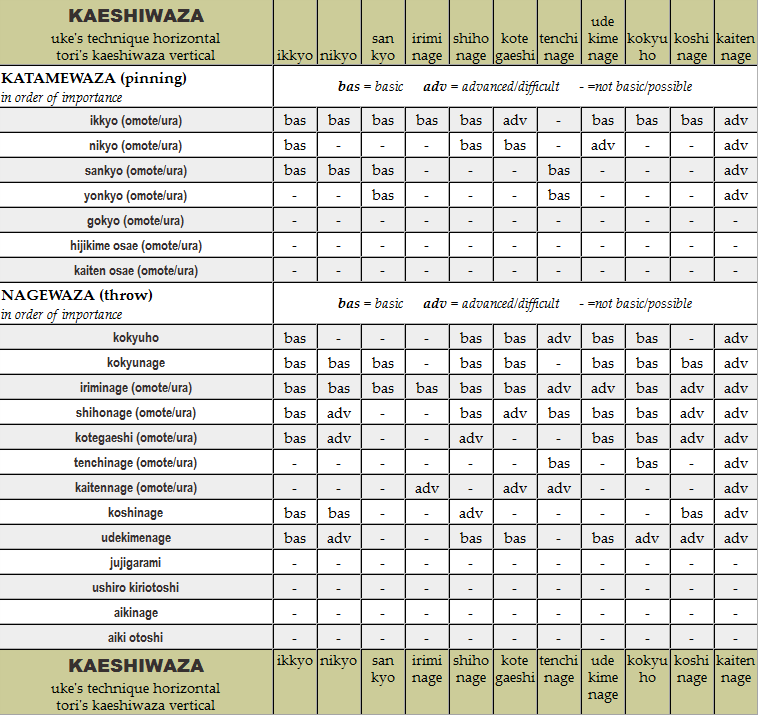
Kaeshiwaza: all attacks and aikido techniques. Click the image to see the table enlarged.
Notes on kaeshiwaza basics
A correctly done technique on a sincere attack, should not really be possible to counter with kaeshiwaza.
Countering is done by "switching roles" from uke to tori, at a certain point, by treating the other one's aikido technique as an attack.
In basic techniques, the shift of "roles" should happen at a moment when the technique of the other has become specific, ie. recognizable as a certain aikido technique.
Kaeshiwaza should be seen as a way of improving the aikido techniques.
Since kaeshiwaza should be done when the technique has become specific, the initial attack form does not matter much.
Additional comments on kaeshiwaza techniques are below.
IKKYO should not be countered before uke's arm is lifted in an arch. It is relatively easy to counter with most techniques, except tenchinage, because of the partner's arm positions.
NIKYO should not be countered before uke's hand is positioned for the nikyo wrist twist. Because of this position, several techniques are impractical against it.
SANKYO should not be countered before uke's hand is positioned for the sankyo wrist twist. Because of this position, several techniques are impractical against it.
YONKYO should not be countered before uke's arm is positioned for the yonkyo pressure. Because of tori's two-handed grip, most techniques are impractical against it.
GOKYO is not practical to counter, since it doesn't really become gokyo before the end pinning, and that is too late for kaeshiwaza.
HIJIKIME OSAE can be countered, but it is quite risky because of the elbow lock. It should be avoided, or practiced with care. Solutions are difficult on most counter techniques, because of tori's arm positions.
KAITEN OSAE is not that meaningful in kaeshiwaza, since it has to be countered before it clearly has become kaiten osae.
KOKYUHO can be countered at tori's first move, but not after tori has started the actual throw. It is reasonably easy to counter with most techniques.
KOKYUNAGE can be countered when the actual throw commences, but preferably right before that. It is rather easy to counter with most techniques.
IRIMINAGE should not be countered before tori moves the throwing arm toward uke. It can be countered with most techniques.
SHIHONAGE should not be countered before uke's arm has been lifted. Most counter techniques can be used, although with differing difficulty.
KOTEGAESHI should not be countered before tori prepares to turn uke's wrist. Because of tori's hand positions, several counter techniques become impractical.
TENCHINAGE is difficult to counter, since it is quite late in the technique that it becomes recognizable as tenchinage, and few options remain.
KAITENNAGE is quite difficult to counter, since it is quite late in the technique that it becomes recognizable as kaitennage, and by then uke's position is weakened.
KOSHINAGE should not be countered before tori has assumed a throwing position. Some counter techniques are quite easy, others very impractical.
UDEKIMENAGE should not be countered before tori has positioned uke's arm for the throw. Several counter techniques are quite easy, but some impractical.
JUJIGARAMI (also called JUJINAGE) is not practical to counter, since it is too late in the technique that it is reognizable as jujigarami, and by then uke's arms are locked.
USHIRO KIRIOTOSHI is not practical to counter, since it becomes recognizable right at the throwing moment.
AIKINAGE is not practical to counter, because it becomes recognizable at the very moment of the throw.
AIKI OTOSHI is not practical to counter, because it becomes recognizable too late in the technique, where uke's options are few.
Aikiken Sword Exercises for Aikido. The aikibatto exercises, practical and spiritual aspects of the sword arts, advice on equipment for training. More about the book here.
About me
I'm a Swedish author of fiction and non-fiction books in both English and Swedish. I'm also an artist, a historian of ideas, and a 7 dan Aikikai Shihan aikido instructor. Click the header to read my full bio.
 Aikido Principles
 Attacks in Aikido
 Aikibatto