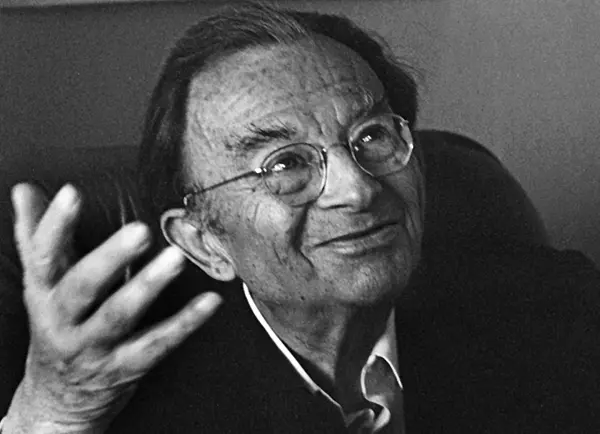
Erich Fromm:
|
by Stefan Stenudd |
 Archetypes of Mythology
 Psychoanalysis of Mythology
He urged that its importance is such that it should be taught in schools just as other foreign languages.
His presentation of this symbolic language, though, is far from as structured and well-defined as is the rule for languages, and he readily admits to the many contradicting interpretations of it by his colleagues in psychoanalysis. Teaching it in high schools and colleges, as he suggests, would be a bumpy ride with the risk of confusing the students more than enlightening them.
Already his definition of this language makes it hard to handle with something similar to the precision of grammar and glossaries:
Symbolic language is a language in which inner experiences, feelings and thoughts are expressed as if they were sensory experiences, events in the outer world.[2]
That would make them akin to metaphors. The real world is used to explain and express inner sentiments:
Symbolic language is language in which the world outside is a symbol of the world inside, a symbol for our souls and our minds.[3]
Furthermore, he insists not only that this language is the same for dreams and myths, but also that it is the same for all cultures and throughout history.[4]
He divides these symbols into three kinds: conventional, accidental, and universal. Only the latter two contain symbolic language. The conventional symbols are the everyday ones we share and assign the same meaning, such as just about any noun in a language. The accidental ones are regular symbols that have by personal experience been given a meaning not shared by others. The universal ones have a symbolic meaning shared by all. Fromm mentions fire and water as examples, in how they carry similar if not identical emotions and associations that go beyond their basic meanings.[5]
It is the language of the universal symbol that is "the one common tongue developed by the human race."[6] He explains this by its links to our traits as a species:
The universal symbol is rooted in the properties of our body, our senses, and our mind, which are common to all men and, therefore, not restricted to individuals or to specific groups.
This takes him very close to Jung's theory of the archetypes, which were also explained as universal because of their emergence from common human characteristics and experiences. Fromm even argues for the existence of these universal symbols in much the same way as Jung did for archetypes:
Evidence for this is to be found in the fact that symbolic language as it is employed in myths and dreams is found in all cultures in so-called primitive as well as such highly developed cultures as Egypt and Greece. Furthermore, the symbols used in these various cultures are strikingly similar since they all go back to the basic sensory as well as emotional experiences shared by men of all cultures.[7]
But Fromm never mentions the word archetype in his book, although he must have been familiar with it at this time, nor does he in any way compare Jung's theory to his.
He allows for some differences in meaning for symbols in separate cultures and environments having separate natural conditions. He suggests that these variations can be compared to dialects. In addition, he allows for different experiences to alter the meanings and impressions of those symbols. Using again the example of fire, it can be both soothing against the cold and terrifying when a whole house is consumed in flames. Consequently, the interpretation of a symbol needs knowledge of the complete context:
The particular meaning of the symbol in any given place can only be determined from the whole context in which the symbol appears, and in terms of the predominant experiences of the person using the symbol.[8]
No wonder he has trouble making a dictionary for this language.
Exploring these symbols and their meanings, Fromm mainly focuses on dreams, weighing heavily but not exclusively on Sigmund Freud's theories about dream interpretation. He claims that all dreams are meaningful and significant, always containing a significant message to the dreamer, because "we do not dream of anything that is trifling."[9]
Not that it makes interpreting dreams any more reliable than defining the language of symbols, since "the right interpretation depends on the state of mind that was predominant before the dreamer fell asleep."[10]
At the root of this mechanism of the psyche he finds the unconscious, but he points out that his definition of it deviates from those of Freud and Jung, using a different wording from that in Psychoanalysis and Religion, but also confusing:
It is neither Jung's mythical realm of racially inherited experience nor Freud's seat of irrational libidinal forces. It must be understood in terms of the principle: "What we think and feel is influenced by what we do."[11]
Fromm's unconscious is simply another consciousness, not its secret ruler or guardian. It is the conscious of sleep as opposed to that of being awake, and never the twain shall meet since "the day world is as unconscious in our sleep experience as the night world is in our waking experience." Still, Fromm finds significant differences between the mind asleep and awake, making it seem like the former is superior to the latter, explaining in italics that "we are not only less reasonable and less decent in our dreams but that we are also more intelligent, wiser, and capable of better judgment when we are asleep than when we are awake."[12]
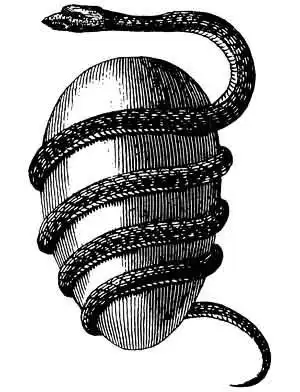
The capacity of the dream state is exemplified by the discovery of the formula of the benzene ring, which appeared in a dream.[13] What Fromm refers to is the German 19th century chemist August Kekulé, who had a dream of a snake biting its tail,[14] which made him realize the shape of the benzene molecule. Jung has also referred to it, with another version of the dream.[15]
But that dream revelation can be questioned. Kekulé described it: "I was sitting, writing at my text-book; but the work did not progress; my thoughts were elsewhere. I turned my chair to the fire and dozed." That's more of a daydream. He had made another dream revelation a few years earlier, which seems a bit much. He encouraged his students to dream, but sensibly added, "let us beware of publishing our dreams before they have been put to the proof by the waking understanding."[16]
Jung and Fromm made more of it than Kekulé did.
Fromm's conception of the unconscious leads him to explain the meanings of dreams not so much by what the symbols stand for as by what functions the dreams have in the personal development of the dreamer.
He has the same approach to myths. His first example of how to recognize and understand symbolic language shows this clearly. It is the biblical story of Jonah, who was reluctant to heed God's command. Fromm claims that it is written in symbolic language and "all the realistic events described are symbols for the inner experiences of the hero."[17]
Thus, the ship's belly and that of the big fish are both examples of the isolated safety of the mother's womb, expressing Jonah's longing for it. When he realizes the imprisonment of it, he calls to God to let him out and then hurries to do his bidding.
The myth, Fromm explains, is a story just like the dream, but one that expresses, in symbolic language, religious and philosophical ideas.[18]
In his examples, though, neither religious nor philosophical issues are as prominent as those of personal psychology. Like with the dreams, he really describes myths as representations of individual emotional struggles.
This is a perspective he shares with Freud and Jung, although interpretations and conclusions about those struggles of the psyche may differ. For all three, the meaning of myths lies in the individual's internal complications and not in concepts of shared beliefs or theoretical speculations. In spite of the universality all three claim to find in the essence of myths, the message is always personal and not collective, psychological and not philosophical.
Thus, Fromm regards the Oedipus myth as one with the central theme of "the fundamental aspects of interpersonal relationships, the attitude toward authority."[19] That moves him far away from Freud's theory of the sexual Oedipus complex, but not from the interpretation of the myth as relating to the individual psyche and its internal struggles. When Oedipus kills his father, it is a rebellion of the son against the authority of the father, and wedding his mother he takes his father's place with all its privileges.[20]
Fromm goes on to describe the Oedipus myth as a symbolic tale of how once in the distant past a matriarchal culture was conquered by men and replaced with a patriarchal society. His source to this idea is the Swiss anthropologist and professor of Roman law Johann Jakob Bachofen (1815-1887), whose book Das Mutterrecht (Mother Right) from 1861 argued for the primeval existence of a matriarchy later replaced by a patriarchy. Fromm describes the differences between the two societies:
Matriarchal culture is characterized by an emphasis on ties of blood, ties to the soil, and a passive acceptance of all natural phenomena. Patriarchal society, in contrast, is characterized by respect for man-made law, by a predominance of rational thought, and by man's effort to change natural phenomena.[21]
Fromm connects the three Sophocles plays referring to Oedipus — King Oedipus, Oedipus at Colonus, and Antigone — and states that they should be understood as "an attack against the victorious patriarchal order by the representatives of the defeated matriarchal system."[22]
He sees the same conflict between matriarchy and patriarchy in the Babylonian creation myth Enuma Elish, which tells of a "victorious rebellion of male gods against Tiamat, the great mother who ruled the universe."[23] In this myth he also sees an expression of ancient male envy towards female ability to reproduce, which he regards as remaining to some extent:
Quite in contrast to Freud's assumption that the "penis envy" is a natural phenomenon in the constitution of the woman's psyche, there are good reasons for assuming that before male supremacy was established there was a "pregnancy envy" in the man, which even today can be found in numerous cases.[24]
The male alternative in mythology — in Enuma Elish as well as in Genesis of the Bible — was creation by words, which is "to produce by the power of thought."[25]
Another example given of the battle of the sexes is the fairy tale Little Red-Cap (Little Red Riding Hood), which Fromm regards as a story of triumph by man-hating women.[26] The male inadequacy is shown by how the wolf "attempted to play the role of a pregnant woman, having living beings in his belly." Fromm sees the red cap worn by the girl of the story as a symbol of menstruation.[27]
He finishes his book by elaborately arguing for the main character of The Trial by Franz Kafka having a receptive orientation: "All his strivings went in the direction of wanting to receive from others — never to give or to produce."[28] This is something the character does not realize until right before his execution, when he says: "I always wanted to snatch at the world with twenty hands, and not for a very laudable motive, either."[29]
Hypnopompic Dreams
The limited scope and the few examples of what Fromm calls a symbolic language do not suffice to give it even an introductory sketch of a structure. Compared to Jung's quite similar theory of the archetypes, it lacks the elaborate definitions and multitude of illustrative examples of the latter. It is more of a notion than a theory.That shortcoming might be the result of his focus on dreams and his assumption that they are fully compatible with myths and tales. But dreams are elusive entities and at his own admission difficult to give universal meanings. They are creations of individual minds, and in a very unclear process at that. Even the recording of them is haphazard.
Fromm mentions that the content of a dream is very much dependent on the personal situation and emotions before sleep. As for the recording of them, though, another situation is unquestionably of much greater importance — the moment of waking up. Dreams cannot be recorded during sleep, so any retrieval of them needs to be done when awake — and very soon, since they are quickly dissolving.
The significant moments where dreams are accessible to the conscious mind are two: hypnagogia, when the mind moves from wakefulness to sleep, and hypnopompia, when it goes from sleep to wakefulness. In the former, it is possible for dreams to start taking shape according to a conscious will. Whether that is the case also for hypnopompic dreams is not as easy to ascertain, but far from implausible. If that is the case, interpretations of dreams perceived when waking up must be done with the reservation that they might be formed at least partly by the conscious mind when waking up.
Although that would put the psychoanalysis of those dreams in a completely different light, the dilemma has — as far as I have found — been ignored not only by Fromm, but also by Freud and Jung. It is understandable, though indeed questionable, since it would risk making the unconscious unreachable by dream analysis in any reliable way.
The dreams retold by Fromm et al. are sometimes suspiciously extended and detailed. It is unlikely that they have been free of reconstruction and additions by the conscious mind. That is particularly the case when they have a long narrative where events follow events in an orderly and fully comprehensible fashion.
Dreams reconstructed in such a manner would actually make their formation closer to what can be assumed of myths — strange tales composed and transmitted by conscious minds. To understand the symbols in myths, searching their parallels in dreams would then be a detour. They should be possible to decipher as expressions of the conscious mind alone.
Notes
- Erich Fromm, "The Forgotten Language: An Introduction to the Understanding of Dreams, Fairy Tales and Myths", New York 1951, p. vi. ⟰
- Ibid., p. 7. ⟰
- Ibid., p. 12. ⟰
- Ibid., p. 7. ⟰
- Ibid., pp. 13ff. ⟰
- Ibid., p. 18. ⟰
- Ibid. ⟰
- Ibid., p. 20. ⟰
- Ibid., p. 24. ⟰
- Ibid., p. 164. ⟰
- Ibid., p. 29. ⟰
- Ibid., p. 33. ⟰
- Ibid., p. 45. ⟰
- The snake forming a circle by biting its tail is a symbol from antiquity called "ouroboros". ⟰
- Carl G. Jung, "The Psychology of the Transference" ("Die Psychologie der Übertragung", 1946), New York 1998, p. 4. ⟰
- John Read, "From Alchemy to Chemistry", New York 1995 (1st edition 1957), 179f. ⟰
- Fromm, "The Forgotten Language", p. 22. ⟰
- Ibid., p. 195. ⟰
- Ibid., p. 196. ⟰
- Ibid., p. 202. ⟰
- Ibid., p. 207. ⟰
- Ibid., p. 210. ⟰
- Ibid., p. 231. ⟰
- Ibid., p. 233. ⟰
- Ibid., p. 234. ⟰
- Ibid., p. 241. ⟰
- Ibid., p. 240. ⟰
- Ibid., p. 251. ⟰
- Ibid., p. 262. ⟰
Erich Fromm on Myth and Religion
Introduction
The Dogma of Christ
Escape from Freedom
Psychoanalysis and Religion
The Forgotten Language
You Shall Be as Gods
Shifting Perspectives
Freudians on Myth and Religion
Introduction
Sigmund Freud
Freudians
Karl Abraham
Otto Rank
Franz Riklin
Ernest Jones
Oskar Pfister
Theodor Reik
Géza Róheim
Helene Deutsch
Erich Fromm
Literature
This text is an excerpt from my book Psychoanalysis of Mythology: Freudian Theories on Myth and Religion Examined, from 2022. The excerpt was published on this website in February, 2026.
MYTH
Introduction
Creation Myths: Emergence and Meanings
Psychoanalysis of Myth: Freud and Jung
Jungian Theories on Myth and Religion
Freudian Theories on Myth and Religion
Archetypes of Mythology - the book
Psychoanalysis of Mythology - the book
Ideas and Learning
Cosmos of the Ancients
Life Energy Encyclopedia
On my Creation Myths website:
Creation Myths Around the World
The Logics of Myth
Theories through History about Myth and Fable
Genesis 1: The First Creation of the Bible
Enuma Elish, Babylonian Creation
The Paradox of Creation: Rig Veda 10:129
Xingu Creation
Archetypes in Myth
About Cookies
My Other Websites
CREATION MYTHS
Mythology in general and creation myths in particular.
TAOISM
The wisdom of Taoism and the Tao Te Ching, its ancient source.
LIFE ENERGY
An encyclopedia of life energy concepts around the world.
QI ENERGY EXERCISES
Qi (also spelled chi or ki) explained, with exercises to increase it.
I CHING
The ancient Chinese system of divination and free online reading.
TAROT
Tarot card meanings in divination and a free online spread.
ASTROLOGY
The complete horoscope chart and how to read it.
MY AMAZON PAGE
MY YOUTUBE AIKIDO
MY YOUTUBE ART
MY FACEBOOK
MY INSTAGRAM
STENUDD PÅ SVENSKA

Stefan Stenudd
About me
I'm a Swedish author of fiction and non-fiction books in both English and Swedish. I'm also an artist, a historian of ideas, and a 7 dan Aikikai Shihan aikido instructor. Click the header to read my full bio.