Aikibatto BasicsKen suburi — basic solo sword exercises
Aikiken Sword Exercises for Aikido
Shoden and okuden are the two levels of teaching often utilized by traditional Japanese sword schools. Shoden, the first mediation, contains the basic techniques, suitable for the beginner, whereas okuden, the inner mediation, refers to what the advanced students are introduced to, when their level of understanding permits it. The famous samurai Miyamoto Musashi sneered at such a division of a ryu. In his opinion the student must from the start learn only techniques which are functional all through — not something first and something else second. Certainly, one should never teach something that must be replaced later. There is only one thing which takes more effort than teaching, and that is un teaching. But if shoden is used for basics and okuden for the more complex techniques, and if both are available also to the beginning student (according to his or her ability), then there is some point to the division. That is how I have applied it, using the words shoden and okuden mainly to be in line with the traditional terminology, which is also good to learn.
The ten aikibatto pair exercises.
Nagare, flowing ki, means that the exercises should be performed in a non-stop, flowing style, preferably but not necessarily with a realistic speed. In aikido this usually means that uke attacks again and again, while tori moves continuously, never stopping on the spot.
Training of this kind is not trustworthy without the student being properly trained also in suburi basics as well as the more fundamental combinations of the shoden exercises. Otherwise, there is a strong possibility that the student will learn unfocused sword moves and imprecise steps. Taninzugake is practice with several partners, multiple attackers, something which is very much kept alive in both aikido and iaido. I regard such training as essential in learning a sophisticated level of those martial arts, where the core of their strategies are revealed and put to the test. Unfortunately, taninzugake is not practiced nearly enough in normal aikido training, as far as I have seen, but in iaido it is, through numerous kata where several attackers are assumed. When taninzugake is performed in aikido, usually only in dan examinations, it is more often than not solely the throw kokyunage against ryokatadori, gripping of both shoulders. The Aikibatto taninzugake exercises aim for a greater variety of techniques, both for the attacker and tori. They might help in adding comfort to a more varied training of taninzugake also in regular aikido.
Contact should be carefully applied, naturally, so that there is no discomfort for the uke. Also, one should take it as a reflex to check one's bokken for damages before exercising. Any unevenness on the bokken surface can hurt the uke at the slightest contact. Such a bokken should not be used. Revisions of the Aikibatto will most certainly be done, probably without end. I do not think, though, that such corrections and additions will change the system as a whole in any significant way — then again, I might be wrong. Whatever the case, I will make sure to mark any such revisions here by date, so that they are easy enough to discover and inspect. I am also very eager to receive any comments and suggestions, as well as experiences from others who have tried out the Aikibatto or parts thereof. Please let me know.
Stefan Stenudd Aikibatto backgroundTable of sword exercisesTable of jo exercises© Stefan Stenudd, 2000. You are free to any non-commercial use of this material, without having to ask for my permission. But please refer to this website, when doing so.
AikibattoIntroductionBackgroundAikibatto BasicsSword exercisesJo staff exercisesSolo video clipsDuo video clipsKen suburiCorrectionsGlossaryVisitor responseShinken, the swordAikibatto — the book
About CookiesMy Other WebsitesCREATION MYTHSMyths in general and myths of creation in particular.
TAOISMThe wisdom of Taoism and the Tao Te Ching, its ancient source.
LIFE ENERGYAn encyclopedia of life energy concepts around the world.
QI ENERGY EXERCISESQi (also spelled chi or ki) explained, with exercises to increase it.
I CHINGThe ancient Chinese system of divination and free online reading.
TAROTTarot card meanings in divination and a free online spread.
ASTROLOGYThe complete horoscope chart and how to read it.
MY AMAZON PAGE
MY YOUTUBE AIKIDO
MY YOUTUBE ART
MY FACEBOOK
MY INSTAGRAM
MY TWITTER
STENUDD PÅ SVENSKA
|
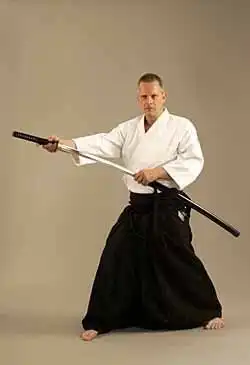
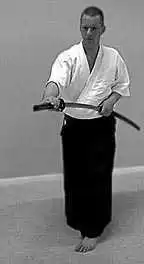 I use the word batto, not to connect to iaido, but to stress the fact that all these exercises start with tori having the sword in the scabbard, or with the bokken in his belt. Thus, in every technique there must be a draw of the sword, nuki tsuke. Although this is very rare in Aikiken training, I find it a pleasant statement of non-violence on behalf of tori, as well as a good exercise of timing and rhythm out of the unprepared state.
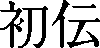 The ten exercises of shoden stress basic steps, turns and sword moves. The link to iaido is particularly strong here, since every iaido school also has a number of kata, series of moves, presenting those basics, usually in forms with few steps, mainly teaching the student how to draw the sword, how to cut, kiri, and thrust, tsuki, and then how to shake off the blood, chiburi, finally to return the blade to the scabbard, noto.
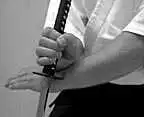 For that reason, these the latter moves are also included in the Aikibatto — ending every exercise with tori doing noto, although with a bokken this may seem unnecessarily elaborate. If excluded, though, one would still need to return the bokken to the belt before the next exercise, so it makes more sense doing this in a proper way, similar to that used with a iaito or shinken.
 The okuden sets are two, nagare and taninzugake. These terms are from aikido, not to my knowledge found in iaido. I use them for their obvious link to aikido training.
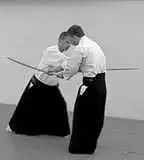 In Aikibatto I translate this to the uke doing multiple attacks, while tori is parrying, counter attacking, parrying again, in a series of techniques before the exercise stops — this is common in any Aikiken system.
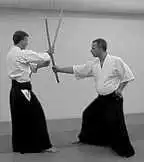 Regarding distance and contact the Aikibatto is partly different from how many bokken systems operate. I think it is essential that the distance between tori and uke should be authentic, not extended so that they would actually not reach each other properly with the techniques. This calls for additional precaution, of course, to avoid any accidents, but as long as that is understood, this way of training teaches accurate timing and movement.
 The same goes for contact, so that when not causing damage, there should be some level of contact between the bokken of tori and the body of uke — absolutely not on hard parts of the uke's body, such as the head and ribs and knees, but with caution it can be used for the soft parts, namely the waist and the wrists in most angles. This helps very much in learning the proper angle of the sword and checking one's balance as well as the firmness of one's grip.
 Aikibatto — Sword Exercises for Aikido Students