Aikibatto JoAikijo Exercises for Aikido
IntroductionAikibatto is primarily a system of basic sword exercises, but I have found the need for some jo exercises as well. The jo, a round staff of about 127 centimeters length and a little bit more than 2 centimeters in diameter, is almost as commonly used in aikido training, as is the ken.
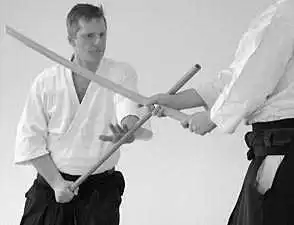 The techniques used vary significantly, and are more often than not quite a handful to remember — even more so to handle diligently. The training of basic jo movements can easily be neglected, because of the volume of techniques needed to be learned — leading to an impressive amount of combinations performed in a not so impressive way. I do hope that this system does not add to that problem. Parallel to what is intended with the ken exercises of Aikibatto, these jo counterparts are primarily meant as a sort of suburi — basic training of the basic movements with the jo.
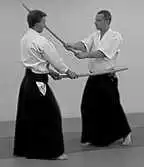 Yokomen with jo and with ken. The jo exercises are almost exact counterparts to the ken exercises, so that Shiho Mae with the jo differs very little from Shiho Mae with the ken, and so forth. The only alterations made, are those necessary because of the differences between the jo and the ken. These differences are big enough, for sure, but then again no bigger than that the sword moves can easily be transformed to jo ones, and vice versa. Historically, the jo was used as a weapon against the sword. Of course, it is also possible to have paired exercises with jo against jo, but that would lead a bit too far away from the Aikibatto concept to be meaningful — at least in the Shoden set. We will see what might happen in the Okuden exercises, when they are completed. Here, then, is the set of ten Shoden exercises, with tori using a jo and uke a ken. Uke is actually doing exactly the same moves as in the ken exercises. For tori, there are some modifications, but not more than for the set to keep the same names as in the ken set — although that does in a few cases lead to some contradictions of terms.
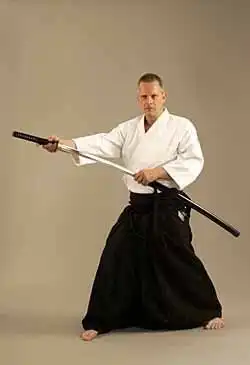
So I stick to a one sided handling of the jo, beginning with the guard which relates the most directly to the sword guard, that is with the jo on the left side in chudan kamae — because then tori has got the right foot and right hand forward, just like in the chudan kamae for the sword. For basic exercises, this makes the most sense. The adventurous student should, of course, feel welcome to try the exercises also with a start from the right sided chudan kamae — then making all the following moves on opposite sides to what is shown here. I do not recommend this to be tried before familiarizing properly with the exercises as they are presented.
For example, the sword cuts, but the jo does not. Any movement with either one must be done in full awareness of this. Also, the jo has got two equal, identical ends, whereas on the sword they differ tremendously. Think about it — the consequences are decisive on how to move the sword or the jo.
I think it is safe to say that the sword is the mightier weapon of the two. But that does not mean the jo is futile. This, the legend has it, was proven by its inventor Gonnosuke in a duel against the very Miyamoto Musashi. But it is essential to respect the difference and make ones moves accordingly. Enough said, let's go to the exercises and examine the matter further by practicing.
Stefan Stenudd
First jo exerciseTable of jo exercisesRevisions of the Aikibatto will most certainly be done, probably without end. I do not think, though, that such corrections and additions will change the system as a whole in any significant way — then again, I might be wrong. Whatever the case, I will make sure to mark any such revisions here by date, so that they are easy enough to discover and inspect. I am also very eager to receive any comments and suggestions, as well as experiences from others who have tried out the Aikibatto or parts thereof. Please let me know.
Stefan Stenudd
AikibattoIntroductionBackgroundAikibatto BasicsSword exercisesJo staff exercisesSolo video clipsDuo video clipsKen suburiCorrectionsGlossaryVisitor responseShinken, the swordAikibatto — the book
About CookiesMy Other WebsitesCREATION MYTHSMythology in general and creation myths in particular.
TAOISMThe wisdom of Taoism and the Tao Te Ching, its ancient source.
LIFE ENERGYAn encyclopedia of life energy concepts around the world.
QI ENERGY EXERCISESQi (also spelled chi or ki) explained, with exercises to increase it.
I CHINGThe ancient Chinese system of divination and free online reading.
TAROTTarot card meanings in divination and a free online spread.
ASTROLOGYThe complete horoscope chart and how to read it.
MY AMAZON PAGE
MY YOUTUBE AIKIDO
MY YOUTUBE ART
MY FACEBOOK
MY INSTAGRAM
STENUDD PÅ SVENSKA
|
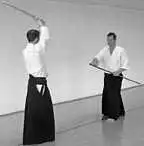 One thing which sets the working with a jo apart from that of the ken, is that the former is so to speak ambidextrous. All the jo movements can be done from the left as well as from the right. Even the very basic guard, which I simply call chudan kamae, can be left sided as well as right sided. That would, though, immediately double the number of exercises, easily creating the problem I mentioned above, about too many combinations taking the focus from the training of the basic movements.
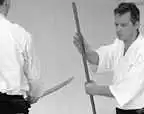 Regarding basic elements of jo, such as how to grip it, how to do tsuki, uchi and so forth, I trust that the explanations in the exercises will suffice. Or maybe I add something about that matter in the future. Just as with the sword, the best way to learn it is to be aware of the jo as a tool, and how to utilize it optimally in relation to its own design and functionality. If you keep that in mind, then you are unlikely to go wrong.
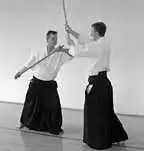 Depending on what tool is used, the ken or the jo, one would also naturally adjust the movements of one's body. Armed with the sword, you move forward more boldly and directly, making evasive steps no more to the side than what is absolutely necessary, and so forth. With the jo, though, all movements are more evasive, and with some additional margin, since the jo needs some room to be used powerfully, but the sword cuts severely even when not swung with great force.
 Aikibatto — Sword Exercises for Aikido Students