Aikibatto 4 DetailsShiho MIGI
DetailsAspects and considerations already treated in a previous exercise of Aikibatto, are omitted here.Shiho, four directions, is commented in the text on MAE. Migi, right side, is the last of the four Shiho, with uke coming at tori from the right. The position of uke could be one behind the corner of a building, in which case a movement to uke's left is awkward — therefore not used here. Just like HIDARI, this exercise uses a more flowing sword move, as well as another chiburi and noto, than MAE and USHIRO.
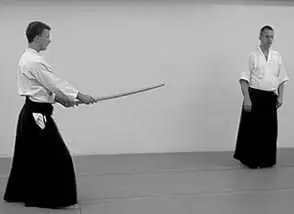 Starting position. Tori at right, uke at left. The starting position is like that of HIDARI, except for uke standing on the right instead of left side. When turning, in movement three, this begins by turning the right foot toward uke, which helps considerably in both turning the body and taking the following step with the left foot. The sliding with left foot in movement four, is part of the taisabaki move away from the aim of uke, and should therefore be done not straight forward, but a little to the side. Not directly sideways, though, which would lead to an inferior position to that of uke.
If you find it difficult to do this prolonged, sliding step, you are most certainly out of balance in some way or other. Even when having a stance where the feet are very far apart, you should be able to slide forward several inches without any problem. When doing so here, in movement four, make sure to let the right foot follow a bit, so that your whole right leg is out of the way of uke's sword, in case it would be coming all the way down to gedan. Also, twist the body in the taisabaki move, so that it is practically parallel to the direction of uke's sword, making sure to avoid it.
Movements eight to ten, the chiburi and noto, are the same as in HIDARI.
Iai considerationsIn iai style single training of the tori movements in this exercise, the modifications of the above would be: some more extension and speed in the do cut of movement four, and the full gedan cut — no stop at head height — in movements six. The difference in extension and orb of the do cut, is not that big at all from when done with a bokken on a partner, the blade just reaches a few more inches farther to the right, especially in the beginning of the cut.Uke's movements in this exercise are not very meaningful to practice in a iai solo style.
Stefan Stenudd Table of movementsNext exercise© Stefan Stenudd, 2000. You are free to any non-commercial use of this material, without having to ask for my permission. But please refer to this website, when doing so.
AikibattoIntroductionBackgroundAikibatto BasicsSword exercisesJo staff exercisesSolo video clipsDuo video clipsKen suburiCorrectionsGlossaryVisitor responseShinken, the swordAikibatto — the book
About CookiesMy Other WebsitesCREATION MYTHSMyths in general and myths of creation in particular.
TAOISMThe wisdom of Taoism and the Tao Te Ching, its ancient source.
LIFE ENERGYAn encyclopedia of life energy concepts around the world.
QI ENERGY EXERCISESQi (also spelled chi or ki) explained, with exercises to increase it.
I CHINGThe ancient Chinese system of divination and free online reading.
TAROTTarot card meanings in divination and a free online spread.
ASTROLOGYThe complete horoscope chart and how to read it.
MY AMAZON PAGE
MY YOUTUBE AIKIDO
MY YOUTUBE ART
MY FACEBOOK
MY INSTAGRAM
STENUDD PÅ SVENSKA
|
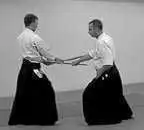 This prolonged, sliding step, is a great asset in the sword art, leading to a more extended range than uke expects, and can be used in many situations. When doing so, though, it is important not just to stretch the leg forward, but rather to push one's hole body ahead with the center, tanden, almost as if someone was actually pushing from behind one's back.
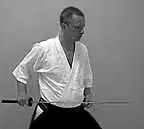 The position of tori's sword in the end of movement four, horizontal and near tori's body, is to avoid it or the arm being hit by uke's gedan cut. This position is reached by doing the do cut a little differently from the former exercises, slashing at the right side of uke's waist instead of through it at the front of uke's body. Most of the cutting in this move is done by the sword being pulled back to the horizontal position. In bokken practice with a partner, some contact is allowed and beneficial for learning the move — just be careful not to hit uke's ribs, which are rather fragile. Hitting the hip would not hurt uke, but is a bad aim — the do cut should be directed at the soft waist.
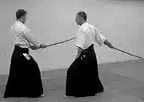 The vertical swing of the sword in movement five, is done in such an angle as not to hit uke's sword. When it reaches the jodan kamae position and left hand grabs it too, the edge of the sword should at once be directed at uke, and at the same time tori's body should be in the position toward uke, feet together, ready for the cut of movement six — and that cut should follow immediately, right foot backing half a step.
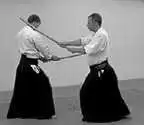 This men cut should be regarded as an interrupted gedan cut, completed in slow motion at movement eight, when uke has backed off. If an actual men cut is intended, though, the sixth movement way of doing it is quite correct. For a men cut, a high stance is to prefer, having a better chance of being above uke's guard, and also making a better angle for the cut. The short move of the men cut, is actually more of a chopping than a cutting, and that is the nature also of a deeper cut's first part — a chop which develops into a cut as the sword keeps on sliding down.
 Aikibatto — Sword Exercises for Aikido Students