Aikibatto 6 DetailsUke nagashi URA
DetailsAspects and considerations already treated in a previous exercise of Aikibatto, are omitted here.Uke nagashi, the high level parry, is commented in the text on OMOTE. So is omote and ura, as well as kesagiri. Ura, reverse, is the second of the two Uke nagashi, differing from the first in movements five and on. Basically, the difference is that tori moves to the other side of uke after the uke nagashi parry, and the consequences thereof. Also, uke makes two charges instead of just one.
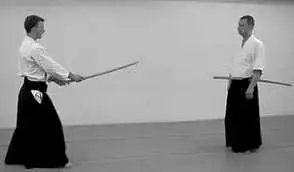 Starting position. Tori at right, uke at left.
Tori moves over to the right side of uke, getting very near uke by this move. There is no problem in this nearness, it is actually a common dueling distance in the old samurai arts. Since the actual cutting is done by drawing the sword back, starting very near uke only means a lot more of the blade than just the outer part of it, involved in the cutting move. The step to the left with the left foot can be done immediately, but the body cannot follow until uke's sword is out of the way by being lifted to jodan kamae — and then, there is need to hurry.
Iai considerationsIn iai style single training of the tori movements in this exercise, the modifications of the above would be: the kesagiri in movement eight is not stopped at neck height, but pulled through to gedan.Uke's movements in this exercise are not very meaningful to practice in a iai solo style.
Stefan Stenudd Table of movementsNext exercise© Stefan Stenudd, 2000. You are free to any non-commercial use of this material, without having to ask for my permission. But please refer to this website, when doing so.
AikibattoIntroductionBackgroundAikibatto BasicsSword exercisesJo staff exercisesSolo video clipsDuo video clipsKen suburiCorrectionsGlossaryVisitor responseShinken, the swordAikibatto — the book
About CookiesMy Other WebsitesCREATION MYTHSMyths in general and myths of creation in particular.
TAOISMThe wisdom of Taoism and the Tao Te Ching, its ancient source.
LIFE ENERGYAn encyclopedia of life energy concepts around the world.
QI ENERGY EXERCISESQi (also spelled chi or ki) explained, with exercises to increase it.
I CHINGThe ancient Chinese system of divination and free online reading.
TAROTTarot card meanings in divination and a free online spread.
ASTROLOGYThe complete horoscope chart and how to read it.
MY AMAZON PAGE
MY YOUTUBE AIKIDO
MY YOUTUBE ART
MY FACEBOOK
MY INSTAGRAM
STENUDD PÅ SVENSKA
|
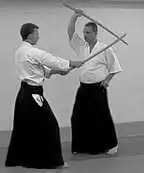 In movement five, tori is doing the same as in OMOTE, bringing the feet together and raising the sword to jodan kamae, whereas uke — because of having done the short men instead of the deep gedan cut — is quick to draw for a new cut. Uke now takes aim at the point where tori stands after the uke nagashi parry.
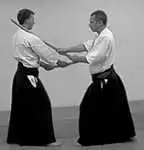 The kesagiri diagonal cut is from left to right, as opposed to right to left in OMOTE, stopping above uke's right side neck. This means, when using the method of leaning with the body, that the body needs to be tilted to the left. In case of a straight body kesa cut, the sword should be held at a high kamae slightly to the left over the head — or left side hasso gamae.
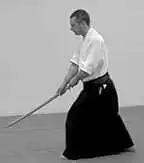 The straightening of the sword in movement ten, is for a more pure and efficient chiburi at the next step. If the body is tilted from a leaning form of the kesa cut, this is the proper moment for adjusting the posture — or the backward step would be a bit awkward.
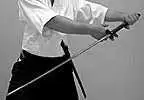 The chiburi in movement eleven, is done the same way as in OMOTE, except that it does not start from a standstill position, but begins just before the left foot step backward stops. From then on, it is the same as in
  Aikibatto — Sword Exercises for Aikido Students