Aikibatto 8 DetailsKote JODAN
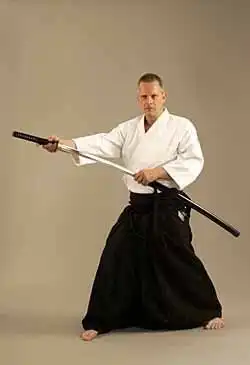
DetailsAspects and considerations already treated in a previous exercise of Aikibatto, are omitted here.Kote, wrist cut, is commented in the text on CHUDAN. So is the migi no waki guard of uke, and the chiburi jodan. Jodan, high level, or upper position, is the second of the two Kote, where the wrist cut is done when uke is charging, sword still on high level, right before uke's cut is done. This kote cutting is one of the few fencing techniques described by Musashi in his Book of Five Rings. Here, though, the following up yokomen is an addition of Aikibatto.
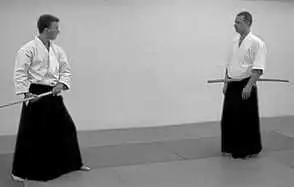 Starting position. Tori at right, uke at left. Tori steps forward, starting the sword draw, at the moment when uke begins the charge. There is no time for waiting — the cut from migi no waki can be done faster than one would assume.
The exact moment for the kote should be when uke's sword has started its downward move — when uke's hands are somewhere in front of uke's face. That is when the left wrist is the easiest to hit, also that is the moment when uke's arm is moving precisely in the direction of tori's sword, so that uke sort of helps in the kote cut. That exact moment might seem hard to find for tori, but is actually not so difficult — especially when doing the exercise a little faster. Still, use caution in the choice of speed, to avoid hurting uke. At the kote both tori and uke should stop their movement, for a little while, to sort of feel the position and balance, the stability of tori's sword grip, and so forth, but also in recognition of the fact that what comes next is a modification of the technique, in partner practice.
At the same time as uke completes the cut, tori flips the extended sword, by turning the right hand holding it, so that the edge of the sword is directed at uke's left temple. The left hand grabs the hilt immediately thereafter. This flip of the sword can be quite awkward to do, needing a lot of practice.
An alternative solution for getting from the kote to the yokomen, would be to continue the kote cut in a circularly swinging way, turning the hand and thereby the direction of the edge of the sword, at the end of it. Such a move, though, tends to make the previous kote cut imprecise, since it very easily starts turning the angle of the blade before the completion of that cut, making it pretty much useless. The chiburi and noto, on high level, is exactly the same as in CHUDAN.
Iai considerations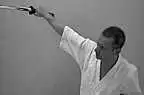 In iai style single training of the tori movements in this exercise, the modifications of the above would be two: the kote cut is not stopped, but pulled through to the high sword position, and the yokomen cut is extended instead of stopped short.
Uke's movements in this exercise are not very meaningful to practice in a iai solo style.
Stefan Stenudd Table of movementsNext exercise© Stefan Stenudd, 2000. You are free to any non-commercial use of this material, without having to ask for my permission. But please refer to this website, when doing so.
AikibattoIntroductionBackgroundAikibatto BasicsSword exercisesJo staff exercisesSolo video clipsDuo video clipsKen suburiCorrectionsGlossaryVisitor responseShinken, the swordAikibatto — the book
About CookiesMy Other WebsitesCREATION MYTHSMythology in general and creation myths in particular.
TAOISMThe wisdom of Taoism and the Tao Te Ching, its ancient source.
LIFE ENERGYAn encyclopedia of life energy concepts around the world.
QI ENERGY EXERCISESQi (also spelled chi or ki) explained, with exercises to increase it.
I CHINGThe ancient Chinese system of divination and free online reading.
TAROTTarot card meanings in divination and a free online spread.
ASTROLOGYThe complete horoscope chart and how to read it.
MY AMAZON PAGE
MY YOUTUBE AIKIDO
MY YOUTUBE ART
MY FACEBOOK
MY INSTAGRAM
STENUDD PÅ SVENSKA
|
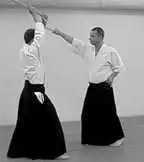 The timing of the kote, the cut to the wrist from below, is not that very tricky — the crux is to do it in a partner exercise without hurting uke. Some caution is needed, and it is preferable to practice it in slow motion, to establish a good understanding of it, before picking up speed.
 Tori's bokken should touch uke's wrist, at the kote of movement three, and in doing so tori's sword grip should be firm enough almost to be able to halt the cut on its way. From below, the wrist is soft and therefore not too sensitive, but of course some care is still called for. Also, the point of tori's bokken is not that far from uke's face, which is an additional reason for taking care.
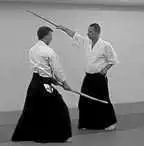 The kote would go right through uke's arm, in its original intent, but here this is modified into stopping shortly when tori's bokken meets uke's wrist, followed by tori sliding the bokken further on, upward to the right side, as if cutting through, and stopping it in a high, extended position to the right. When tori's bokken has slid past uke's wrist, uke completes the cutting move. This is to point out that the cut is not stopped by the kote technique.
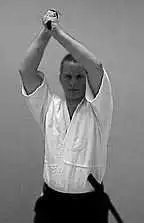 Speed as well as precision is essential — once flipped, the sword should be in a correct position for the following yokomen cut, at uke's left temple, which is to be done as soon as the left hand has grabbed the sword. This tricky maneuver of movement five certainly takes time learning, but will then prove to be a very efficient technique, applicable in many situations.
 Aikibatto — Sword Exercises for Aikido Students